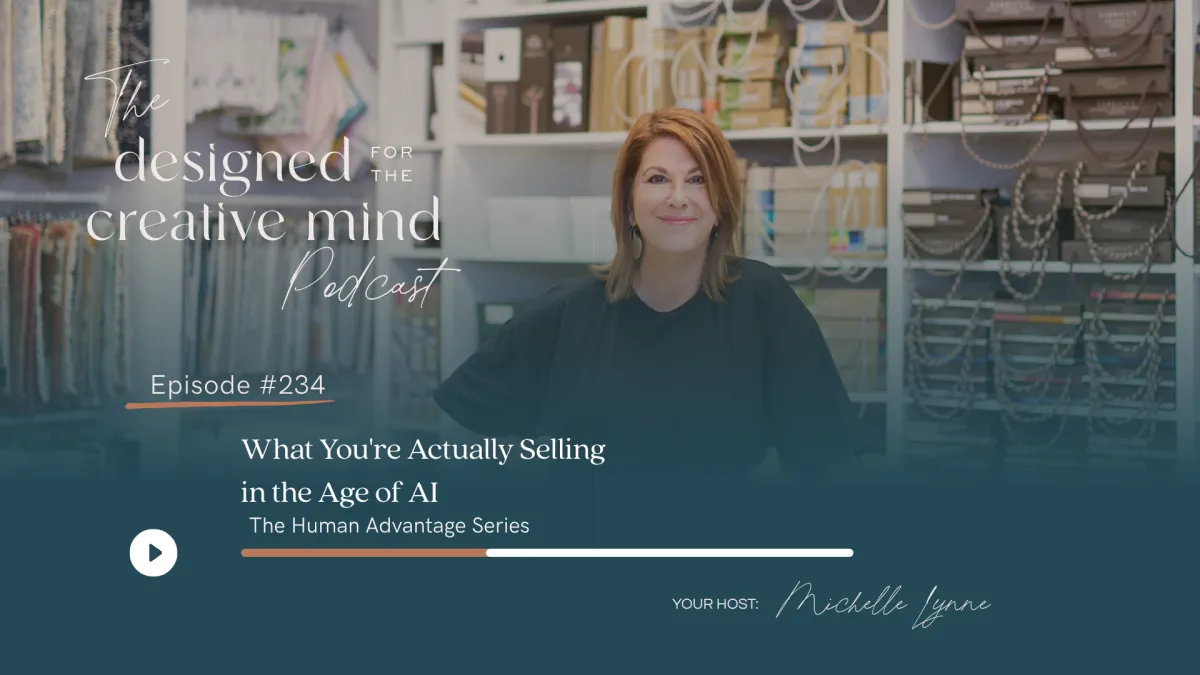
Ep 234: The Human Advantage - What You're Actually Selling in the Age of AI
AI can generate a beautiful mood board in seconds.
But that's not what clients are actually hiring you for.
In this episode, Michelle Lynne kicks off a brand-new series exploring what artificial intelligence really means for interior designers. Spoiler alert: this isn't another conversation about the latest AI tools or which software you should be using.
Instead, Michelle dives into a much bigger question:
What are clients actually paying you for?
If you've been feeling uneasy watching AI create room concepts, layouts, and design inspiration at lightning speed, this episode will help you shift your perspective. Because while technology can generate images, it can't replace your judgment, experience, relationships, project management, or ability to navigate the countless decisions that make a project successful.
This conversation is about moving beyond deliverables and learning to communicate the real value you bring to every project.
In This Episode, We Discuss:
Why AI isn't replacing interior designers—it's exposing weak positioning.
The difference between selling deliverables and selling expertise.
The "Deliverable Trap" many designers unknowingly fall into.
What luxury clients are actually paying for when they hire a designer.
Why procurement is one of the most undervalued services in the industry.
How better messaging leads to stronger pricing.
Questions every designer should ask to clarify their true value.
Why this moment is an opportunity—not a threat—for established firms.
Key Takeaway
Your clients aren't paying for mood boards.
They're paying for confidence, leadership, problem-solving, experience, and the ability to guide a complex project from start to finish without costly mistakes.
The clearer you become about that value, the less threatened you'll feel by AI—and the easier it becomes to confidently communicate your worth.
Mentioned in This Episode
The Art of Being the Principal: Be In the Room — An immersive one-day event for established interior design firm owners focused on operations, sales, marketing, profitability, and leadership.
Private Coaching with Michelle Lynne — Personalized coaching designed to help interior designers strengthen their positioning, pricing, and business strategy.
Sidemark — Marketing, sales, and operations software built specifically for interior designers.
Connect with Michelle
If you're ready to build a business that's as strong as the spaces you design, explore Michelle's coaching, resources, and software through the links in the show notes.
If You Enjoyed This Episode
If this episode challenged the way you think about your business, share it with another interior designer who needs to hear it.
And if you haven't already, follow the podcast and leave a review. It helps more designers discover the conversations that move our industry forward.
MICHELLE LYNNE (01:02)
Hey y'all, before we jump into today's episode, I want to tell you about an event that Katie Decker -Erickson and I are doing this August in Dallas. It's called The Art of Being the Principal, Be In the Room, and it's a one-day immersive for established interior design firm owners. Over the years, I've noticed something, and that is that most designers don't have a design problem, they have a business problem. The work is beautiful, clients are coming in, projects are moving forward.
But behind the scenes, they're just carrying too much. Every decision runs through them. Every question lands on their desk. Revenue is growing, but profit isn't always keeping pace. This is not a conference about trends, social media, how to get more followers, how to price. It is actually a room where we are going to talk about the real business behind the beautiful work: sales and marketing, operations, profitability.
And what it actually takes to build a firm that doesn't depend on you for everything. We're limiting the room, and this is for established design firm only. This is for established design firm owners only because we want real conversations, not a ballroom full of people taking notes and heading home unchanged. So if you've ever looked around your business and thought, there has to be a better way to do this, I'd love for you to join us. You can learn more and reserve your seat at my sidemark.com.
dot com forward slash room. Now, let's get into today's episode.
MICHELLE LYNNE (02:28)
Welcome back to Design for the Creative Mind. I'm Michelle Lynn, interior designer, firm owner, and someone who's been in this industry long enough to have strong opinions about most of the things. Today we're kicking off a brand new series and I want to be up front with you about something before we even get started. I am not an AI expert. I am not going to sit here and give you a ranked list of tools to download or tell you which software is going to change your life. Okay, that's not what this series is about.
And honestly, there are about ten thousand people on the internet already doing it, right?
What I'm what I am is a working interior design firm owner. And I'm watching this moment unfold in real time and asking the questions that I think actually matter for people like us. People running real businesses, managing real clients, dealing with real projects.
And trying to figure out what all of this means for how we operate. And what I keep coming back to is this. The most important questions right now are not about technology, they're about your business model.
They're about what you're actually selling. And that's where we're gonna start.
This first episode is called What You're Actually Selling. And I think for some of you it's going to be a little bit uncomfortable, not in a bad way, but in the way that in the way that feel things feel uncomfortable when you hear something that you know it's true, but you're not quite sure what to do with it yet.
So let's get into it.
So here's where I want to start. In the last couple of years, AI design tools have gotten genuinely good. Like, not perfect, there's a lot of hype in there, but they're good enough that a client can go to one of these platforms or heck, even Chat GPT, upload a photo of their living room, pick a style, and get back something that looks like a mood board in about 45 seconds. It's good enough that some clients are doing this before they ever call a designer.
good enough that I've had conversations with designers who are worried. And I get it. On the surface, that feels and it looks like competition. But I want to offer you a different frame because I think that the panic is pointed at the wrong thing.
When a client uses an AI tool, even if it's just plain old chat GPT, okay, if they're using an AI tool to generate a mood board, what they're actually doing is playing around with ideas. They're satisfying the part of their brain that's excited about the project, that wants to see something, they're a little impatient, a little bit curious, which I get it, okay, but then this is the part that gets lost in all of that noise.
They call a designer anyway, because the mood board didn't tell them whether that sofa would actually fit. It didn't account for the fact that their house faces north and it has terrible natural light, and that every warm and airy concept that they're drawn to is gonna fight with that reality. It didn't warn them that the contractor that they're planning to use has a six month backlog and that they need to start thinking about that now.
Okay, this AI did not give them someone to call when the tile that they fell in love with gets discontinued two weeks before installation.
AI gave them a photo, it's a picture. Okay, and a picture is not a project.
So, in my opinion, the question isn't can AI do what I do? The question is, do you know specifically and clearly what it is that you actually do? Because if you if your answer, if your answer to that question centers around delivering beautiful concepts and sourcing furniture, then yes, that is getting harder to differentiate. But if your answer goes deeper than that,
If you can articulate the real thing that you're providing, then this moment is actually an opportunity to get more precise about your value. Okay, not less confident in it.
So let's talk about something that I see constantly in this industry. And I was guilty of it too, for longer than I'd like to admit. I probably still fall into this trap. And it's called the deliverable trap.
What most okay, so when most designers describe what they do to their clients on their websites, in their proposals, they lead with deliverables, floor plans, furniture selections, mood boards, renderings. And I get it. I understand why. Okay, those are the tangible things. Those are the things that you can see and point to and say, look, here's what you get.
These things feel concrete in a way that's easier to explain than the less visible stuff.
The problem is that the deliverables are the easiest part of the job to commoditize. They always have been, even before AI showed up. I mean, think about it. There were these online decorating services for years that would sell a client a say quote quote room design for a couple of a hundred bucks. Okay, but high-end design firms still kept their clients because their clients weren't buying a room design, they were buying something else entirely.
And both the designer and the client understood that, even if neither one of them had like put a name on it.
So AI has just made the deliverable trap more urgent because now the cost to get a a concept, okay, has dropped from a couple hundred bucks to about twenty dollars a month.
So if what you're selling in your own mind, okay, or in the way you structure your fees, or in the way you talk about yourself, in the copy on your on your on your website is primarily concepts and selections and beautiful solutions. Yeah, today is gonna feel a little threatening in in the AI environment, okay, but it should. Because that pricing pressure, it it's real.
But what I know from running my own design firm and from working with designers across the globe, the ones who were not rattled right now are the ones who were never really selling deliverables in the first place. They were selling something else. And they knew it.
So I bet you're sitting there wondering, well, come on, Michelle, tell me, what is that something else? So let me let me try to name it.
Because don't really know exactly how to talk about it clearly enough, but it's when a high-end client hires a designer, they're not primarily buying a mood board and they're not buying a beautiful room. Okay, they're, I mean, that that's that's a byproduct of it, but what they're doing is they're buying certainty, they're buying someone who has done this before and can tell them with confidence how to spend a significant amount of money on their home.
And doing so without making mistakes that they're going to regret for the next 10 years. That, my friend, is worth a very different number than a concept.
And then on top of that, they're buying access, and I don't just mean to our trade accounts, right? Although that matters and we'll come back to that, but I mean access to your judgment, to your taste, your ability to walk into a space and understand immediately what it needs and what it doesn't. Because that's not something that old Chatty G can do, okay? That cannot be transferred into any AI app. Okay, this has taken you years to develop.
And it lives in you. Clients who have worked with good designers, they know the difference between being guided by that kind of judgment and not being guided by it. There's a pretty big gap.
Our clients are buying someone to manage the chaos. If you've ever managed a renovation from start to finish, okay, you know how many things can go wrong and how many decisions have to be made. And how much of your job is actually just managing the circus, keeping everybody coordinated and calm. Well, your client gets to show up for the fun parts. Okay, that's not a deliverable.
You cannot put that in a line item on a proposal the way that fully captures what it actually involves. But you and I both know that it's a massive part of the value. Contractors know it, trade vendors know it, clients who've had a project go sideways without a designer, or maybe with a not good designer, they know it.
And then and then y'all, and then on top of that, there's procurement. So and let's just spend a minute here because I think that this is one of the most undervalued and undercharged parts of what most designers do. Okay. When you source a piece of furniture, you're not just picking something pretty, you are vetting a vendor, evaluating lead times, understanding the quality of the construction.
Knowing whether that piece is going to hold up in a home with three kids and a dog, okay, you have the relationship with the showroom rep that means that you can pick up the phone when something arrives damaged and you get it handled. And that it doesn't become your client's problem. That expertise is real and it's taken years to build. Most designers are giving this away or barely accounting for it in their fees.
Which is a conversation we will have in depth later in the series. Because it's because it's a thing.
But the through line across all of this conversation today is that clients are not buying what you can show them in a presentation. They're buying what happens between the presentations, the judgment calls, the problem solving, the experience, the relationships, the ability to shepherd a complex project through to completion without everything falling apart.
So think about that. AI can generate a beautiful image, but it cannot do any that.
So here's the part that might sting a little bit. Okay. And I say this with genuine love and compassion because I've had to look at this in my own business too.
If you're feeling threatened by AI right now, I want to ask. no, I want you to ask yourself honestly, is it because AI is actually capable of replacing what you do? Or is it because the way you've been positioning and pricing yourself hasn't fully reflected what it is you actually do?
Because for a lot of designers, and again, I include myself in the earlier version of this, the way I talked about our work, the way I talked and structured my fees, okay, but these are the things, the way we present our proposals. This is heavily tilted towards the deliverables. Heck, as I'm saying this now, I'm thinking about phases in my own sales process that I can edit and update. So there's there's always room.
There's always room. But what we're doing is we're we're showing the mood boards, we're listing the services. We describe the process in terms of what the client will receive, not in terms of what we're actually managing on their behalf.
And when you're leading with deliverables, you are vulnerable to anything that makes those deliverables easier or cheaper to produce. AI, online decorating services, design forward furniture retailers, like all of it. So the answer is not to panic. The answer is to get precise, to be honest with yourself about what the real value is, and then to make sure.
That value is what you're communicating, what you're charging for, and what your entire client experience is built around.
I was having a conversation not too long ago with a designer who was worried that her clients might start questioning her fees now that AI tools are everywhere. I actually had a meet and greet with a client a few weeks ago myself that asked me how we use AI. But my question to this designer that I was talking to, it was, what do you tell a new client when they ask you what it's like to work with you?
Okay. And you what she did? She described the process. The initial consultation, the concept presentation, the revisions, the final selections. These are all deliverables. And I said, What about the contractor call you took last week at seven in the morning because something wasn't right and you needed to sort it out before your client found out? What about the fact that you caught a measurement error before anything was ordered?
What about the vendor relationship that got your client's sofa delivered in eight weeks instead of 12? And she said, I don't really mention that stuff. And that's the gap, babe. That's where the work is. So if you're sitting there thinking, okay, Michelle, I hear you, but where do I actually begin? Here's what I'm going to suggest. Start by writing down not what you deliver, but what you prevent.
What are the mistakes your clients don't make because you're involved? What are the problems that get solved before the client ever knows that they were problems?
What would a project look like if you weren't there? That list is your value. And it should be informing how you talk about yourself, how you write your proposals, and how you price your services.
The second thing I'd say is get specific about your expertise. Not, I have great taste. Because babe, every designer thinks that. Be specific. What do you know about procurement that a client doesn't? What do you know about contractors in your market? What have you learned from the projects that went sideways that now makes you a better advocate for your clients? Yes, we've all had projects that have gone sideways. Okay. But that
Specifically is what creates genuine different differentiation. And it's something that no AI tool can replicate because it's yours. And the third thing, and I know I sound like a broken record on this, is that all of this connects directly to your fee structure.
You cannot charge for value you haven't named. If you're still pricing based on hours or on a percentage of purchases and you haven't had a real conversation with yourself about what the actual scope of your expertise and your management is worth, this right now is the moment to do that. And it's not because AI is making you, but because you've probably been leaving money on the table for years, and now there is a clear reason to fix it.
So if any of this is landing and you're realizing that part of your challenge is that you're not sure how to have that conversation, how to articulate your value to a prospective client in a way that's confident and clear and doesn't feel like you're overselling, that's exactly the kind of work I do with designers and private coaching. It's not a course, it's not a program with a dozen modules to get through. It's a real conversation specific to your firm, your market, your clients.
And where the gaps are. So if that's something you want to explore, you can find me at the designbakehouse.com forward slash private coaching. But enough with that. I want to leave you. I'm going to leave you with this. The designers who are navigating this moment well are not the ones who figured out AI the fastest. They're the ones who were already clear on what they were actually selling.
And they knew that it wasn't the mood board.
That clarity takes some work to get to. It requires you to look honestly at how you talk about yourself, how you've been charging, and whether those two things reflect the real depth of what you bring to a project. But once you have it, you're not threatened by AI tools. You might even use them for yourself. I highly recommend that you do. But the tool, it's not the value. Not in your work, babe. You are the value. So that's what this new series is about.
Okay, it's not the technology, but the business decisions that the technology is forcing us all to look at more honestly. And we're just getting started because next week I'm gonna talk about the AI noise itself. All the think pieces and the panic and the predictions. And we're gonna figure out what in that conversation is actually relevant to your business, to my business. Okay.
And what we can safely ignore. Because not all of it deserves our attention. Because y'all, our your attention, it's worth protecting. There's so many moving parts. So thanks for spending this time with me. If something in today's episode really resonated with you, share it with another designer who needs to hear it, please. This is the kind of conversation our industry doesn't have nearly enough of. And then
Drop a review and follow the podcast wherever you're listening. It truly helps with that dreaded algorithm. So I'll be back next week. And until then, keep building something worth owning.
Michelle Lynne (17:32)
Well, that's a wrap on today's episode. And I just wanna say thank you for spending this time with me. I don't take it lightly that you chose to show up and listen. And I hope you're walking away with something you can actually use this week. if you wanna keep going, come find me. The Design Bakehouse is where designers learn to build a business that's as beautiful as the spaces they create. Real coaching, real results.
And if your operations need some attention and your sales and marketing, SideMark was built specifically for that. Two different places depending on where you are right now, but both designed with you in mind. You can find the links in the show notes. and one small ask. If this episode meant something to you, leave a review. It takes two minutes and it helps other designers find their way here. I appreciate it more than you know. I'll see you next week.
