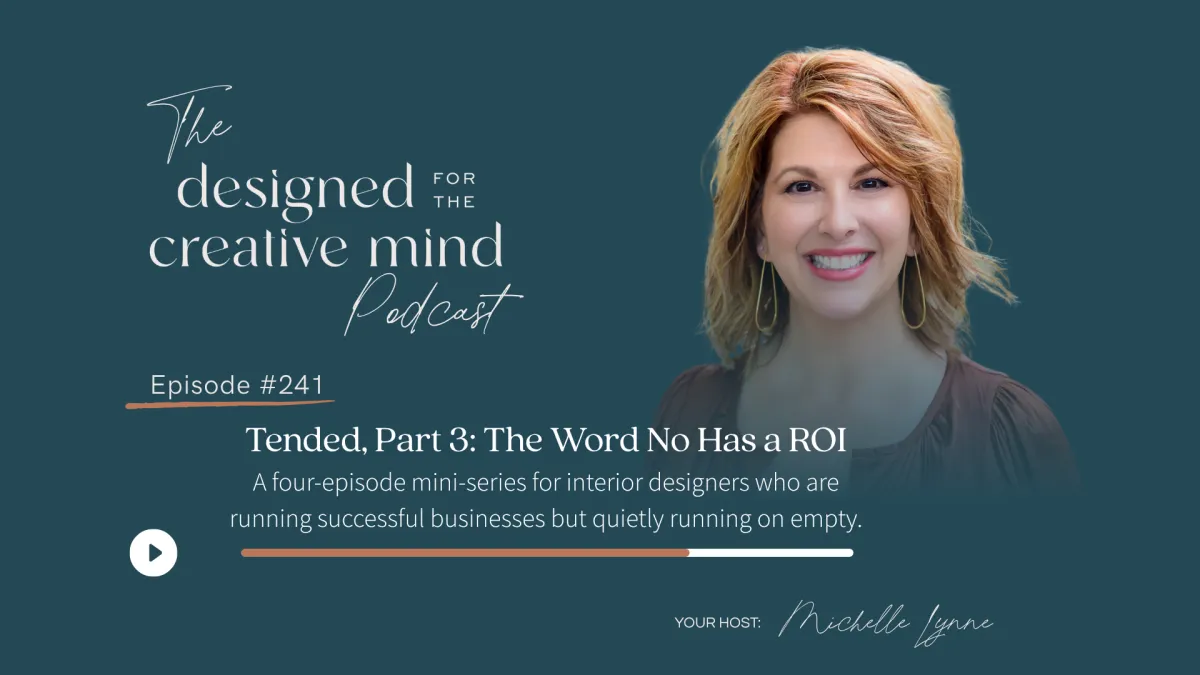
Ep 241: Tended Pt 3, The Word No Has a ROI
Saying no doesn’t come naturally to most people—and it certainly didn’t come naturally to Michelle.
In this episode of Tended, Michelle makes the business case for one of the hardest words for interior designers to say: no.
Because every yes has a cost.
Whether it’s taking on a client you knew wasn’t the right fit, quietly absorbing scope creep, accepting projects you’ve outgrown, or saying yes to every personal request outside of work, the easy yes often creates a much bigger problem down the road.
Michelle breaks down why designers struggle to say no, what’s really underneath those yeses, and how creating stronger structures and boundaries can protect your time, energy, and business.
She also gets personal about the guilt that can come with saying no at home—and why honoring your capacity isn’t selfish or neglectful. It can actually be one of the most intentional things you do for yourself, your family, and your business.
In this episode, Michelle talks about:
Why saying no is a skill, not a personality trait
The hidden cost of taking on a client you knew wasn't the right fit
How “small” yeses turn into scope creep and unpaid work
Why scope creep is often a communication and structure problem—not a client problem
What happens when your firm outgrows the kinds of projects you used to accept
How scarcity fear can cause you to make today's decisions based on an old version of your business
Why saying no creates space for better-fit clients and projects
The connection between business boundaries and personal boundaries
Why “no” doesn't require an apology or a lengthy explanation
How to practice saying no in low-stakes situations before you need the skill in a high-stakes one
Why the way you feel after a well-held no is valuable data
The big takeaway
The yes you give to avoid discomfort today may be creating a much bigger problem for yourself tomorrow.
A well-held no creates space—for the right clients, the right projects, the right pace of growth, and a business you actually want to stay in for the long run.
And remember: “No” is a complete sentence.
Work with Michelle
Visit our website at https://thedesignbakehouse.com/private-coachingto learn more about how you can work with Michelle 1-1.
Transcript:
MICHELLE LYNNE (01:02)
Hey, hey, welcome back to Tended. I'm glad you're here for this mini series about the part of business that nobody really puts in a standard operating procedure.
This episode is one that I wish someone had handed me early on. Not as a podcast, but more as a permission slip. So if you've been with us through episode one and two, you know that I've been building a case, not for working less or caring less, but for being smarter about where your energy goes. We've talked about what it means to treat yourself as a business asset. We talked about the specific places energy leaks.
Without you realizing it, such as the wrong fit clients, the comparison spiral, overfunctioning. You know, it's just that low hum of always being reachable. So hopefully you've been listening and you've started to notice some of your own patterns. Today I'm gonna go somewhere that sits underneath all of that because a lot of the energy problems that we talked about in our last episode have the same root, at least in my opinion. Okay, and the root is this. Most designers
Have a very hard time saying no. Sound familiar? It's not because they're bad at business, not because they're naive, but because you're saying yes has always felt like the safer choice. And I'm not sure, but for the most part, I'm going to assume that nobody has ever really showed you what a no actually costs. So that's what we're doing today. We're making
We are making the business case for the word no. We're gonna look at what it looks like in practice inside your design firm, what it costs you when you skip it, and why the fear underneath the yes is almost always bigger than the actual consequence of the no. And we're gonna go there. We're gonna talk about the personal side of this too. Because y'all, this doesn't stop at the office. It follows you home.
So I want to start by saying no is not a personality type. I think there's a story, or at least in my head, there's a story in my head that gets told about people who are good at setting limits. And the story is that they're just wired differently. That saying no comes naturally to them because they're more confident, they're more assertive, or just less caring about what other people think. That now
As I've let's just say grown up, okay, it's not my experience. And I don't think that's actually true. I think that the people who say no well have just done the math enough times to trust the outcome. What actually probably happened is that they've said yes when they should have said no and they paid the price for it. They learned. Right? They've watched the c the cost.
Add up over time. And at some point they just made the decision. Maybe it was a conscious one, or maybe it was just a gradual shift, that the pain of saying yes that they didn't actually mean was worse than the discomfort of the no that they needed to say. So I don't think anymore, I don't think it is a personality trait. I think it's a skill. And like any skill, it develops with practice. And when you avoid it, it atrophies.
I was not naturally good at this. I came into this business years ago, okay, years ago, as someone who genuinely wanted to help everybody. I felt uncomfortable with conflict. I read disappointment somebody else's face as evidence that I had done something wrong. And that made me the kind of person who said a who said yes a lot. And then I just had to figure out how to manage the consequences of all those yeses on the back end.
What I eventually had to reckon with though is that managing the consequences of a bad yes, y'all, it's always just harder than saying no in the first place. Always. But in the moment, I get it. The yes, it feels easier because the discomfort is deferred. You say yes and the awkwardness disappears immediately. The cost comes later. And by the time it arrives, you've almost forgotten the moment that you had a choice.
That's the trap, babe. And it runs through every layer of this business.
So let's start with the most obvious version of this: the jobs you knew you shouldn't take. I think we all have a story here. Picture this: you get an inquiry. Maybe it was during a slow period. Maybe the project sounded interesting on paper. Maybe you just needed the money. Whatever the reason, something in the intake conversation gave you a signal that this wasn't quite right, but you took the project anyway.
Maybe the client pushed back on your fee in that very first conversation. Or they mentioned a previous designer in a way that made you wonder what really happened. Okay. Maybe their budget didn't match their expectations and you thought that you could manage the gap.
Or maybe you just had a feeling. Okay. I call it the birdie. It's it's in my gut. It's the birdie. It's that specific kind of feeling that you talk about when you say, you knew from the first meeting, but you overwrote it because you couldn't point to anything concrete. Okay, it was just that gut feeling. And y'all, all of those are examples are from my experience. I've done it more than once. Yeah. And the pattern is.
Remarkably consistent. The project takes more time than you anticipated. The client relationship requires more management than the actual creative work. Something always goes sideways. It's a delayed shipment, a contractor issue, a change of direction after approvals. And instead of a client who trusts you to handle it, you have a client who treats the problem as evidence that you're not doing your job.
Gosh, it's stressing me out just thinking about this. Okay, you spend energy you don't have managing a relationship that was never going to be right. And at the end of it, you're not just tired, you're resentful. And for me, and I'm assuming a lot of y'all, resentment is one of the most expensive emotional states that a business owner can operate from because it changes the color of everything around it.
So the no that you didn't say in that intake conversation cost you months. It costs you the bandwidth that you could have spent on a better fit client or the bandwidth you could have spent getting a better fit client. It costs you the creative energy that you're putting into damage control. Damage control instead of design is never an ideal situation.
And depending on how far sideways things went, it might have cost you referrals, reputation, a peace of mind that took a long time to get back.
I'm not saying this to pile on. I'm saying it because I want you to feel this full weight of what the easy yes actually costs. Because we usually only feel that immediate relief, avoiding the awkward no.
I mean, we rarely sit down and calculate what we're trading that for, right? So the question that I started asking myself and that I asked designers that I work with is this. If you knew on install day what you sensed in the first meeting, would you have taken the project?
Almost every single time the answer is no. So work backwards from that. Build the intake process and the qualifying conversations that let you act on what you already know at the beginning. Before you're four months in, before you're eight months in. And that custom order that's non-refundable. And a client that you dread calling because it showed up broken. So
Trust your gut. Trust your gut.
So let's see what else. There's the scope creep creep. Okay, scope creep is a yes problem. Okay, this one doesn't say, hello, I'm here as a boundary. Okay, this actually kind of creeps in. Maybe that's why we call it scope creep, right? This is what happens when the work expands beyond what was agreed upon. And you accommodate it without adjusting the fee.
It's a sneaky little booger because it almost always happens through a series of small yeses. And each of these feels like really harmless, actually helpful in the moment. You know, again, I'm drawing from my experience here. The client that just says, Can you take a look at the breakfast nook while you're here? Can we add the powder bath? Like, what would you do in here?
I know we said we were done with the guest room, but we had one more question. Or can you hop on a quick call this week to talk through some ideas that we've been having? Right? And each of these is just a small yes. Absolutely. Let me tell you what I would do with that powder bathroom. Sure, let me hop on the on a call. I've got a few minutes on Thursday. Each of these is easy to give into because it feels like being helpful, being flexible, being the kind of designer that clients brag about to their friends.
Right? But when you add them up, you've done a meaningful additional, like you've done meaningful additional work for free. And you've also taught that client that the scope that you agreed to is a starting point, not a boundary. And that there's more available if they just keep asking.
I'll be in different forums for designers, and I see designers griping about this. But y'all, it's not a client problem. It's a communication and structure problem. The client's not wrong for asking. Right? You created the conditions where asking made sense, and then you reinforced these conditions by saying yes. So the fix.
is not becoming rigid or transactional or unpleasant to work with, even if you feel like it, I get it. The fix is having a clear way to respond to scope creep that doesn't depend on you summoning courage in the moment.
Put it in your contract, in your onboarding conversations, put it in both, okay? In your project management process, a structure that makes the answer automatic rather than a personal negotiation every time. What I have found is that when you handle the scope with clarity and warmth, most clients respond well. They're not trying to take advantage of you. They just didn't know where the edges were.
Babe, you're the professional. It's your job to show them. And when you do, you end up with a relationship that's built on honest expectations instead of accumulated resentment that you're just pretending isn't there.
how about those projects that just don't fit anymore?
This is a version of no that I think is really hard for designers who've been in business for a while. Because what it does is it requires you to say no to something that used to be a yes. What I mean is that as your firm evolves, as your aesthetic develops, as your positioning shifts, as you grow up, you become more sophisticated.
And the kind of projects that made sense for you three years ago may not make sense anymore. And it's not because there's anything wrong with them. They're just not where you're grown going. Let's just say you've outgrown them. But they're familiar. They're within your competency. And oftentimes they'll come through some trusted referrals. And so turning them down feels like turning down good work, which feels ungrateful, which feels like a risk that you can't really afford. Does that make sense?
I went through a version of this when I made the decision to shift more fully into whole home projects or to have a minimum design fee. I had clients from referral sources from a differ different chapter of the business. And there were moments when someone that I respected sent me a lead, but it just wasn't aligned with where I was going, and I had to make a decision about what to do with it. Admittedly, I took a few of those.
And they just didn't line up. And they sucked my energy.
But what I've learned is that saying no to a misaligned project, it's not ingratitude. It's clarity. And you know what? I think the clients that I actually said yes to probably would have appreciated me saying no and explained to them why. Because clarity communicated with honesty and warmth. It's not a relationship ender. You can say this one isn't quite right. It's not quite the right fit for where we are right now. But here's someone I would trust who'd be wonderful for this.
You're not closing a door, you're just being honest about what room you're in.
I've seen that the designers who struggle most with this are the ones who haven't gotten clear enough on where they're going to feel confident saying no to where they've been.
That clarity is worth investing some time in because without it, you keep taking the familiar work, and the familiar work keeps you from building towards the intentional work, towards the dream work, towards the the projects that.
That'll really make you proud as you and your firm grow up, grow more sophisticated, however you want to phrase it.
All right. So I promised we'd go here. Everything we've talked about so far, it's been in the context of business. But you don't stop being a business owner when you leave the office and you don't stop needing energy just because you switch contexts. For a lot of women running design businesses, the personal demands are their own significant drain. Oftentimes it's unexamined.
Often wrapped in enough love and obligation that saying no feels genuinely wrong. Like mom guilt. It's real, right? I have a daughter. She's eight years old right now, just started second grade. And there is no version of this conversation where I pretend that that is simple. So you are trying to build something, and building requires time and focus.
And time and focus sometimes means you're not at the thing, you're not in the moment, you're working late, or you're traveling for market, or you're mentally somewhere else during dinner.
And there's guilt associated with that.
But I wanna offer you a different viewpoint because I've heard that I just don't think guilt is the most accurate read on that situation.
When I'm building a sustainable business, when I'm making decisions that keep me sane and operational and present for the hours that I am home, I am modeling something for my daughter that I think is genuinely valuable. I'm showing her what it looks like for a woman to take her work seriously, to set limits, to operate from a place of intention rather than just obligation.
And I I really don't think that that's a compromise of motherhood. I think it's a very intentional and specific kind of parenting.
The no that is hard is not the one that comes from neglect. It is the one that comes from a very honest assessment of your capacity. I cannot be at every event, at every appointment. I cannot be fully present all the time. I cannot say yes to every request on my personal schedule any more than I can say yes to every client inquiry. And the standard that I hold myself to professionally should not disappear the moment.
Someone I love is doing the asking.
Whew. I know.
But there's more, because it extends past parenting. The wife who is expected to manage the household logistics on top of running a business. The friend who is always the one who shows up, who listens, who helps, who holds things together for everyone else.
The sister or the daughter who's been reliably available and has never once thought to ask whether that availability was sustainable.
Y'all, there is a version of being good to the people you love that requires being honest about your limits.
Couple weekends ago, we had a family birthday party. It's my in laws.
I I could not go. I told my husband, honey, I I I'm not moving. I cannot get off this couch. I am gonna lay here and rest. So it wasn't cold and I wasn't un like rude. I was just honest. And I passed that on to the birthday boy. I just can't.
So it's a complete sentence. It does not require a lengthy explanation or a guilt payment alongside it. Because the people who love you, and I mean the ones who really love you, they can receive that. The ones who can't receive it or don't, y'all, that's information too.
So let's take a few minutes to kind of explore what's underneath all of this.
And this is all my take. This is all my perspective because I've experienced all of this. But I think that if we don't actually explore it, that everything that I've said so far is just good advice that you probably agree with, but you haven't been able to act on it.
The fear under most designer yeses is not come complicated. It's usually one of a few things: fear of losing the client, fear of losing the referral, fear of the reputation hit, fear of the conflict that comes after the no, fear of being seen as difficult or ungrateful or not hungry enough. And underneath all of these, somewhere, usually the fear.
That if you say no enough times, the work will stop coming.
Should I say that again? Underneath all of those fears is usually the bigger fear that if you say no enough times, the work will stop coming.
think that that's the most powerful but the least recognized, or at least it was the least recognized as as as I was doing my own work. But the scarcity fear is is very real.
And it's very real to business owners in this industry, especially if you have had lean seasons and you remember what it was like when the phone wasn't ringing and you would have said yes to almost anything.
Y'all, that memory does not go away even when your business is in a different place. It's for me, it sits underneath my decision making and it applies pressure every time a lead comes in. And sometimes it's like saying to me, it's like whispering in my little ear, you know, you've got like the little devil and the little angel on your shoulders, and it's saying, You should take it just in case. I know.
But what I want you to notice is that the scarcity fear is almost always backwards looking. It's based on a version of your business that may no longer exist. So when you make decisions, current decisions, based on past fear, you keep recreating the conditions that made that fear valid in the first place. You take the wrong fit work, the wrong
Fit work drains you. The draining keeps you from showing up fully for the right fit work, and the right fit work doesn't grow the way it could.
No, said clearly and said often enough create space.
Space for the right clients, the right projects, the right pace of growth. That space feels risky before it fills. And that's the part, I don't think anybody talks about it. Or at least nobody was telling me. So I hope you hear this that the gap between the no and the right yes can feel uncomfortably empty. But it's not evidence that you made the wrong decision. It's just the transition.
The designers I work with in private coaching who've done the work, they've done the work on getting clear on who they serve and how they work, consistently report the same thing after they start holding on to it. That the clients they get feel different. The work starts to feel different. And it's not because the market changed, but it's because they did.
And what it looks like in practice is that
I think boundary conversations are one of those areas where the principle of it is easy to agree with, but the application is where people get stuck.
So here's like a loose breakdown of what I found works. And that's first that the no needs to be structural whenever possible. So what I mean by that is that the less like you have to build into your business, the less you have to summon courage in the moment, the more consistently you'll be able to hold that no. So that means that your contract has to have
Clear scope language, your onboarding conversations, your sales process needs to set expectations explicitly. Your communication policy is written down and shared, not just assumed.
That means texts. That means phone calls. That means how quickly are you going to reply via email? So when the structure is in place, the no is not personal. It's procedural. That makes it so much easier to deliver and dramatically easier for clients to receive. Get that? It doesn't feel personal.
Second thing is that the no does not require an apology or a lengthy explanation. No with a period is a full sentence. And I know that that runs counter to every instinct you have, but explanations invite negotiations. Ooh, that could be a bumper sticker. Explanations invite negotiations.
When you explain why you can't do something, you're implicitly saying if those reasons went away, the answer might change. And so now the other person is trying to remove the reasons. my God, I just did this with my eight-year-old last night. Okay. A warm direct no with a brief redirect is almost always better. So think about that. Parenting, clienting. Okay.
This is if this isn't the right fit for us right now, but here's a direction that might serve you well. That's a complete response.
Third, practice with low stakes before you need it for high stakes.
The place to start rehearsing no is not with your most important client or your most valued referral source. Start with the easy ones. The vendor who keeps calling it inconvenient times.
The industry group that you joined out of obligation, but you have stopped finding it valuable? The request that you know immediately isn't the right fit, but usually say maybe to while you figure out how to get out of it.
Practice the clean no in those places and it will come more naturally when the stakes are real.
I'm gonna go practice with my eight-year-old. she knows the word no. Who are we kidding? All right, and then fourth is notice how you feel after a well-held no versus a yes that you didn't really mean. That feeling is data. Every time you say no and the sky doesn't fall, you're building evidence against the fear.
Every time you say yes, when you mean to say no, and you pay the cost of it, you're building evidence for the change. Pay attention to what direction that evidence is accumulating.
So if you're in a place where this feels like the work you need to do, where you know intellectually that you need better structure around your boundaries, but you're not sure how to build it inside your specific business, that's a conversation I'd love to have with you. Private coaching is where we get into the details of your firm, your clients, your fees, your processes, and we figure out what actually needs to change in what order.
You can even use me as the bad guy. Sorry, my business coach said I can't do that. Okay, until you can build your own muscles that say no. So you can find out more at the designbakehouse.com. Go to private coaching. If it's not the right fit for everyone, but it wait.
If it sounds like what you need, reach out and let's talk. So, thanks for spending time with me. If anything from today hit close to home, I'd love to keep the conversation going. You've spent a lot of energy building something worth protecting. Let's make sure you're in it for the long run. I'll see you next time.
