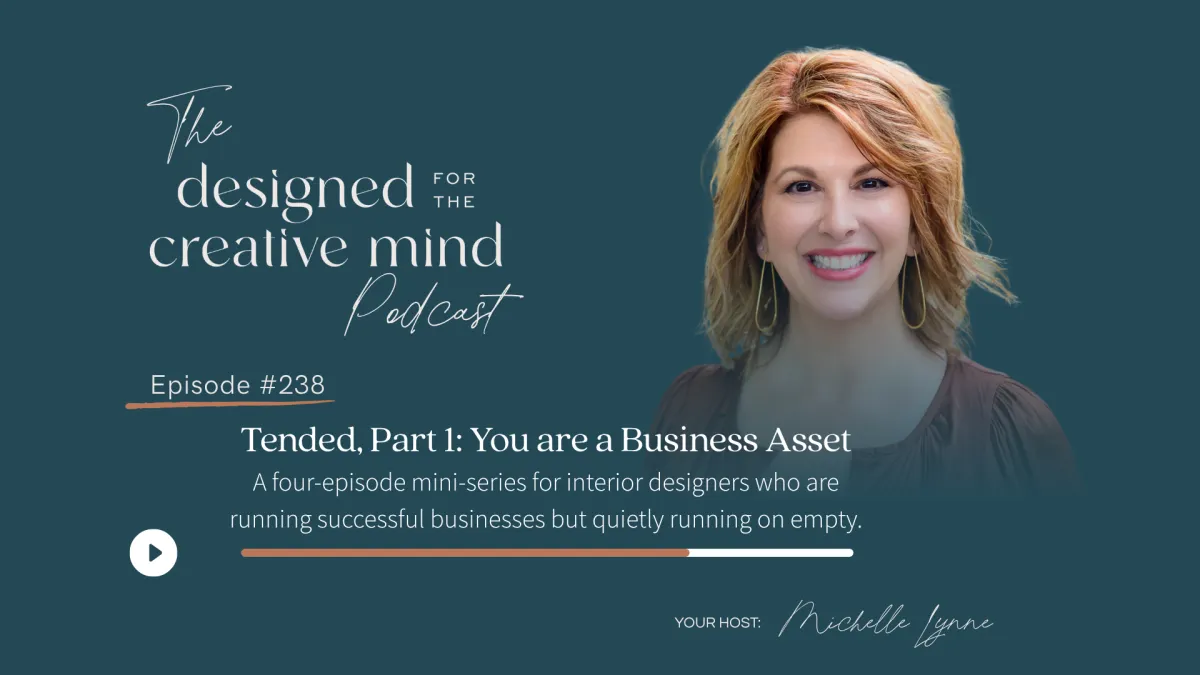
Ep 238: Tended, Part 1: You Are a Business Asset
As business owners, we’re really good at taking care of everything else.
We protect our clients, our teams, our projects, our cash flow, our systems, and our businesses—but somehow, we put ourselves at the bottom of the list.
In this episode of Tended, Michelle Lynne gets personal about what happens when the person running the business is running on empty. From skipping appointments and sacrificing sleep to giving up movement and carrying the mental load of both business and family, Michelle shares her own struggles with putting self-care into practice.
Because for a business owner, burnout doesn't always look like collapsing. Sometimes it looks like shorter patience, harder decisions, less creativity, resentment toward the business you built, or simply sitting at your desk for hours without actually accomplishing much.
And when you're a sole proprietor or small firm owner, you're often the single point of failure. If you go down, the business goes down with you.
This episode is a reminder that taking care of yourself isn't a distraction from your responsibilities. It's what makes you capable of meeting them.
In this episode, Michelle talks about:
Why business owners are often the first to protect everything except themselves
The “oxygen mask” analogy and why it applies so directly to entrepreneurship
What running on empty actually looks like before you reach full-blown burnout
How exhaustion can affect your patience, creativity, decision-making, and relationships
Why sleep isn't a luxury or a badge of honor—and what you're losing when you consistently sacrifice it
Michelle's experience of stopping exercise and realizing that movement was about far more than aesthetics
Why regular movement can be a form of business maintenance
The difference between being busy and actually contributing
How the “first one in, last one out” mentality from corporate life can follow you into entrepreneurship
Why the work will never truly be finished—and why waiting until everything is handled before resting doesn't work
The impact of your relationship with work on your team and your family
Why ambition and health don't have to be opposites
How being rested, fed, and physically cared for can make you a better leader and business owner
A question to take with you
If your business systems went down tomorrow, you'd do whatever it took to fix them. When was the last time you applied that same logic to yourself?
You are not a distraction from your business.
You are the person who makes the business possible.
Want support beyond the strategy?
Michelle's private coaching works with interior designers on more than just the numbers and business strategy. It's about the owner behind the business, too—creating a business that works within the reality of your life and learning how to lead well while carrying a heavy load.
Learn more about private coaching at The Design Bakehouse.
And if you're sitting at your desk right now staring at your computer but not actually getting anything done, take Michelle's advice: get up. Stretch. Move.
You don't have to earn rest.
You have to tend to yourself.
Transcript:
Michelle Lynne (01:02)
Alright. Welcome to Tended. This is a mini series inside Designed for the Creative Mind. And this one is a little bit different. We're not talking about procurement or pricing or what software you should be using for your business. We're talking about you, the person running the business. Because I've noticed something over the years, both both in my own firm.
And in working with designers all over the country, all over the globe, we will protect every other part of our business before we protect ourselves. And I wanna spend some I I want to spend some time talking about that. So we've got three, maybe four episodes where I've broken it down into what seems to me pretty nor
Broken it down into three or four episodes in what I feel are pretty logical segments. So I want to start off by leading with something that I will freely admit, and that that is that I am not the best at putting my own words into action. I am inconsistent. I know what I should be doing. I talk about it and then life gets lifing and some of it just falls away. What I am consistent about though is listening to my body and resting when she says so.
In fact, this past weekend, I took a nap on Friday, Saturday, and Sunday. Monday too, actually. So four days in a row, I I thought I was just in heaven, but genuinely I I believe that this is what keeps me from actually getting sick. Like my friends know I generally don't get sick because my body asked for something and I listened.
And while that's not a perfect system, it's it's it's what's worked for me for years. But let me be clear, like like from right here at the start, this is not me preaching at you from some elevated place of self-care mastery at all. Y'all, this series is as much a reminder to myself as it is a conversation with you. It's just what was on my heart. And I wanted to go ahead and put it out there on the podcast. Because
So let's just pretend like we're sitting across from each other having this conversation. And I would tell you that I'm the one who skipped my most recent dental cleaning because the day felt crowded. It just stressed me out. I'm the one who I haven't been to the dermatologist for what I call the mold patrol in a couple of years. So I am not judging you. I am sitting right here with you and I'll be the first to call myself out. So
Speaking of calling out, I think it's worth mentioning. Did you know that perimetopause starts in your 30s? And your 30s, y'all. So if you've if you're already navigating the business, the team, the clients, the family, like go ahead and add that fun circus into the mix. Our bodies are doing things that we sometimes don't even have a language for yet. And we're still expected to show up and lead. So that like, let's put that into context when we talk about taking care of ourselves.
So
Ugh, something happened on a plane the first time I traveled with Genevieve. Okay. Genevieve's my now eight-year-old daughter. And I was stressed out about flying with a a young child anyway. I think she was two years old. We were going to the beach. Maybe she was three. But the flight attendant was doing the safety demonstration, right? Oxygen mass drops down from the ceiling. Secure yours before assisting others. I've heard it a hundred times before.
But on this particular flight, the first flight I had taken with my daughter, I heard it differently. But I thought about how many of us are as business people, how many of us are actively passing the mask to everybody else first? Our clients, our vendors, our team members, our families. And we just keep going without it, telling ourselves that we'll be fine. I'll be fine.
I'll be fine, I'll get to it later.
Because there's not time right now, right? Like the reason I didn't go get my teeth cleaned. I I was just stressed out. There was too much going on. But the problem with that approach in your business is that it's gonna be slower to show up than it would be on a plane, right? The plane just like drops out of the sky. It's pretty apparent. You don't collapse all at once. You just gradually become a less capable version of yourself. And then you start wondering why everything feels harder than it used to.
And hell, we probably blame it on perimenopause when it's not just that.
So let me ask you something, sister. If your project management software went down tomorrow, what would you do? You'd get it fixed. You'd call support, you'd pay for the upgrade, do whatever it took. Because you know what it costs when that system doesn't function for you. So when is the last time that you applied that same logic to yourself? We ensure our businesses, right? We ensure our cars, our equipment, our homes.
We track our accounts receivable, we monitor our bank account cash flow. But the person who makes every single decision in your firm, the person who manages every client relationship, who holds the vision, who knows where all the bodies are buried, like we run her on four hours of sleep in a cold coffee cold cup of coffee and we call it a Tuesday.
Sole proprietors and small firm owners are by definition single points of failure. What I mean by that is that if you go down, honey, everything goes down with you. Not just for a day, but for however long it takes you to recover. And you know the recovery always takes longer than you expect because you are already running depleted before you hit the wall. So it's not drama, it's just math.
A business that depends entirely on one person needs that person to be functioning at a reasonably high level. And somehow we have just decided that taking care of ourselves is the last item on the list. The thing we'll get to once everything else is handled, but nothing.
Everything else is never fully handled. There's always something else. So so that item on our list to take care of ourselves, it doesn't it that that item doesn't move.
So
Let's let me let me paint a real picture here. Because I think I've built up a fairly dramatic image of what burning out looks like. And because it usually doesn't look like that, we think we're fine. We're not lying in bed unable to move. Okay, we're not dropping it down onto the floor. We're still showing up on site visits and returning emails and getting shit done. So we tell ourselves, we're I'm okay.
But running on empty is it looks like shortened patience. And let me just tell you, if you've ever heard of menopause rage or perimenopause rage, which again starts earlier than anybody tells you, you know that this is not just a little bit of irritability. It is a trigger that is suddenly much closer to the surface than it used to be. And it doesn't just stay in the office where you get pissed off at a client. It carries over to the people you love the most.
And the shortened patience isn't just like I said, with a client who changes her mind for the fourth time. It's with your husband. It's with your kids. It's it's with the dog. It's with the person in line in front of you at the grocery store.
When we're depleted, this buffer disappears. And the people closest to us are the ones who generally feel it the most. It also looks like making decisions you know aren't your best because you're too tired to think them through. It looks like the creative part of your brain has just like checked out. It's gone quiet. Okay. And and maybe it's not gone, gone.
But it's just not available in that same beautiful artistic way. Okay. Running on empty looks like lying awake at night, just checking through your to-do list. Check, check, check, check, check. And then dragging yourself through it the next morning, wondering why you can't seem to get ahead. It's because you're exhausted.
And and here's one that I've it's it's taken me a while to recognize it. It's a subtle version. Okay. It's the resentment that creeps in towards the business itself. The business that you built, the one that you wanted. It showed up for me because I was looking at my calendar and feeling something closer to dread than enthusiasm.
And y'all, that feeling is disorienting because this is what you chose. This is what you love to do. It's what we've worked for. And now some mornings it can feel like a weight instead of a life.
I went through this shortly after the pandemic. And y'all, like, I was just ready to burn the business down. And I'm really grateful that I personally have a strong constitution. It genuinely takes a lot to knock this girl down. But I was tired. Like bone tired.
Not seriously, not permanently did I want to burn this down. Well, sometimes if I admit it. The feeling was there. Okay. I had to reckon with what I had been running on and what I had been ignoring for too long.
So it's not it's not just that we need more sleep, although I want to take a moment and talk about sleep.
I think that sleep oftentimes gets treated like a nice to have. Something to optimize when everything else is under control. Y'all, I used to be able to operate on four hours of sleep, and I thought it was a badge of honor. Okay. Sure, maybe when I was in my 20s, maybe part of my 30s, but I want to argue that without sleep, everything else is harder. It's, I mean, you can still get it done, but it's harder.
Harder. Sleep is when your body does the repair work, not just physically, but neurologically. Okay, there are sleep cycles. I know that because I've got my aura ring. Okay, there's light sleep, deep sleep, rem.
And each one of these does something different. Okay. Deep sleep is where physical restoration happens, your tissue repair, your immune function, hence my multiple naps this last weekend. Okay, the kind of rest that makes your body feel like it is actually recovered. REM sleep is where your brain consolidates memory, it processes emotion, and it does that creative synthesizing. And
Y'all, quite frankly, that's what makes you good at your job. It's the creativity. When you cut your sleep short, you lose disproportionately from both ends. So you wake up and you don't have the physical recovery, nor do you have the cognitive reset. And you do that for enough days in a row, enough weeks, enough months. Y'all, you cannot perform at the level that your business requires.
Most adults need seven to nine hours. And so many of us are getting less and calling it discipline. Okay. Or calling it the, like I said, the badge of honor. I don't need that much sleep. I'm superhuman. That's bull blowing. Okay. It's not discipline. It's not a badge of honor. It's debt and it compounds.
And Okay, so
This is I I want to get personal about movement. Okay. And I lived a version of this recently. You might have seen it on my Instagram stories if you follow me at at by Michelle Lynn on Insta.
But recently I lived a version of this that I think some of you guys will recognize. let's see. So I'm recording this podcast where the this is August. Okay. I stopped working out right around the first of the year. Kind of ironic. Everybody starts working out. I stopped working out at the first of the year. I had truly, I just gotten stressed about appointments in general. Okay. The calendar, the commitments, all of it.
I just needed to cle I just needed some white space on my calendar. So I started stripping things out. I took off my fingernails, like I wasn't getting them dipped or done anymore. I canceled my skincare, the micro channeling that I was doing. I stopped going to the gym. Okay, fine. My nails, they're press on still. Okay. Skincare, that can hold for a bit. Although I'll be the first to admit that the dermatologist that's been on hold for a couple of years, it's not helping the cause, right? But movement.
Removing movement was a mistake that showed up in my body almost immediately. And I'm not talking about my thighs. Okay. I'm not talking about this what chicken wing under my arm. Okay. I was more tired. I was crankier than usual. I told my husband, I'm so tired. I need to get back to the gym. And I'm it's like that's so that's so backwards, right? It's like I'm tired. I don't want to go to the gym. No, I'm tired. I need to go to the gym. I was crankier.
Things that I normally handle with reasonable amount of steadiness, I could even laugh at. It just it felt heavier. So I went back to the gym in March and it was to save my sanity. Okay. Save my marriage. Okay, I say that with a laugh, but I mean it a little bit, like in real life. But here's here's here's what I want to explain about why movement works.
Okay, and it's not just about aesthetics. Yes, would I love to get rid of this chicken wing? Sure. Would I love if my th thighs were thinner? Sure. But when you exercise your body, it generates new cells, including your brain. Okay, you maintain and you build muscle. I got little bit of a little bit of a little little rock above my chicken wing. Okay. But what happens is the muscle.
You maintain and you build your muscle. It keeps your metabolism functioning well. And it's not just for weight management, babe. It is for energy. Muscle is metabolically active tissue. It's part of what keeps you feeling alive and capable. Regular movement also regulates cortisol, which is your stress hormone. And y'all, as business owners, we have sleep stress hormones. Okay, so when cortisol is chronically elevated, which it is for most business owners.
Who are not managing it in some way. Okay. And just let's let's let's let's hold on a second. It's not just business owners, your business owner, your mom, your wife, your friend, you're like trying to keep the household in order. Like it's it's it's a lot. So when cortisol is chronically elevated, it affects your sleep, your mood, your decision making, your immune function.
And movement is one of the most effective tools you have for bringing it back into balance. Now, what this looks like, what movement looks like, it's entirely up to you. It could be at a gym, it could be in your garage, it could be walking around your neighborhood, it could be standing in your kitchen doing jumping jacks, whatever works for you. Okay, whatever works for your time, your life, your body. The form matters far less than consistency.
Okay, regular exercise is not a performance. It is maintenance. Put it on the calendar, the way you put a client meeting on the calendar and protect it the same way. Be your own best client. If you put something on the calendar for your client meeting, you're not gonna meet that, you're not gonna miss that meeting. Right? Like you will bend over backwards to not miss a meeting on your calendar with a client. Maybe your dermatologist, you'll miss that.
Okay, or the dentist. But with a client, never. So be your own best client.
Now, like I said earlier, I can talk the talk, consistency. I don't walk the walk. Okay. I've been in business for about two decades. I've been in business for myself for about two decades. And I'm still unlearning things that I absorbed in corporate life before I went out on my own. Y'all, this I mean, seriously, I've always been a slow learner. This is really taking me a lot longer than I expected. But what I mean is that
When I was in corporate the belief that the first one in and the last one to leave is the most valuable person in the room. Okay, I followed that model for years. And then I went into business for myself and for a while I just brought the same operating system with me. Okay. I was newly married.
I was able to navigate the amount of time it took, but
Let me just let me just help you move faster. Okay. Because right now there's just too many moving parts in our lives. That version of productivity that I have that I'm trying to rid myself of in regards to corporate burning the candle at both ends, y'all, it's it's a lie. It is just a big fat lie. Being present the longest is not the same as contributing the most. Like I will find myself sitting at my computer in my office.
Not doing a darn thing. But I'm busy. Okay, so let me let me say this again for the people in the back. Being present the longest is not the same as contributing the most. When you own the business, that confusion can cost you in a very specific way because there is no clock to punch out.
The work will always be there. The inbox will never be at zero.
And if you're waiting until it is to rest, you're gonna be waiting forever. You're gonna be dead before you rest. So and and I don't know, maybe this is just me, but I don't think it is. I don't think it is. The because we carry this idea that rest is something that we earn. The taking a nap, leaving at a reasonable hour, actually using vacation days, that these are indulgences. Things for people with lighter loads.
And as I've referenced a couple times in this episode, we are women who often have enormous loads, not just in the business, but at home. The mental weight of holding it all together. Y'all, if you're a woman, you understand this. Dudes, sorry, you probably don't. It's you're holding it the business, the team, the clients, the household, the relationships, and it's just always up in our head. It's real and it's cumulative.
And it sits on top of whatever our bodies are doing hormonally, which, as we've already established, can be quite a lot.
So here's the shift that I I'm asking you to consider. Okay, because I'm I'm I'm talking to myself here as well. Like I said, this episode was on my heart. I think I probably needed to hear it just as well.
So taking care of yourself is not a distraction from your responsibilities. It is what makes you capable of meeting those responsibilities. The version of you that is rested and fed and has moved her body, makes better decisions. She is more patient. She handles the hard conversations with more steadiness. She can access the creative thinking that makes her.
Genuinely good at her job.
So neglecting yourself does not make you more responsible. It erodes your ability to do any of it well.
And then there's the ripple effect. Okay, there's one more piece to this to when you are the owner, you set the culture whether you intend to or not for your business. Your team watches how you operate. They notice if you answer emails at midnight. They notice if you never take a real lunch. They notice if you come in clearly running on fumes and push through it anyway. Because the unspoken message in all of that.
Is that this is what dedication looks like around here. And if you don't have a team, what if you have children? What if you have both? Okay. Because your kids, they're watching too. Doesn't matter how old they are. They're absorbing your relationship to work, your relationship to rest, and your relationship to your own needs. What you model becomes their template.
And you have the opportunity, not the obligation, but the opportunity to show them that ambition and health are not opposites. They are not in opposition. They do not work against each other.
Your clients will feel when you bring steadiness to a difficult moment, a complicated install, something that goes sideways, a decision that has to be made under pressure. That comes from somewhere, that steadiness. And it does not come from running yourself into the ground. It comes from having enough in your tank, enough in reserve. Clients can feel it.
It's part of what they're trusting when they hire a firm like yours.
Now, if you heard yourself in any of that, if any part of this episode felt a little too familiar, just know that the work of changing it is not something that you have to figure out alone.
Y'all
I've shared with you that I'm not I don't always practice what I preach. Okay, like I said probably in the f the opening of this conversation is that sometimes life just lives. But if you want to work with somebody who understands that life lives, but also that it's really important to be taking care of ourselves, to tend to ourselves, private coaching is where I work closely with designers, not just on the business, but on the reality of it.
Of this exact kind of thing. So it's not just the strategy and the numbers, but the owner behind the business. How to structure your days, you know, how how to lead well and stay in it for the long run while you're carrying all of this heavy load. So if that sounds like the right next step, you can learn more at the designbakehouse.com. Just go to the private coaching. Okay. No pressure, no pitch.
Just an open door if you're ready to walk through it.
But take take this episode to heart when you find that you are sitting at your computer staring at it but not getting anything done because you feel like you need to be sitting at your desk. Yeah, that's me. when you find that you are tired and your muscles are sore, but not from a good workout, just from the fact that you've been sitting so much, get up and stretch. If you're in a place right now, get up and stretch.
That's what I just decided I'm gonna do when I'm done recording this. So, with that, let me say thank you for being here for this one. Tended, this series, this little mini series, is about taking the same care with yourself that you take with every other part of your business. Next week, I think we're gonna talk about energy. Okay. I've got some bullet points, might be consolidating a few of them.
But I think where we're gonna go with this. Actually, we are specifically. What depletes your energy? What restores it? And why learning to pay attention to that distinction might be one of the most useful things that you can do for your business this year, next year, and the year after that.
Until then, have a wonderful week and make sure you are building something worth operating.
