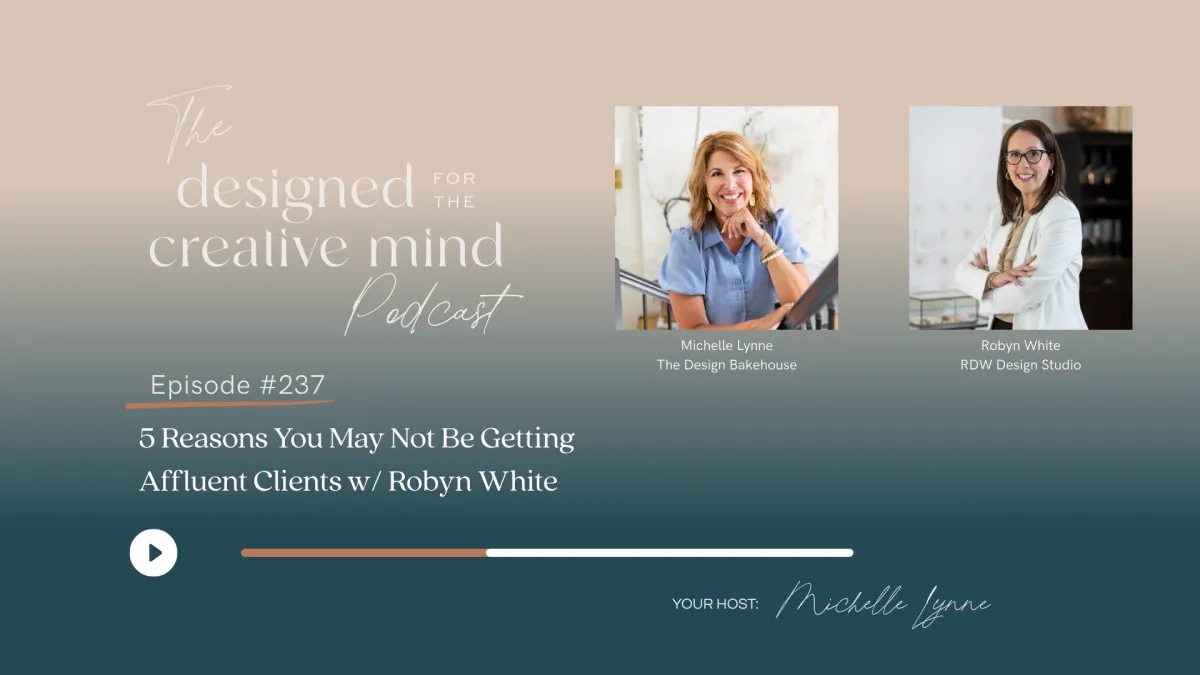
Ep 237: 5 Reasons You May Not Be Getting Affluent Clients with Robyn White
In this episode of Designed for the Creative Mind, Michelle welcomes back website strategist Robin White of RDW Design Studio to talk about one of the biggest questions interior designers ask:
"Why aren't I attracting more affluent clients?"
Spoiler alert: it probably isn't your pricing.
Robin specializes in helping interior designers position themselves to attract premium clientele, and she shares the five biggest reasons your website may be sending the wrong message—even if your work is exceptional.
Together, Michelle and Robin discuss why affluent clients buy differently, how trust matters more than luxury buzzwords, and why your website should communicate confidence, ease, and expertise long before a consultation ever happens.
If you're ready to elevate your brand, attract better-fit clients, and create an online presence that reflects the level of work you truly do, this episode is packed with practical insights you can implement immediately.
In this episode, you'll learn:
Why your website—not your pricing—may be costing you affluent clients.
What "perception misalignment" is and how it quietly drives away premium prospects.
How luxury clients evaluate trust before they ever contact a designer.
Why your messaging should shape perception instead of simply explaining your services.
The importance of speaking to your ideal client instead of trying to appeal to everyone.
How your portfolio can either elevate or dilute your positioning.
The subtle design elements that create a truly premium online experience.
When it's time to invest in a website refresh—and when DIY is perfectly acceptable.
Key Takeaways
Affluent clients aren't looking for the cheapest designer—they're looking for the one they trust most.
Your website should communicate:
Confidence
Expertise
Simplicity
Exclusivity
A seamless client experience
The goal isn't to convince people to hire you. It's to create an online presence that makes the right clients feel like you're the obvious choice.
Resources Mentioned
Luxury Client Website Appraisal (complimentary personalized website review): https://rdwdesignstudio.com/luxury-client-website-appraisal/
Connect with Robin on Instagram: @rdwdesignstudio
Connect with Michelle
If today's conversation made you rethink your own website, remember that attracting great clients starts long before the consultation. Building the right systems, messaging, and client experience will help you create a business that's not only profitable—but enjoyable to run. Visit our website at https://thedesignbakehouse.com/.
Transcript:
speaker-0 (01:02)
Hey everybody, welcome back. I am excited to introduce to you a returning guest, Robin White. We just figured out that the last time she was on the podcast was episode 44. Y'all, so we have got an oldie but goody. Right? That was from that was from 1922. It was from 2022. We're not that old. Some days I feel like it. But let me introduce to Robin White.
Robin combines brand strategy, website design, and SEO expertise to help interior designers align their online presence with the expectations of affluent clients. So she is with RDW Design Studio. And I want to welcome you back, Robin. Yay!
speaker-1 (01:49)
Thank you. So great to be here, Michelle. Thanks for having me back.
speaker-0 (01:52)
So excited. And the funny thing is, y'all, Robin and I were just talking. So we did the podcast in 2022. And then it felt like I'd known her forever. We met like in person, like, or as the kids say, I R L in real life, at high point this past April.
speaker-1 (02:10)
April and October.
speaker-0 (02:12)
April and October. Yes, but it just feels like I've known you for so long.
speaker-1 (02:16)
I know. It felt like seeing an old friend, even though we'd never met in real life before. Yeah. Which is super cool.
speaker-0 (02:22)
It is super cool. And I think that's the I mean, that's the fun of today. I like we've got all this technology and whatnot, which is fantastic, but sometimes it just feels like I just want to slow down and and like know people in real life. But this this definitely helps expedite that.
speaker-1 (02:39)
Yeah. And it's so nice to be able to give someone who you've been like doing Zooms with or, you know, communicating on Facebook group, give them a hug in person, you know.
speaker-0 (02:49)
No. Here in the south we say, I I'm so excited to hug your neck.
speaker-1 (02:53)
Yes.
I love it.
speaker-0 (02:55)
Well then let's let's talk about what you've been doing since twenty twenty two. Your expertise is websites. Yes. Specifically for interior designers.
speaker-1 (03:05)
Yes, exactly. So I niched down very early on in my business to working specifically with interior designers. And it it comes from something you're gonna hate hearing me say and your listeners are going to hate, but I love watching HG TV. It's how I relax in the evening. And I was thinking about okay, what who do I want to niche down and work with? Like what brings me joy? And I love watching that and
You know, I've never been a design interior designer myself. I think it would be super cool, but I don't have that kind of skill set or anything. And I'm like, you know, I think it would be really cool to work with these people. You have beautiful imagery for me to work with on the website. That's
speaker-0 (03:46)
Should
speaker-1 (03:47)
very different than if you're working with like a financial advisor or a lawyer. So it really came from my love of relaxing and watching HGTV. And I now understand your industry and how that
Those shows are completely unrealistic, but they're still fun to watch. Absolutely.
speaker-0 (04:06)
Absolutely. how funny. I don't think I knew that.
speaker-1 (04:09)
Yeah, yeah, that's where it comes from.
speaker-0 (04:11)
How long have you been doing this?
speaker-1 (04:13)
So I'm entering my eighth year. Yeah, yeah. If you can believe it. Yeah. Yeah.
speaker-0 (04:20)
It's been fun to sit back and kind of watch as you've grown. Yeah. I think you first got plugged in in my Facebook group.
speaker-1 (04:28)
We did. Exactly. Exactly. Yeah.
speaker-0 (04:31)
Launch pad. Yeah.
speaker-1 (04:32)
And over the years I've really, and this is something that I advise all of my clients of is figuring out what your unique differentiator is. Right. That's so important. What makes you unique? Why should someone hire you over everyone else who's doing the same exact thing? Yep. And over the years, I have finally figured out what mine actually is. And
Because of that, I am now leaning into working with interior designers who are really trying to attract a more premium client or affluent client. And it comes from my first job. So I have a master's in art history. I worked in one of the top art galleries of the world for nine years in their New York office. And it wasn't something I ever shared about my story. And then I started to think about it, and I'm like,
Well, you don't get more luxury than people who are spending twenty million dollars on one painting for their wall for their living room.
speaker-0 (05:29)
Right? Yeah, I'd say so.
speaker-1 (05:30)
And this is who I worked with for almost ten years. So I'm like, I understand these people. This makes me unique. I don't know any other website designer who has that background. So
speaker-0 (05:40)
Absolutely, to be able to target somebody so specifically.
speaker-1 (05:45)
Yeah, exactly. So I share this because it took me many years to figure this out. it's a hard thing. It's something that's like so innately part of us that we don't see that it's special.
speaker-0 (05:59)
It's funny that you say that because in my in the my signature program, One of the first exercises we go through is who are you and what makes you a badass? Because you have to be able to say, This is who I am, and this is what I bring to the table, and this is how it benefits you to our clients. But
It is an exercise to get to that point because like to you like you just said, it we're so close to it, it's hard to see the forest through the trees.
speaker-1 (06:29)
Yes. And something that's just where we don't see there's any relation whatsoever, right? Between art gallery and website design. Like what could it possibly be? But it's there. And when I say it now, it's so obvious. Right.
speaker-0 (06:43)
Right?
speaker-1 (06:44)
and it was almost something I hid in the beginning. 'Cause I was like, Well, there's no correlation. Like who would care? You know? No.
speaker-0 (06:50)
No, that's it's that's exactly what I did, Robin, is when I got into interior design, I didn't talk about business. And I felt like somewhat insecure because I don't have a classical training for interior design. So then I was like, but hold on, my business acumen is my superpower, just like so we have that very parallel. So it's like duh.
speaker-1 (07:12)
Yeah. And everyone has it. Right. And it might not be a previous job. It could just be something that happened in your personal life that you've experienced. But there's always something. It's just figuring out what it is.
speaker-0 (07:26)
Absolutely. And how it benefits our clients.
speaker-1 (07:29)
Yes, because that's it. It's spinning it in terms of how it helps and benefits them, not just in terms of sharing your resume.
speaker-0 (07:37)
Well then let's talk about that because what makes the luxury side different?
speaker-1 (07:42)
Yeah. So many things. but I would say if I if I had to just call out one thing, I think they need to feel safe more than the mass market does. And what I mean by that is they have so many choices, right? Right. Money's not the issue with them. so because of that, they can choose from any
designer, but let's also think about this. They can also choose to spend their money not on an interior designer, but on a private jet or on a yacht. So what is the priority for them in terms of where they're spending their money? You're not necessarily competing with other designers. You're competing with other places where their investment can go. But because they need to feel safe, trust becomes very, very important.
And getting that feeling of safety and trust across on your website is critical. I think that that can often be the differentiator.
speaker-0 (08:46)
So how do you do that? Like Yeah, let's dig in. Yeah. I'm going back to my own website and I'm thinking, shoot, here we go. I'm gonna have to make some changes soon.
speaker-1 (08:56)
Yeah.
So I think that a myth that a lot of people have is that they spend their money effortlessly, but they actually almost have more risk when they're spending their money. Because think about the fact that they might have employees who they're responsible for, staff in their home who they're responsible for. So their investment carries more risk with it.
So when they're making these decisions, they need to feel understood, right? Safe, confident in their decision, and confident in the person guiding them. And I would say that that is probably the number one thing that you have to get across on your website, that they can feel confident that you can take this investment that they're making in you, right? And
guide them through this complex complexity that is interior design or renovation or custom home building.
speaker-0 (09:53)
It's a lot.
speaker-1 (09:54)
Yes, exactly. So this comes through establishing your credibility, right? Establishing that you have a seamless process, that you've done this before, that you know what you're doing. Right.
speaker-0 (10:11)
Just rainbows and fairy dust and poof your house is pretty.
speaker-1 (10:14)
Exactly. Exactly. because they're inviting you into their home, right? That comes with risk. They're committing to a long process, right? They're making choices that can be irreversible sometimes, right? They're investing significant resources and they want the outcome to match their vision. So they don't want to make the wrong decision. They don't want to be disappointed. Mm-hmm. Right.
they don't want stress. Right? You need to take that off your plate. Everything needs to be with ease.
speaker-0 (10:47)
Robin, I I I I really wanna hit that hard because I think so many designers think it comes down to money.
speaker-1 (10:54)
No. But it's not at this level.
speaker-0 (10:57)
Right. But I not at this level, but also like if they can afford to hire an interior designer, money yes, it's something. I mean, this isn't just like w charity or anything. But it it's it's taking the stress away, it's saving them the time. Like I think that that is such a key component that we oftentimes forget about. And then you're right, when you do get to that next level of affluency. Yes that word. Affluence.
speaker-1 (11:23)
If
it's not I love it. Let's use it.
speaker-0 (11:25)
It is okay. When you get to that next level of affluence, it's it's yeah, it's the money is sec yeah secondary.
speaker-1 (11:32)
But yes, everyone interior design is a luxury industry. Right. Right. So whether you're dealing with the luxury market or the budget conscious, it's still discretionary income for that person, whether it's a smaller number dollar amount or a larger dollar amount. So interior design's a luxury service, regardl irregardless of the income bracket that you're working with. So
Yes, I would say in that instance, ease and simplicity is important to everyone and taking stress off their plate, right? Like I can pick my own paint color and my own sofa, but I'm going to be stressed about whether I'm making the right decision or not because I don't have your expertise, right? I don't have your resources, your contacts, your years of experience. So you want to share all of that and you want to
illustrate it in ways you're not just don't just say it you want to say it in a way that shares the story if that makes sense so yeah so like you don't just want to you don't want to say I'm a luxury interior designer that has no meaning right and I have an example of what you can say and I'm just looking for it
here, but if you could say instead of saying I love helping clients create beautiful spaces, like that's something every interior designer could say. And it sort of has no meaning really. But if you were to say we manage every detail from concept through installation, coordinating with architects, builders and trades so our clients can enjoy the process as much as the finished home, that tells me something.
Right.
speaker-0 (13:17)
Yeah, and it I think to your point, when we simplify it to the point it's like I love creating beautiful spaces, that almost translates to the rainbows and fairy dust. Yes. Like we have to educate our clients as to how much detail really falls in our lap. Yes.
speaker-1 (13:37)
And you want to make sure that you're getting across that you're taking all of that off of their plate.
speaker-0 (13:44)
Great, great point.
speaker-1 (13:45)
Yeah. Yeah.
speaker-0 (13:47)
It's yeah, and it's such a simple tweak. Also
speaker-1 (13:49)
Yes.
speaker-0 (13:50)
goes back to like where we're so close, it's it's hard to see the forest through the trees. Yes. This is just what we do.
speaker-1 (13:57)
Exactly. Exactly. We
speaker-0 (13:58)
Have to explain it. Yes.
speaker-1 (14:00)
have to explain it. And we have to explain it in a way to this market that again goes back to building that trust and making them feel safe.
speaker-0 (14:11)
Right. I've my sales process that I use for ML Interiors Group and that I teach to my client, private coaching clients, is very much along that line of education. And I think one of the reasons why it is so effective is because once if I can get them to call me based on the website, yeah, then it is just that reiteration of like this is what we do and this is how it benefits you
it's been a while since I've done my website, probably since yeah, it's been a while. But thinking about it, I don't know if it goes back and talks enough about the stress that we take from our clients and how we navigate these I always say I'm the Sherpa. Yes. I am the Sherpa leaving my leading my clients up the Mount Everest of interior design.
speaker-1 (14:58)
I so love that you said that because you are the guide. Yes. Yes, you are leading the process. You are leading the client through this. That's why they're hiring you for your expertise and your guidance. So that's something else to think about on your website. You might want to share that you work collaboratively. That might be something that's important to your business. But
You wanna be careful how you're using that word because you're guiding it. Yeah. You don't right? So you you really need to be careful in terms of how you're getting across that you're leading this. Like you're taking the work off their plate and sometimes collaborating. Right. Exactly. Exactly. And you're the one who's you know, taking what you've learned from them and creating the vision. Right. Right. So you have to be really careful how you
how you phrase things like that on your website so they understand you're the Sharpa.
speaker-0 (15:59)
Well
so let's let's talk about let's say I'm not getting high end clients. Is there like a a guideline of why like reasons that we're not getting?
speaker-1 (16:13)
Yeah. Well I would say I have five reasons that you might not be getting perfect. affluent clients, you know, from your website. and I'll list them out and then we can go into them in a little bit of depth. But I would say the first one is something that I've coined, which is perception misalignment. So your brand and your website are creating perception misalignment. That's number one.
Okay. Number two, we've kind of talked about a little bit, but your website isn't building enough trust or reducing risk. Number three is your message is explaining what you do instead of shaping perception.
Number four, you're trying to say everything, show everything, and appeal to everyone. I see you smiling. Yeah.
speaker-0 (16:58)
do that in the day. Yeah.
speaker-1 (17:00)
And number five is your website doesn't look or feel like an elevated experience.
speaker-0 (17:05)
Nice. All right.
speaker-1 (17:06)
And you'll notice that I put the design part of it last. Yeah. because some of the some of the other things are actually more important. Yeah. So if we start with the first one, which is perception misalignment. what I mean by that is the real reason that affluent clients aren't hiring you is not your price, your portfolio, your quality, or your visibility.
It's because what you believe your brand and your website are communicating doesn't match how premium clients are actually experiencing it. So there's a disconnect.
So a lot of interior designers focus on how their brand looks and feels to them instead of how it's being perceived by the clients they want to reach.
speaker-0 (17:57)
That because we are not our clients.
speaker-1 (17:59)
No. I wouldn't hire me. Yeah.
speaker-0 (18:01)
Wouldn't hire me.
speaker-1 (18:03)
Yeah. We probably each can't afford to hire each other, right? And that's okay that we're not our ideal client. Our best friend is not our ideal client. Our mom is not our ideal client, right? So we have to this is why having such a clear understanding of who your ideal client is, the demographics and going deeper into the psychographics of who they are.
is so important because we need that clear understanding of what motivates them to buy something or to hire someone in order to understand what our brand and website needs to be for them. Right. And it's not pink because our favorite color is pink.
speaker-0 (18:45)
my gosh. Right? Right. I've I've had that conversation. It w it was a little bit ago with a coaching client and her it was very feminine. Yeah. I was like, it's really pretty, but do you really think the husbands are gonna wanna sign off on this when their wife says they wanna hire you? Right.
speaker-1 (19:03)
Right, exactly. Exactly.
speaker-0 (19:05)
What
grandma? Yeah.
speaker-1 (19:08)
That's the thing that we have to think about that. And of course we we need to love our own brands and websites. Of course. But it's more important that they resonate with who we want to attract.
speaker-0 (19:20)
Only if you want to be in business. Like you can do that if it's a hobby, make it all about you. But if you want to be in business, you're absolutely right. You have to talk to the person you're trying to attract.
speaker-1 (19:30)
Exactly. Exactly. It is so, so important. And the the thing to realize is I don't believe that luxury clients are scrolling online trying to find an interior designer. Like I don't think that they are Googling interior designer near me. I don't think they're asking AI who to hire. And I don't think they're looking for you on Instagram. They're finding you on the golf course from trusted friends.
Right. Who are referring you, right? Then they're gonna go to your Instagram and they're gonna go to your website and they're gonna make sure that that trusted referral, what was said about you, is actually what you are putting out there. Right. So within like 30 seconds, they're gonna decide are you a $4,000 designer or a $400,000 designer? And that's where your Instagram and your website come into play.
they need to be aligned with that amazing referral. Otherwise, if there's a disconnect, they get a great referral and then they go and you've got this DIY website and an Instagram that hasn't been touched in two years. Right. Think what they're thinking in their head right now. Like that's breeding mistrust, hesitancy, right? Exactly. Exactly. Perception
speaker-0 (20:46)
Okay, so number one was what
speaker-1 (20:49)
perception misalignment.
speaker-0 (20:50)
Okay.
I'm yeah, I'm taking notes. Okay, number two.
speaker-1 (20:54)
And I'm just gonna say the reason perception misalignment is so important is because at the luxury level, it's assumed you can do the job and that your designs are going to be amazing. That is the bare minimum. Right. Right. So the confidence that you put out there through your brand and your website, that's what's gonna set you apart. And the trust is going to set you apart as well. And that's number two.
is making sure that your website is building trust and reducing risk.
speaker-0 (21:27)
And that's why you're talking about you're li okay, building trust.
speaker-1 (21:33)
Exactly. Exactly. I think at this level, the transaction isn't the risk, the person is. Right.
speaker-0 (21:42)
Experience.
speaker-1 (21:43)
And the experience. They want to make sure they're hiring the right person, like we said, to lead them through. Like the number one question they're asking is do I feel comfortable being led by this person? Like they want to make sure.
everything's gonna meet their expectations. They're not gonna regret this later, right?
speaker-0 (22:04)
Yes, because your house might be beautiful, but if you're way over budget, the timeline was jacked up and it was just a terrible experience. Right. That can yeah.
speaker-1 (22:15)
That matters a lot. Exactly. Wait, they don't want it to create more problems than it solves. Right? Yes. Yes. They want everything to be frictionless. Like that goes back to ease and taking the stress off. They want to feel understood. They want to feel safe, confident in the person who they've hired to guide them to be their Sherpa, like you said. trust reduces any kind of spending anxiety they might have.
And yes, they do have spending anxiety at this level, right?
speaker-0 (22:45)
They Yeah, just because I mean they've worked hard to earn their money. They're not just gonna throw it away.
speaker-1 (22:50)
Exactly. Exactly. So and trust starts before they actually reach out to you. So that's why your website is so important in getting that across. And they wanna look for signals of authenticity, certainty, sincerity, confidence, and understanding. So that's really what you wanna hit on your website, right?
speaker-0 (23:11)
She's complet which is like a I I would I'm having a hard time speaking today. which is funny because we talk more about the beautiful fabrics and the textiles and how the real makes you feel. But we should be focusing on how we make them feel.
speaker-1 (23:26)
Exactly, exactly. Because think about this. Authenticity is going to answer is this person real?
speaker-0 (23:35)
Right.
speaker-1 (23:36)
Certainty will answer can this person guide me? Right. Sincerity is going to answer, does this person genuinely care about me?
speaker-0 (23:46)
Right.
speaker-1 (23:46)
Right? Because these things matter to them. Confidence is going to answer can I rely on this person?
Right. Understanding is gonna answer does this person truly get me?
Right. So they're they don't want to be persuaded. They want to know that they can trust you and that you understand them. And your website's gonna help them decide that. the basic is that you're going to execute something beautiful and you can do what you say you can do. Then you need to take it to the next level.
speaker-0 (24:16)
And don't you think that in this age of AI, that is I mean, it's the it's the it's the human
speaker-1 (24:22)
The
human yep. Human connection.
speaker-0 (24:25)
That's exactly what AI is not going to take away from us.
speaker-1 (24:28)
Exactly. And AI can generate beautiful images. So then we're going to get to the point, you know, did AI do that stunning living room or did the designer actually do it? Right. So then speaking to these other components that are really important becomes more paramount in the age of AI, right?
speaker-0 (24:51)
Absolutely,
because AI doesn't have all the experience that we have to understand that sofa is really pretty, but it sits like a rock.
speaker-1 (24:58)
Exactly. Exactly.
speaker-0 (25:00)
It's
only gonna last for three years because it's kind of disposable.
speaker-1 (25:03)
Right. It doesn't know that at all. I mean, and then you also, you know, that authenticity, is this person real? That is important for the client and also for AI. You know, you having a very distinct and unique point of view. Right. Is really important nowadays because AI can't create it, right? And it's what's gonna set you apart from everyone else when it's deciding.
who to mention and cite. that's another
speaker-0 (25:36)
That that could be its own episode, but yeah, that makes sense. But if I'm gonna hand over so much money, I wanna know that I can trust you with it.
speaker-1 (25:43)
Exactly. Exactly. Yeah. So the trust and the safety. number three is that your messaging is explaining what you do instead of shaping perception. And this is a really important one. many designers think that the words on their website exist to explain, and they do, but more importantly, they're there to create a feeling and shape perception. Because when an affluent client visits your website, and really any client, they're not reading every single word, right?
They're generally skimming through. And with the luxury client, they're looking for signals in the words on your website that are answering questions they're asking themselves about you. Like we've already touched on these. do they understand me? Can I trust them? Can they lead me? Can they deliver? so they're looking for answers to these questions before they're gonna reach out to you. And what I think is really interesting is
They're not answering them based solely on the words you've chosen. They're answering them based on the conclusions they draw from your words. And that might be very different from what you've intended, right? Because you're coming at it very differently than they're coming at it. and that's a really important distinction that you need to think about.
speaker-0 (27:02)
And
that's also the reason why you hire somebody to help ya.
speaker-1 (27:05)
Exactly. Exactly. Yes. Yes.
speaker-0 (27:07)
can like if to hiring if I were to hire you to do my website, you're gonna translate what I'm trying to say into the language that they need to hear.
speaker-1 (27:16)
Exactly. Exactly. Yeah. And that's really important. and again, you want to be very specific about what you're doing for them and you want to sound different from everyone else. right? And you want to use words think about it. There's certain words out there, timeless, luxury, bespoke, elevated.
that are not bad words, but everyone is using them right now. So they've lost their distinction.
speaker-0 (27:47)
The word bespoke has had my head spinning for years because it is everywhere.
speaker-1 (27:53)
It is everywhere. It is not bespoke anymore.
speaker-0 (27:55)
It can be spoken. It's done.
speaker-1 (27:57)
So when every designer is using these words, they stop helping potential clients distinguish one designer from another. So what you want to do is share, you want to communicate how you work, the experience that you create, the expertise that allows you to reach that conclusion rather than just saying, I design timeless interiors. How do you design them, right? Share that.
Don't use the word timeless or bespoke. Use words that lead the reader to draw that conclusion.
speaker-0 (28:30)
That and also if I can add on to that is s it that also points back to you. Because I think that at the end of the day, I mean interior design, I'm sorry, I might piss off some some listeners. Y'all, it it's not it's not rocket science, right? There's a lot of things that are very cumbersome and there's a lot of details that go into it, but to create a beautiful room, like there's there's a lot of us that can do that. But to create a beautiful room in the way that
I do it versus the way another designer does it. I think it's important that we point that out. Like what she does isn't wrong, but somebody's gonna resonate with me because they resonate with me. Somebody's gonna resonate with her because they resonate with her. So I think bringing our personality out in our words, man.
speaker-1 (29:19)
So important. So important. Because that's how you get across your who you are as a person and your personality and your unique point of view. It's all so important. sharing your process, talking about premium resources, artisans, craftspeople to the trade that you have access to, emphasizing exclusivity. These are all things that you can.
talk about on your website that might set you apart from someone else and also make you more appealing to a premium clientele.
speaker-0 (29:51)
All right.
speaker-1 (29:52)
Because they are looking for exclusivity. You know, we might try to want to be all inclusive, but that's not really necessarily what they're looking for.
speaker-0 (30:01)
Because there's sometimes you just can't tell who you're working with because it is exclusive and confidential.
speaker-1 (30:05)
Yes. Yes. Yes. Yeah. number four is you're trying to say everything, show everything and appeal to everyone.
speaker-0 (30:14)
Yeah.
speaker-1 (30:15)
I know you have a lot to say about that.
speaker-0 (30:17)
Yeah, I learned that one the hard way years ago.
speaker-1 (30:20)
Yeah.
I mean, i if you're saying that you're for everyone, you're basically creating noise and you're not establishing any authority. And there isn't a luxury client on earth who's going to want to hire somebody who is looking to work with anyone and everyone. Absolutely. Right. Because one of the most important things in luxury mindset is exclusivity. So we need to
you have to pick your lane and you really need to to niche, right? And I know that can be scary
speaker-0 (30:53)
Well, I think
speaker-1 (30:54)
but
speaker-0 (30:55)
So let's let's let's expand on that because niching does not necessarily mean it doesn't have to be your style. Like but so let's like you just need to be able to ha it's like niching into your own identity. So it goes back to that who are you, what makes you a badass, and then who's your ideal client, like knowing who your client is, and then merging those, like building
speaker-1 (31:18)
Finding
where they intersect. Yes. Exactly. It isn't niching into a particular style. that could be a way to niche if you decide that's the way you want to go. I like what you said much better. You're niching, you're figuring out about you, and then you're niching into the ideal client that you want to work with and understanding everything you possibly can about them so that you can speak directly to
what they're looking for. They see themselves mirrored back in your website and your messaging. And that's what they want, right? That shows that you get them. Feels comfortable. Exactly. Exactly.
speaker-0 (31:57)
It
goes back to what you said earlier that just because I'm branding my website for what makes me comfortable doesn't necessarily mean it's gonna make my ideal client comfortable because I might be too low.
speaker-1 (32:08)
Exactly.
Yes. Yes. And you know, the other thing is, high net worth buyers are going to associate expertise with curation. So it's kind of like that less is more. So let's just think about your portfolio on your website. I feel that quality over quantity is so much more important. No one is going to hire you based on the number of projects in your portfolio.
I would rather see three amazing projects rather than twelve meh projects. Do you know what I mean? I want to see professional photography. If you're looking for a luxury client, you must have professional photography. Yes. I mean, if you aren't willing to invest in photography, how can you expect them to invest in you? Right? Think about that. and then also when you're looking at your portfolio, you
You don't want it to appeal to everyone. You want it to appeal to who you're looking to work with, what kind of projects you want more of. So let's just say, for example, you only want to do whole home remodels. That's what you need to have in your portfolio, not five different living room projects and two kitchen projects. That's telling me you do single rooms, right? So you're sending a mixed message there. If your ideal client are
single bachelors in their 20s, we should not have nurseries and playrooms in your portfolio, right? So you want to think really strategically about that and curate and edit. Less is more.
speaker-0 (33:43)
Less is more and also as you get more sophisticated in your designs, take the old ones off. Yes. It's it's it's strategic and it it's sometimes it's counterintuitive because we want to show how much experience we have. I've been doing this since 1902. Yeah, but you know what? When you decorated for the flintstones, it doesn't look the same as the Jetsons. Exactly. So you
speaker-1 (34:04)
Yeah.
speaker-0 (34:05)
need to bring yourself into today.
speaker-1 (34:08)
Yes,
it's that's so true. I mean, your website, I I think of them as living, breathing creatures and they need to be constantly updated. So as you get a new project photographed, you add that in and then look at the other projects, something can potentially come out. They don't all have to stay always, right?
speaker-0 (34:29)
I literally just made a note, Robin, on my on my paper right here that I need to go check my portfolio because I haven't been the one who's been managing it as much as some of my team. I wonder. Yep.
speaker-1 (34:39)
Yes,
you need you need to do that periodically. Yeah, because
speaker-0 (34:42)
Yeah.
speaker-1 (34:43)
you're sending a subconscious message by what you put out there. And it's not just your portfolio, it's also the words. So a concise and intentional message on your website is going to feel much more premium than paragraphs of explanation.
speaker-0 (34:59)
Right.
speaker-1 (35:00)
Right? So you want to think about it, mass market is here's everything we do. Right luxury
speaker-0 (35:07)
Walmart.
speaker-1 (35:08)
Yes,
exactly. Luxury is here's exactly who we're for and why we're the obvious choice.
speaker-0 (35:14)
Boutique.
speaker-1 (35:15)
Yeah. And there's a big difference there, right? and you also don't want your website to feel like it's trying to convince.
speaker-0 (35:22)
Okay, I'm in the laugh. It reminds me of a a a a desperate dating profile. Yes.
speaker-1 (35:28)
Exactly that's exactly it. Exactly it. We don't the luxury client doesn't want to be persuaded. They're going to feel things and it will click into place. and if you're convincing and persuading, that's not gonna work with them. Right. you just need to set everything else up properly so it just clicks into place.
speaker-0 (35:49)
Love that. Yeah. Love, love, love it. Yeah. Don't don't put desperation on your website, y'all.
speaker-1 (35:54)
Exactly,
exactly. No desperation. and then another thing to remember in in this is sell you want to sell outcomes and transformations, not the services and every little thing that's included. Because many people visiting your website don't know what procurement is.
speaker-0 (36:12)
Right.
speaker-1 (36:13)
That's an industry term, right? Tell them, don't sell procurement and renderings.
Help them understand what it means for me. How will it simplify it? How will you coordinate it? And how will you make the process feel effortless? That's what they want, the transformation and the outcome.
speaker-0 (36:29)
Yeah, it's the concierge. Like you go with anything hotel, you need the concierge that's gonna buy you that's gonna set your dinner up and make you the reservations and all of that sort of jazz. You don't need to be calling around all the place.
speaker-1 (36:40)
Exactly.
That's exactly it. You're the Sherpa.
speaker-0 (36:42)
Yes. Tell me what to pack, Sherpa.
speaker-1 (36:44)
Yep.
Yep. And then the last one is that your website doesn't look or feel like an elevated experience. And there's so much that goes into this. Here's where we can think about your brand visuals and making sure that you are choosing the right color palette, the right typography fonts, so that everything f about your brand feels premium. Mm-hmm. Right.
Your logo should feel premium. The way everything is laid out on the pages of your website needs to feel a certain way. So there needs to be a hierarchy of fonts, right? there needs to be white space, which doesn't have to be white, but it is the space between, let's say, objects, whether it be images or headings or paragraph text, that just gives it
an air of sophistication and allows the visitor space to breathe and for their eyes to rest.
speaker-0 (37:48)
Well, I think that the audience can relate that to the spaces that we design has a similar approach as the websites that you design. Why
speaker-1 (37:59)
Mm-hmm. It's very true.
speaker-0 (38:01)
we hire the experts to do it because just because we can make a pretty room doesn't mean that we understand. Like you said, the hierarchy of fonts. Your your what is it, your title, your sub.
speaker-1 (38:12)
Yeah, your headings, your subheadings, your paragraph text, your call to action, they should all be different sizes. There are consistent throughout the entire website. Exactly. Exactly. your main navigation menu at the top. You know, now we're getting into user experience a little bit, but we don't ever want again, everything needs to be easy, everything needs to be
frictionless. If there's too much up there, I'm gonna get overwhelmed and confused. I'm gonna leave. A confused buyer doesn't buy.
speaker-0 (38:48)
So think about that as as your bookshelves, you know, you juge enough, but then also oftentimes you're just taking shit off because it's looking cluttered. Yep.
speaker-1 (38:57)
I think this is exactly the same as interior design. Do something and then look at it and what can you remove?
speaker-0 (39:03)
Was it was it Coco Chanel that said that? You get dressed and then you take off more
speaker-1 (39:07)
Yes,
take off one accessory. Yep. Yep. And it's absolutely
speaker-0 (39:10)
One piece of clothing, y'all. You take off one accessory. I gotta sentence there.
speaker-1 (39:13)
Accessories.
Exactly. Exactly. But truly in a website, we want the visitor to really just effortlessly glide through it. And every element needs to work seamlessly together, right? Elements between sections on the same page, elements from page to page. There's really a lot of thought that needs to go into this. And it's something that a DIY website just
does not usually ever achieve. Nor should it. It's the same way if I was to put together my own living room, it's not going to feel the same as if I had it professionally designed. It just isn't.
speaker-0 (39:54)
Even my living room doesn't feel as if I had it professionally because I've I've accumulated, I've moved, I didn't have it done all at once. And he's probably my website right now, Robin. We should potentially have a conversation because it's been something that I had it done, I think it was in twenty two. When we were talking, it I was probably thinking, man, I hope I went with the right person because But anyway, that's a whole different story. But I've added to it and I've
edited it and I've like rearranged a couple things on my own. Yep. So I just undid what the designer did. So how often
speaker-1 (40:27)
Right. That can happen.
speaker-0 (40:29)
do you suggest, you know, you have fresh eyes and potentially redo your website? Rebrand
speaker-1 (40:34)
Yeah.
speaker-0 (40:35)
at the same time.
speaker-1 (40:36)
Yeah. So I don't think that there's any hard and fast answer. I'm never gonna say it should be every three years, every seven years. I think a lot of it depends on what's going on in your business, right? Have you changed who your ideal client is since you last did your website? Have you changed any of your services? Have you changed your brand, your visual brand? Have you changed your positioning or your messaging? Because if any when any of that changes,
Then it's really time to look at it and do a big overhaul, right? Exactly.
speaker-0 (41:06)
Yeah.
speaker-1 (41:07)
Exactly. Because as soon as your ideal client changes, that is going to make me question your messaging, your positioning, and your brand visuals immediately, right? Forget about the fact that you might have new team members who need to be added. You might have new projects that need to be added. You might have new client testimonials that need to be added. Like those should be going on almost all the time, right?
this is more like those big overhauls. And with the ideal client changing or services changing, that's where it's more of a a bigger thing. So if you're someone who's keeping everything pretty much the same, you know, then your website might be perfectly fine as long as it was designed timelessly. So it doesn't look like it's from, you know, nineteen two thousand one, right? Yeah.
speaker-0 (41:53)
man, you should have seen my first website because I was a DIYer. There is a time and a place for DIY when you're just starting your business. If you
speaker-1 (42:01)
Absolutely.
speaker-0 (42:02)
but that is the key, is like you start making money and then you start investing and then you're gonna start making and it's an investment, it's not an expense.
speaker-1 (42:09)
Exactly.
speaker-0 (42:10)
It will make you money.
speaker-1 (42:11)
It will. It will. You should see a return on that pretty soon, I would imagine. I mean, I would imagine one new client is going to more than pay for your new website and brand.
speaker-0 (42:23)
And if not, call me for coaching.
speaker-1 (42:25)
Yes, exactly. Exactly. And just to to bring up one thing that you sort of just touched on there, it is really okay to DIY your website in the very beginning. I actually don't recommend investing in a custom brand and website in the very beginning because those first like two years or so, you know everything is gonna change. You're gonna start out doing one thing and then you're gonna realize I don't wanna do that service. I wanna do this. You're gonna start out thinking this is your ideal client and it's all gonna change.
So there's a time and place for hiring a professional and it's not necessarily always at the beginning.
speaker-0 (43:00)
I love that. That's really great advice. So, Robin, for the people who are listening and thinking, hmm, I probably need to elevate or I need to reevaluate and I'm convinced that I don't need to do it myself. How can people get in touch with you? Yeah. for for consideration? Yeah.
speaker-1 (43:20)
Sure.
So the best place is my website, which is rdwdesignstudio.com. and I am most active social media wise on Instagram, and that is RDW Design Studio. and the other thing I would love to offer your listeners, Michelle, if I can, is I have something called a luxury client website appraisal. And I will share the link so that you can put it in the show notes for people. But
If you share your website with me, I will create a personalized video and share two shifts with you that will help you align your brand and website with a more premium client.
speaker-0 (43:59)
No kidding. Yeah. Okay, so basically we I'll put the link in the web in the in the show notes.
speaker-1 (44:06)
Yeah, and if they click on that, there's a little form to fill out, you know, name, website, email, that sort of thing. And in a couple of days I'll have a little short video to send them. Complimentary
speaker-0 (44:17)
That's fantastic, Robin. Thank you very much for sharing that.
speaker-1 (44:21)
You're welcome. You're welcome. I hope some people will sign up for it and find it a valuable resource.
speaker-0 (44:26)
Damn skipy. That sounds fantastic. Yeah. Fabulous. Well, I've really enjoyed the conversation. It's so good to catch up with you again.
speaker-1 (44:33)
Thank you so much for having me back on. It was an absolute pleasure.
speaker-0 (44:37)
Yes. Well we're gonna have to we're gonna have to do it again before like a couple hundred episodes have gone by. I can't
speaker-1 (44:43)
would love that.
speaker-0 (44:44)
believe it's been that long.
speaker-1 (44:46)
I know. Twenty twenty two I went and checked. I was like, my gosh, I can't believe four and a half years. I think it was January.
speaker-0 (44:52)
Look exactly the same.
speaker-1 (44:53)
Of course we do.
Fabulous.
speaker-0 (44:55)
Thanks for being here, Robin. I really hope that the listener well, I know that the listeners are really going to have some great takeaways. And I hope that they all give you a call. And y'all just remember that our goal as business owners is to build something worth spending all this time on.
speaker-1 (45:13)
Yes. I love that, Michelle. That's great.
speaker-0 (45:15)
Thank you. That's great. Yeah. All right, y'all. We're signing off before I embarrass myself. Have a great one.
]
