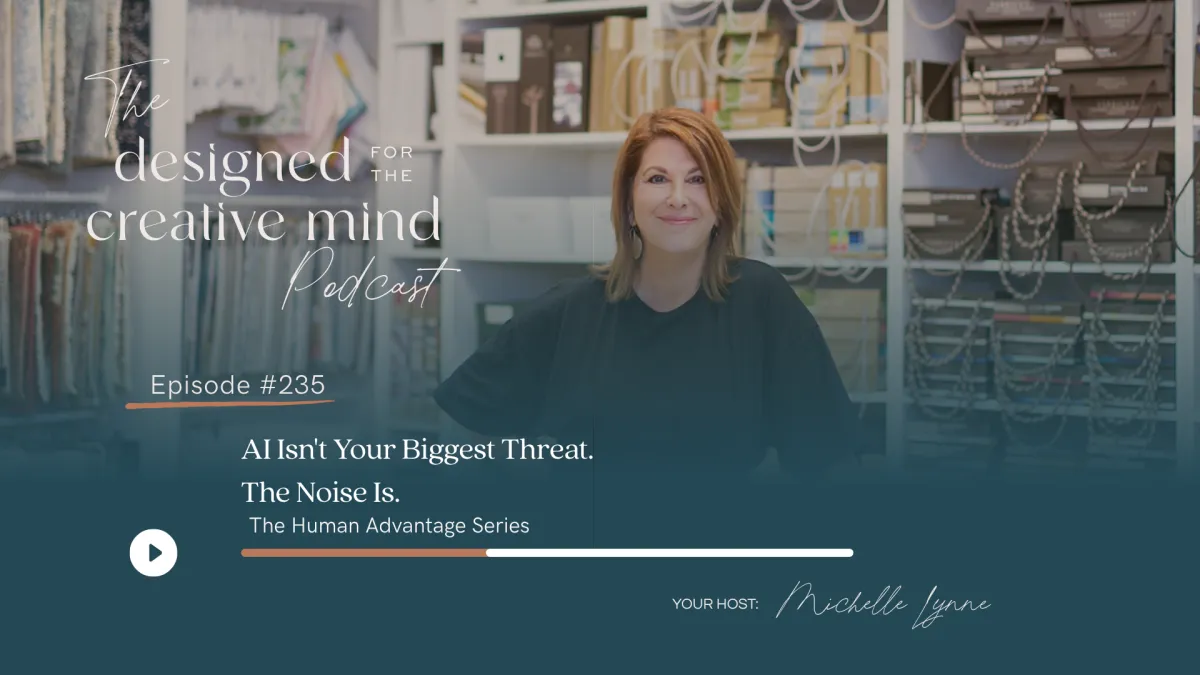
Ep 235: The Human Advantage - AI Isn't Your Biggest Threat. The Noise Is.
Episode Description
Everywhere you look, someone has a new opinion about AI and the future of interior design. One expert says AI will replace designers. Another says it never could. The constant stream of predictions, hot takes, and fear-based headlines can leave even experienced designers questioning their business.
But what if AI isn't actually the problem?
In this episode, Michelle Lynne explores why the biggest threat to your business isn't artificial intelligence—it's allowing industry noise to distract you from strengthening the fundamentals of your own firm. She breaks down what AI has actually changed for clients, what it means for design businesses, and why clarity around your positioning, pricing, and process matters now more than ever.
If you've been feeling anxious about where the industry is headed, this conversation will help you separate fear from fact and refocus on what truly moves your business forward.
In This Episode, You'll Learn:
Why AI isn't replacing established interior designers—but it is exposing weaknesses in some business models.
How AI is changing client expectations before they ever contact a designer.
Why education has become an even more valuable part of your sales process.
The biggest pricing mistake designers make when using AI tools.
How to differentiate yourself when AI can generate beautiful concepts in seconds.
The difference between reacting to industry noise and making strategic business decisions.
The questions every designer should ask to evaluate the health of their business.
Key Takeaways
AI has changed the client journey.
Today's clients often arrive with AI-generated inspiration, stronger opinions, and more visual references than ever before. That doesn't replace your expertise—it simply changes where education happens in the relationship.
Faster work shouldn't mean lower profits.
If AI allows you to complete design work more efficiently while you're still charging hourly, you're actually reducing your earning potential. Efficiency increases value—it shouldn't decrease revenue.
Your real competitive advantage isn't your deliverables.
AI can generate beautiful presentations, but it can't replace experience, judgment, project management, vendor relationships, or the trust clients place in an expert to guide a complex renovation from beginning to end.
Don't let fear drive your business decisions.
Instead of obsessing over industry headlines, evaluate your own business. Strong positioning, profitable pricing, and clear processes will always matter more than the latest AI prediction.
Memorable Quote
"Stop letting the industry conversation set your emotional temperature. You're not the thermometer—you should be the thermostat."
Connect with Michelle Lynne
If today's episode made you realize your challenge isn't AI—it's gaining clarity around your pricing, positioning, or business model—Michelle's private coaching is designed to help you build a stronger, more profitable design firm. Learn more at The Design Bakehouse.
Enjoyed the Episode?
If this conversation resonated with you:
Leave a review wherever you listen to podcasts.
Share this episode with another interior designer who's feeling overwhelmed by all the AI conversation.
Subscribe so you don't miss next week's episode on why hourly pricing has become even more problematic in the age of AI.
Transcript:
MICHELLE LYNNE (00:00)
Hey y'all, welcome back to Design for the Creative Mind. I'm Michelle Lynn and this is episode two of our series on AI and the design business.
If you haven't listened to episode one yet, you might want to go back and start there. We talked about what you're actually selling, and that conversation sets up everything that we're doing in this series. So today I want to talk about the noise. Okay, because there's a lot of it. And I think it's costing designers more than we realize. And it's not because AI is taking anything from us, but because the constant intake of industry opinion it's pulling our attention.
And it's pulling our attention away from the one place that it actually needs to be, and that's our own businesses. So that's the point of this episode. Stop letting the noise make decisions for you. Stop letting it scare you. Because everything outside of your firm, it's loud. And none of it is specific to your clients, to your fees, or what's actually happening inside of your business.
Do we need to be aware of it? Absolutely. But the designers that I see struggling right now are not struggling because of AI. It's because they were already on shaky ground. Okay. And the noise just gave them something external to point at instead of looking at what they were doing in their own backyard, okay, or in their own business. So we'll come back to that. But first, let me tell you what's actually going on out there and how to think about it without losing your mind.
So my feed has been relentless, and I'm guessing that yours has been too. And what I mean by that is that people are saying AI is going to replace designers. AI can't replace designers. Here are 17 tools that you need right now. Here's why those tools are overhyped. Here's a designer who transformed her business using AI. And here's a counter-argument about why AI generated spaces are soulless, and clients will eventually see that.
And on and on and on every single day. Admittedly, for a while, I was I was reading all of it. Okay, I was listening to all of it. I was trying to, I was trying to form my own opinion. I was trying to stay informed. I was trying to figure out what was real versus what was just clickbait, right?
But at some point I just had to stop and ask myself whether any of it was helping me make better decisions as an interior design business owner. And the answer was no. What it was doing, maybe it's doing this for you too, it's keeping it was keeping me reactive and anxious. I mean, I was constantly processing somebody else's take on a situation instead of paying attention to what it was actually happening in front of me. So that's we're gonna do something a little different today.
We're going address two questions. One is what has this actually changed for your clients? And two, what has it actually changed for your firm? Because right now, those are the only changes that are going to affect how you operate. Everything else you can read on a Sunday afternoon as you're scrolling. Okay, but it does not necessarily need to scare you or really.
I don't want to say it shouldn't impact your decision making. It should, but it should you should not be operating from a place of fear.
So what this means for your clients is that, I mean, the most concrete shift is that they now have fast, cheap access to visual ideas. Okay, outside of Pinterest and Instagram and house and all the all the places that we've traditionally gone. Because now what they can do is they can upload a photo of their living room, type in a style description, and have something that looks like a mood board, okay, or a rendering in some instances, apply in less than a minute.
And I think I said this last week is that some of them are actually doing this before they'll ever even reach out to a designer. Okay. They've been doing it for weeks before the first call. So what that means in practice is that clients are showing up differently. They're they're they're they're reaching out to us a little bit more opinionated. Okay.
These and these opinions are more formulated, more visual and more specific, but that can actually work in your favor because a client who has done some exploration might have a clearer idea of their directions and make decisions faster. Okay, but it could also mean that you're walking into a meeting who's somebody who's convinced that they already know exactly what they want based on the images that actually may not.
Be realistic to their actual space, their actual budget, or getting anything built or delivered right now. Okay. So the recalibration piece has always been a part of our job. Client wants this, what they really need is this, they want to pay for that. What they really can afford is this. So, I mean, we've always been juggling a lot of this, but it's just a little bit more front-loaded now.
Because the clients who generated 100 AI concepts before calling you, they might just need a little bit more time and a little bit more education earlier in their in your sales process and the conversations before they're ready to actually hear what you have to say. Okay, so so knowing this is going to affect how you structure your conversations in those the initial consultation.
the the the discovery call. Okay, it's it it it could change how you what you cover in your onboarding.
And how you're pricing that early phase of the relationship, this discovery aspect of it. Because the education and the cali calibration work it has real like real value. A lot of designers are giving it away for free in their in their free consultation.
So the other shift that impacts our clients as well is that they have more reference points for what things cost. Doesn't mean they're accurate, but now they can find products online, compare pricing, look at retail options. Okay, again, this is nothing new. Clients have always been able to Google things. Remember when Google Lens came out, we're like, my gosh, we're all damned. But you know.
It didn't it didn't crush us all together. Okay. But the ease of finding these things, it's it's it's increased. Okay. So what meant that your conversation about working and and providing access to the trade vendors, to the trade vendors, okay, and your fee structure. Now, y'all, if it hasn't been deliberate before, it needs to be deliberate now.
Not defensive, just like very specific. You need to be able to explain clearly what your access to the trade vendors gets them that retail doesn't, what your vendor relationship means when something arrives damaged, what your procurement process protects them from. If you cannot explain that clearly, that is the immediate gap to close.
Okay, and it's not because AI opened it. It was probably already there. But what AI is doing is it's making it more visible.
And it's probably what's keeping you awake at night because something just feels a little hinky and you can't quite put your finger on it. So
I want to now we talked about what this means for our clients, but what this means for your firm now is that the tools that we have available as interior design firm business owners, like the as designers, the tools have greatly expanded. Okay, as a business owner, we have tools that we can use in AI. As designers, there are tools that we can use from AI.
So parts of the work, so many parts of the work can move faster. Now, I'm not gonna get into specific tools, okay, because hell, by the time this publishes, the landscape might have already shifted. And what I'm gonna say, what I would, what I'm using today might be outdated. And yeah, by the next week or two. But what I want to talk about now is what's happening to your business model as a result.
Okay, because this this little AI series is not about the tools. It's about the business impacts.
Of AI. So if you're using tools that help you work faster, think about this. If you're using tools that help you work faster, but you're still billing by the hour, okay? So let's say the tools are your design tools, not your administrative tools. If you are using design tools that help you work faster through AI and you're still billing by the hour, babe, you are earning even less per project than you were before.
The more efficient you get, the less you make. I have been preaching this concept ever since I drank the Kool-Aid for the value-based fee. I have been preaching that concept and it has gotten even more impactful with AI.
Okay, we're gonna talk about the pricing model because it's a pricing model problem, not a technology problem. Okay, this was always going to come to the surface. It's something, like I said, I've been preaching this forever. It's just really at the forefront and slapping us in the face right now. We're gonna talk about the pricing model problem. I think probably in our next episode. I'm still outlining that, but I think that'll be our next episode. But the other shift, the other shift.
is the competitive landscape at the lower end of our market.
The other shift is in the competitive landscape in the lower end of the market. And what I mean by that is that the barrier to entry for certain type of design services, okay, the barrier to entry has dropped.
To be a designer who couldn't have put together a polished looking concept package a few years ago can now produce something that looks really, really credible and badass right now.
So if but if your value proposition was mostly centered on the deliverables, okay, the concept deck, the selections, the design presentation.
You're gonna be the ones who are feeling the pressure.
Designers who are competing on experience, judgment, relationships, the ability to manage a complex project from start to finish, their pressure looks different. The clients worth working with, in my opinion, okay, the dream clients, they are not going to be handing a rent a renovation project to Chat GPT.
or any of the other any of the other AI tools. Okay, let's just call it a an app. They're not going to be handing a renovation project to an AI app. They're going to hire a human being that they trust to shepherd the whole thing. Okay, like a Sherpa taking you up the Mount Everest of Interior Design.
But the question for you is whether you are positioned clearly enough for those clients to recognize that you are the designer for that. And that positioning, that question has nothing to do with artificial intelligence. It's a positioning question, a clarity question. This is part of your sales and marketing. This is part of your brand.
So I said at the top of this episode that the designers that I'm seeing struggling right now are not struggling because of AI. Okay, I want to come back to that. Because I think that that is one of the most useful things in this episode. If you're anxious right now, I want to ask you this. Is it because AI is genuinely threatening your specific business and your specific clients?
Or is it because there were already some soft spots? Fees that weren't quite holding? Positioning that's a little fuzzy? A business model that works okay when things were easy but does not have a lot of structure underneath it?
I always say that the every project is different, but the process should be the same.
So, what's going to happen is that the noise in the industry about AI is making those soft spots probably feel more exposed. So, I'm not saying this to be harsh. I'm asking because these are two completely different conversations, two different problems with two completely different solutions. If it's the first issue,
We need to talk about strategy. If it's the second one, and in my experience it usually is, then the answer is to stop reading those think pieces and start looking at your own business. You're listening to everybody else's advice and they don't even know your problem. Okay, what are your actual margins on projects? What are you charging for and what are you giving away?
Do you have a clear process that clients can see and understand and feel confident in? Can you articulate specifically what working with you versus another designer can do for a client that they can't get somewhere else?
So the designers who are not rattled right now have these answers. Not because they figured out AI before everybody else, because y'all, we're all still figuring out AI. Even the experts cannot keep up with how fast AI is changing and developing. Okay, but the designers who are not afraid right now, they were already running clear, deliberate businesses.
Their fees reflect their value, not just their time. Their process is visible. The clients understand what they're paying for and why. So when something external came along and pushed on us, the industry, I mean, gosh, it's pushing on every industry, but let's we're talking about designers, right? When something external came along and pushed on our industry, it didn't push on them because they weren't, there's nothing soft.
To push against. Or there's not very much that's soft. Let's let's admit it. None of us are running a perfect business. Okay, but that's what we're working towards in the series. And it stops by stopping the noise just long enough to look actually at what's in front of you instead of just all of the, all of the, again, it's just noise. All of the noise out there.
So if you're sitting here listening, okay, Michelle, that's fine. What do I actually do? Well, yeah, I can't tell you exactly what to do. Well, actually, I can. Okay, but but that's a whole other conversation about coaching. But here's how I would think about it. First, take an honest inventory. Okay, not of your Instagram, not of your portfolio, of your business. Are your fees covering your real costs? Do you know your margins?
Can you explain to a prospective client in plain language what you do that they couldn't get from a cheaper option? If any of those questions make you uncomfortable, then that's useful information. Pay attention to it.
And it probably doesn't have anything to do with AI. Just saying.
Second thing to do is stop letting the industry conversation set your emotional temperature.
You are not the thermometer. You should be the thermostat. You set your own emotional temperature. You can stay informed without being reactive. Read what's useful, scroll past what's noise, close the tab, and get to work on your business. The designers who are going to come through this next few years, the ones who come out well are the ones who stay focused on their own house.
And finally, this connects to everything we talked about last week. Get clear on what you're actually selling. If your positioning is still centered on a pretty living room, a new build, like the deliverables, now is a good time to shift that. And it's not because AI is forcing you to, because it's always the stronger move. And now you have a really clear reason to do so. So if you were just, you know, making it along, things.
Fine. Well, they're not going to be fine forever if you don't make some changes. So here we go. If you're listening and you realize that the issue isn't the tools, it's clarity. Okay, so we're talking about clarity on your positioning, on your fees, your value, how you're talking about yourself to prospective clients. That's a conversation that I have with designers in private coaching. It's not a program, not anymore.
It's not a course with modules to work through on your own, although I do share some content with you through a virtual portal. Okay, but but this is a direct conversation specific to your firm. I joked earlier that I don't have the answers for you, but I for you, when we sit down and we look at who you are, what makes you a badass, where you're positioned, like this is specific to your firm, your pricing.
your margins, like let's take a look at what's actually going on inside of your firm. If that's where you are, come and find me at the designbakehouse.com. Okay, just click on the private coaching tab. We'll get you all hooked up.
But for all of us, stop letting the noise frighten you.
Or make decis or and and make you make decisions out of fear.
We need to look at how this is impacting you. That's what I want you to walk away with today. Because these AI conversations, y'all, it's gonna keep going. It's gonna keep going. And it's gonna get a lot. It's gonna be, it's gonna get a lot. There are going to be more. There's gonna be more content. I call them think pieces. Okay. More predictions, more opinions. Some of it's gonna be useful. Most of it won't.
I mean I can tell you as a as a as a creator of content
The more clicks you get, then it helps you become more visible. So when you see these titles that are like AI is gonna be the doom of interior design industry or or or the questions in the in the forums or whatnot, you can read everybody has a different opinion.
But none of it knows your clients, your market, your fees, or what's actually happening in your specific business. You do, babe. Trust it. Go and do the work that's actually in front of you instead of living in fear or anxiety. Okay. Next week, we're gonna get into the fee structure. Specifically, why Hourly has always had problems.
And why the current moment has made those problems like impossible to ignore and what to do about it. I envision it to be one of the more direct conversations in the series that I've that I'm creating.
Think it'll I think it'll work really well for a lot of you. So join me next week. Thanks for being here. if you would please leave a review wherever you listen to this podcast. Okay, that helps the visibility. Share it with a designer who's caught up in all the noise. Okay, I'll see you next week. Of course, I always want to thank you for spending time with me.
If something in today's episode landed, hit ya, resonated. This is the kind of conversation that our industry needs to have. So I'll be back next week. And until then, keep building something worth owning.
