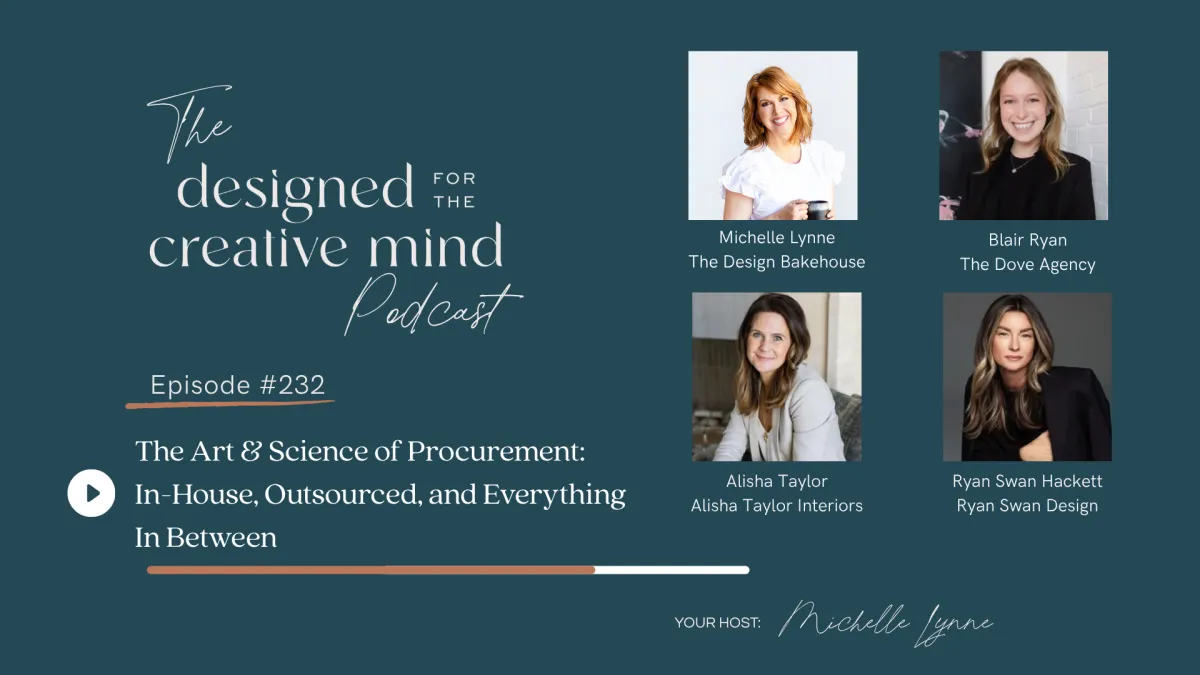
Ep 232: The Art and Science of Procurement - In-House, Outsourced, and Everything In Between
Episode Summary
Procurement can either elevate the client experience or become the biggest bottleneck in your business. In this candid roundtable discussion, Michelle Lynne sits down with Alicia Taylor of Alicia Taylor Interiors, Ryann Swan of Ryan Swan Design, and Blair Ryan of The Dove Agency to talk about the realities of procurement in interior design firms.
From in-house teams to outsourced solutions, these powerhouse women share how they manage procurement, communicate with clients, charge for their services, and avoid costly mistakes. Whether you're a solo designer or leading a growing team, this conversation will help you create a procurement process that supports both profitability and exceptional client experiences.
In This Episode, We Discuss:
The different procurement models designers are using today
The pros and cons of keeping procurement in-house vs. outsourcing
How firm size and market influence procurement decisions
Why clear processes and communication are critical to success
The importance of creating seamless client experiences during procurement
How regular client updates reduce stress and build trust
Common areas where procurement processes break down
The connection between procurement and bookkeeping—and why it matters
Why every designer should be charging a procurement fee
Various ways firms structure procurement and installation fees
How to communicate procurement fees to clients without pushback
Mistakes designers make when scaling procurement operations
The systems and software that keep procurement organized and profitable
Why specialization within your team can reduce costly errors
Key Takeaways:
✨ There is no one-size-fits-all procurement model. The right process depends on your market, team structure, and business goals.
✨ Procurement isn't just "placing orders"—it's an ongoing service that requires communication, problem-solving, and project management.
✨ Consistent client communication is one of the most important elements of a luxury client experience.
✨ If your procurement team and bookkeeping team aren't communicating, you're likely losing money.
✨ Designers should be compensated for procurement work. Failing to charge for procurement means leaving money on the table.
✨ Systems, processes, and clearly defined roles are essential as your business grows.
Memorable Quotes:
"It's death by a thousand cuts if procurement and bookkeeping aren't talking." – Blair Ryan
"Designers design. That's where the money is made." – Michelle Lynne
"No one really wants to see how the sausage is made." – Alicia Taylor
Connect with Our Guests:
Alicia Taylor Interiors
Instagram: @aliciataylorinteriors
Website: aliciataylor.com
Ryann Swan Design
Instagram: @ryannswan
Website: ryannswandesign.com
The Dove Agency
Instagram: @thedoveagency
Website: thedoveagency.com
Learn more about an upcoming in-person event:
The Art of Being the Principal: Be In The Room Event
If you enjoyed this episode, please share it with a fellow designer and leave a review. There are plenty of ugly houses for all of us!
Transcript:
MICHELLE LYNNE (01:03)
Hey, hey, hey, welcome back everybody. This is Michelle Lynn with Design for the Creative Mind, and I have another group of powerhouse women. Today we're going to be talking about how procurement shapes the client experience. Like literally, is it a white glove experience or is it a bottleneck? So it's all things procurement. Let me introduce my lovely guests. I have Alicia Taylor with Alicia Taylor Interiors. I hello, so good to have you.
Alisha Taylor (01:28)
Hello.
MICHELLE LYNNE (01:31)
Ryan Swan with Ryan Swan Design. Hello, so glad you're here. And Blair Ryan with the Dove Agency. So glad you're here. So, for those of you listening, the way we have gotten to know each other is we I was I had the pleasure of moderating a panel at High Point. We were at the phasey showroom and that was just this last spring, right? Was that spring or was it it was, yeah.
RYANN (01:35)
Hi.
Blair Ryan (01:40)
Everyone.
Alisha Taylor (01:43)
you
MICHELLE LYNNE (01:59)
I don't even remember what yesterday was. So we had such a great time. We had such a great time. We are bringing the show on the road. Or actually, I guess we're taking it off the road and we're going virtual. So I know. Let's dig in, y'all. Let's start. Let's just ground the conversation right now and describe your procurement model just briefly. And what we'll do is we'll just start with Alicia and we'll
Alisha Taylor (02:09)
Ha ha.
MICHELLE LYNNE (02:23)
cruise around and describe like what are you doing in your firm. And actually let's also talk about how big your firm is, like how many people are on your team. Is it just you? Do you have 17 people? All the things.
Alisha Taylor (02:33)
Okay, thank you. We are a team of eight. We are in Scottsdale, Arizona, so you know kind where our market is and primarily do work in Arizona.
For our procurement model, we have an amazing in-house gal. Our office manager does all of our procurements. And so we have decided to keep it in-house to kind of control it and to oversee it a little bit more closely with our clientele and have it as personalized as it needs to be. So that's how we've chosen to take procurement.
MICHELLE LYNNE (03:06)
Fabulous.
And Ryan, tell us about your procurement model.
RYANN (03:09)
So we are a team of four based out of Greenwich, Connecticut. And ⁓ we have a varied procurement model, so we do some of our smaller procurement in-house. and then for our larger jobs, we actually partner with the Dove Agency and Blair's team and they will run our procurement model through their employees.
MICHELLE LYNNE (03:29)
Fabulous. Blair, tell us a little bit about how you're involved.
Blair Ryan (03:33)
Yeah, so the Dove Agency is a ⁓ boutique service provider for interior designers. We help designers nationwide with their bookkeeping and their procurement. So we are largely back office. We don't interact with clients, but we're here to support in any way. And for some designers, that looks like everything from entering items into their platform all the way through getting things ready for installation. And for others, it's
Troubleshooting, challenging things that they haven't run into before, just doing the order tracking. So it's a pretty big variety bag of the things that we assist with.
MICHELLE LYNNE (04:07)
Fantastic. Fantastic. And at ML Interiors Group, we've done both. So we generally are using the dev agency. I currently have a designer and a half right now. We have kind of repositioned ourselves and it just makes more sense for us to outsource it at the moment. And it's so nice to just be able to pick up the phone and call Blair and say, Girl, I need some help. See on but yes, onboarded this e easily.
Blair Ryan (04:30)
What we're here for.
MICHELLE LYNNE (04:33)
Okay, so let's go back to when you made the decision, like what whether whether you were going to build it in-house or outsource, like what problems were you trying to solve at the time? And this is just a conversation, so we're not gonna call on anybody, like just pipe in and we're just gonna have fun. Just like when, just like when we were on the panel. So
RYANN (04:54)
I'll go first
since ours changed, so I was running in-house and our projects are very varied. So we do hospitality retail as well as residential. And we were doing a project in Canada, and the thought of trying to figure out how to get items over the Canadian border and managing all the logistics in-house would in addition to running and designing all of our jobs was just overwhelming. And I had been partnering with the Dev agency for a while, they do all of my
my bookkeeping and back end financials. So I knew that this was a service they offered. We had a quick call to kind of talk about what I was looking for and it was a really seamless process for me. You know, they dealt with all the sales tax implications and helped me find a truck to get everything over the border.
Were damaged, which they always are. They helped me solve that. So it's really been a value added, especially since we work in such different markets with every job. You know, we just did a job in Naples, and I don't know a receiving warehouse in Naples. So they were able to do research and recommend a few for me to select from. And ⁓ you know, they don't know this, but we have four trucks of items coming over the border from our Mexican fabrication facility that they're gonna help me get to the East Coast in a week. But
MICHELLE LYNNE (06:04)
Ha ha ha ha ha.
Blair Ryan (06:05)
Love it. Ready for
it.
RYANN (06:07)
So it's definitely nice to lean on them as a problem solver, especially in the more complex jobs.
Alisha Taylor (06:07)
you
MICHELLE LYNNE (06:13)
Right because you're trying to run a business.
RYANN (06:15)
Exactly.
MICHELLE LYNNE (06:15)
That is fantastic.
That is fantastic. And Alicia, you kind of touched on it in regards to the fact keeping it in-house so that it felt a little bit more under your control and and and clientele. But when given the option to outsource it, like what what were you thinking through? Like what were some of the pros and the cons?
Alisha Taylor (06:32)
So I
think some of this is a little organic. As many business owners know, you grow and you're shifting constantly. We had always done procurement in-house, and that's going to date me a little bit, you know, over 25 years. Just that's how it was always done before, before a lot of these firms and services came to be. I like it.
MICHELLE LYNNE (06:36)
Mm-hmm. Yeah.
So you started your business when you were what, twelve, fifteen?
Alisha Taylor (06:59)
So we've always done it that way and as I grew and the team grew, we just continued to keep it in house. Now where we may be different than someone like Ryan's team is all of our projects are pretty much right in our own markets. We aren't having to figure out different sales tax.
MICHELLE LYNNE (07:02)
Mm-hmm.
Alisha Taylor (07:20)
States and places and over the border and that and so the personal touch that we can offer in person literally And to be there and our clients have met these gals in the office throughout the design process and it's It has really been a really cool process and I think my light bulb moment to keep it in house was Listening to people smarter than me and my industry teaching me about how to run a business
is going into a procurement fee and charging for this. Because for years I didn't. It was just something we designers do. ⁓
MICHELLE LYNNE (07:51)
Right.
Yeah.
Alisha Taylor (07:57)
And that actually opened my eyes because I had the right people on staff and now it can help justify paying for their salary here. And our gal who does procurement, who's incredible, also handles all of our marketing. She keeps this office running so smoothly, you know, and half if not all of her salary is completely taken care of by our procurement fee. And we benefit on so many other layers from her.
And so for us, the timing, the implementing of that procurement fee to be able to play with that fee internally. Obviously you do that procurement fee, then you can take it into like, you know, other agencies and have that help that way. But for us, she's kind of like this amazing jack of all trades and does so much for us that
MICHELLE LYNNE (08:37)
Mm-hmm.
Yeah.
When you find
that unicorn, you definitely want to keep her busy. Yeah.
Alisha Taylor (08:56)
Exactly.
And so that's where I saying it was more organic. It wasn't like I had this master plan with a checklist of how we're going to keep procurement perfect. this is, you know, it's more the people that were already here made the most sense for us. Now, I always encourage business owners don't look at how we do things as like, I have to copy that because every business, every market is different. If
MICHELLE LYNNE (09:19)
So true.
Alisha Taylor (09:22)
let's say she leaves this company, ⁓ you better believe I'm going to look at all different models. ⁓ And so I think that's most important as business owners is just what works for you. There's no one right way. And we're going to be talking through this whole thing about all these different ways of doing it.
Blair Ryan (09:28)
Right.
MICHELLE LYNNE (09:39)
And I
was just gonna ask Blair, from your vantage point, like where where do you see the things that are working versus maybe where things break down between either doing it in-house or outsourcing or a combination of both? It sounds like Brian, you do some of the smaller jobs in-house and some of the larger ones you like what do you Blair, what do you I'd love to hear some of the stories over some cocktails.
Blair Ryan (10:01)
We have we have ⁓
RYANN (10:04)
Ha ha ha.
Blair Ryan (10:05)
We have a kind of a a full range of clients. So we have a sole proprietor where they're the person who's handling it all. And they may not have the volume to justify having someone full time on staff or just not have the workload, even in adding some of the marketing and different things. And so we're a stopgap so that they can take on more on their plate without paying a full time employee that they don't have the hours for.
MICHELLE LYNNE (10:30)
Right. That makes sense.
Blair Ryan (10:30)
And then on the flip side,
we also have where there are such large teams with so many things moving through it that we're an assistant to the in-house procurement person. And so we're handling maybe all of the online orders and they're handling all of the custom pieces. it I think where we add the most value is in the in-between stage of my businesses growing. I'm not quite at the point of having someone 40 hours a week.
It's difficult to find someone who's looking for limited hours and procurement ebbs and flows. Sometimes you are incredibly busy and other times you're not in an ordering phase. And so that's light work to be done. That's difficult when you have a in-house someone who you have on salary that you're paying ⁓ full time regardless of the work being done.
MICHELLE LYNNE (11:02)
Yes.
Mm-hmm.
Yeah, or even if they're hourly, you don't have enough hours for you don't want to lose
Blair Ryan (11:18)
Mm-hmm.
Right, exactly. So we're we're a good in between where there's no commitment but we're we're keeping things moving, ⁓ to fill maybe s slow periods but also really busy periods for other teams.
MICHELLE LYNNE (11:33)
And where do you see things going off the rails? Like in in my experience, a lot of it just comes down to standardized processes and a lack of communication because I mean, my mind reading skills kind of suck. So
Blair Ryan (11:45)
Mm-hmm.
Yep. Two places where I most see it. One is a baton path that's not clear. So who's taking over at what point? Whether it's your in-house team member, an outsourced solution, there has to be a clear point between the designers and whoever is handling your procurement to know whose role is overseeing which part. And that's on the front side of the process. On the back side, I see the biggest breakdown. If your procurement associate is not talking to your bookkeeping team.
MICHELLE LYNNE (12:07)
Mm-hmm.
Blair Ryan (12:14)
you're losing money, inevitably. You've got to reconcile the freight charges and the sales tax that you've paid and all the different pieces. And if they're not speaking with your bookkeeping and accounting team, you're losing bits and pieces throughout.
MICHELLE LYNNE (12:25)
And that adds up quickly.
Blair Ryan (12:26)
It does. It's death by a thousand cuts.
MICHELLE LYNNE (12:28)
Good way to put it.
Alisha Taylor (12:29)
I'll chime in. We use Dove a lot on the bookkeeping and big, almost like CFO type of strategy and then into the nitty gritty bookkeeping. And my procurement gal in-house has a clear communication with Dove. So even though we aren't using Dove for procurement services, there is...
MICHELLE LYNNE (12:49)
Mm-hmm.
Alisha Taylor (12:51)
a connection with bookkeeping and accounting, a direct connection between our in-house procurement person and just the bookkeeping arm.
MICHELLE LYNNE (13:01)
Well, and shout out to Dove. This is not a commercial forum, but I just speaking from experience, although maybe I could get a a little bit of an advertising fee. ⁓ anyway, but one of the things that I think is so valuable is when you have a bookkeeper who understands our industry. Like you cannot just hire some random bookkeeper off the street, no matter how good they are. There's a lot in this industry that is so unique. Like so unique. Funny story, y'all. I had didn't tell you this.
RYANN (13:05)
Ha ha
Blair Ryan (13:09)
Ha ha ha.
MICHELLE LYNNE (13:29)
in a previous life, I used to place accounting and financial professionals on projects. That was I I used to be the sales manager for a recruiting firm. Okay, random. I know. The hardest position for me to fill when I started my business, the most turnover, the freaking bookkeeper. So it was ironic that I could hire for everybody else, but to hire my own, I just thought it was another industry. No, this industry is.
Alisha Taylor (13:39)
I
MICHELLE LYNNE (13:55)
Challenging. Challenging. my gosh. Right.
RYANN (13:57)
It definitely is.
Blair Ryan (13:58)
From from the accounting
Alisha Taylor (13:58)
Yeah.
Blair Ryan (13:59)
standpoint,
interior designers, there's a part of your business that operates like a law firm, part of your business that operates like a manufacturing firm, part of it operates like a service. It's a lot of different pieces coming together, which can blow some people's minds when you get into the details of it.
Alisha Taylor (14:13)
Mm-hmm.
MICHELLE LYNNE (14:14)
Yeah, definitely. Mine mine included. okay, so each of y'all, how do you handle accountability when let's say issues arise, delays happen, let's say multiple vendors, you know how it is, it's kind of like it just all starts to stack and domino. Like how do you let's say how do you relay that to the client? How do you navigate it internally?
Alisha Taylor (14:31)
you
MICHELLE LYNNE (14:37)
And I'm not talking about just, you know, going home and having wine. Like how does how does how do you navigate this? Because we all feel the pain.
RYANN (14:41)
Ha ha ha.
So for us with Blair and her team, what they do is every Friday, once we get into the procurement phase, they put together a tracking report, which they send to me ⁓ to have a look over to make sure I'm okay with it. And they are always if they're ever contacting a client directly, it's coming from an email address that I have set up for them that's an at Ryan Swan. You they're not emailing from at DevAgency. So they are an extension of my team and it's an email inbox that I can
Alisha Taylor (14:45)
I
RYANN (15:11)
respond from as well and it's more of like a generalized purchasing email box. But you know, every Friday they're putting together reports so we have an update on if anything's delayed, what's been received, if it came in damaged, and then once we review that, confirm that we're okay with them sending it, they will send it directly to the client and and then the client will have that information.
MICHELLE LYNNE (15:31)
All right. So what about you, Alicia? When you have these issues come up, you don't have a necessarily somebody sending you a report, you've got a right next door to you, probably within reaching distance.
Alisha Taylor (15:44)
I think procurement just as a whole, I'll talk first with client expectations and then I'll go kind of internally how we handle it.
Whoever speaks first is right is a line that I was taught by a business coach, which just means if the client has to call you and ask, hey, where do you think that sofa is? Should I have purchased it? my gosh, should we reselect? Now they're in the driver's seat. If you have a system or process to handle client expectations where you speak first, you tell them the expectations, you tell them the timeline, you tell them things that could go wrong before they go wrong. And then you only come with solutions.
So I think first of all just communication and always being the first one that speaks to the client. In procurement is everything. That is the difference between failure and success according to the client.
MICHELLE LYNNE (16:28)
Yes.
It's true though. I mean, think about the whole project just telling what they're what's coming next.
Alisha Taylor (16:40)
Yeah.
Yes, so now internally, you have to be super organized to do that. And so kind of like Ryan and Blair's system where it's once a week, we educate our clients on the very, very front end. You are gonna get an email from us every other Friday during the entire procurement process, even if that's five months of ordering furniture and waiting for their new house to be finished.
MICHELLE LYNNE (17:03)
Mm-hmm.
Alisha Taylor (17:06)
And it is a very organized kind of spreadsheet format table. It gets updated what's arrived to the receiver, if there's any delays. And then if there's anything she needs to personalize or educate them. Otherwise, all we're trying to communicate is you're in good hands. If you need the details, dive further.
MICHELLE LYNNE (17:27)
Mm-hmm.
Alisha Taylor (17:29)
And it's consistent, easy to read, and it goes like clockwork every other Friday until the very last delayed in table gets dropped off.
MICHELLE LYNNE (17:39)
my gosh.
my gosh. So I'm curious, how much detail are you giving your client? Like are you so are you so I hear that there's a table. Is that just internal? Or are you sharing that with the client saying, hey, you've got 137 items that we've placed an order for? This one came in this week. This one came in this week. This one's back ordered until like
Alisha Taylor (17:45)
I'm not a liar.
Stop!
So we
keep the format almost similar to the proposals that we're doing in the studio where we say, because they're approving those big bulk items for us as a firm, we accessorize and stylize and that's kind of separate. So it's the sofa, the rug, the chair, you know, those kind of items.
And that's how they've seen the pricing of each item. That's how they saw it on their proposal. That's how they approve the whole proposal as a whole. And so we just combine those items on a quick little table. And it's just like a couple more. It's like room, sofa.
You know, it may be sofa with seven designer pillows in this fabric and this frame. That may have appeared on the proposal, but for just the tracking, it's a very simple table where it's room underneath that room, the item. And if it's in production, it's like a few options in production, in route to Arizona, received damage, received great condition until everything kind of says,
MICHELLE LYNNE (18:43)
Procurement.
Right.
Alisha Taylor (19:02)
ready for install or ready for and so it's super simple simple table that then just get update so it only takes a couple minutes to just update whatever's happened in the last two weeks and the format is the same so they they just know what to expect with a little we try to limit it to maybe four sentences at max if there needs to be any little personal updates or notes with it
MICHELLE LYNNE (19:04)
Awesome.
RYANN (19:08)
Yeah.
MICHELLE LYNNE (19:14)
Gotcha, gotcha, gotcha.
makes
sense. And what about you, Ryan? How much detail are you sharing with your clients?
RYANN (19:31)
It's probably even more minimal than that. It's, you know, received, received damaged, shipped, ordered. I think those are kind of the main buckets. And there are moments where we let's say we order for some something from Creighton Barrel and
it's damaged and we've got the notification that we have new ones coming, we will sometimes omit that we have received a damaged version of it. Because I do find that sometimes clients who don't know that sixty percent of the things you get are damaged at some point very stressed out about that. So if we know it's a quick fix for us or there's a little nick on it and we're gonna have somebody come touch it up so that it's
Good as no. ⁓ we'll sort of just keep that off of the receiving report and fix it. which I think sometimes is helpful. The less you know.
MICHELLE LYNNE (20:15)
Yeah, absolutely. Yeah,
true. When we do it actually, so it's interesting. We went from a little bit of detail to a little bit less detail. And then we're just like, we're on track. You don't need to know about anything. Like literally every Friday. It's like, okay, we're on track. We're still good for this particular installation date. Or hey, by the way, this got bumped. It's probably gonna I'm probably gonna have to run the lamp out after installation or whatever the case may be.
RYANN (20:26)
Ha
Blair Ryan (20:28)
Okay.
Mm-hmm.
MICHELLE LYNNE (20:43)
But
literally it's as we call it efficiently lazy. And we I I bits and pieces sometimes I'll ask a client, would you want to see the information? And our feedback for our firm has truly been, no, I don't have time. I'm trusting you to handle it. Like, okay, not a problem. So that's been nice for my team.
RYANN (20:47)
Yeah.
Yeah, that's a lot of the feedback we get too. And I think in reality you're delivering we're all doing a luxury service for our clients. And the luxury service I think is in like the security and knowledge that if the lamp is damaged, then you're gonna fix it for me. And I don't have to even think about that. So I think there's some beauty in doing it behind the scenes. but I did have one client recently who we we had when we installed there were some damages that were not noted.
receiving warehouse. So we added that and he was surprised that there were two things out of 125 items that were arrived. And it was really small things, but for me it was more than I could handle. So I flagged them. and he was like, I can't believe that two things came damaged. And I was like, 40% of the goods that were received into your home were damaged at some point. Like you have no idea no idea. So there's some like there's some beauty in that to know that you've given that to a client and they've been able to sleep at night.
MICHELLE LYNNE (21:54)
and w
Alisha Taylor (21:54)
There's
a careful dance there though, because some of times our clients are wondering why they're paying a procurement fee if everything just comes magically and just shows up in their house. Yes.
RYANN (22:02)
Yeah.
MICHELLE LYNNE (22:06)
It's like Amazon, right?
Blair Ryan (22:07)
Well, that's what I was gonna say. The
retailers who all have free shipping skew it for everyone else because you have the freight and the receiving and all of these things that for some people is bundled into the cost of the item and happens behind the se behind the scenes, but it's here in their face for most of it, on on invoices in these documents. So explaining that can be difficult.
Alisha Taylor (22:13)
Hmm.
So I think with our little table, we've had the client feedback of everything from, ⁓ I never opened those. I'm sure my procurement gal's like, thanks, know? You.
MICHELLE LYNNE (22:28)
yeah.
Yeah.
RYANN (22:37)
Ha
ha.
Alisha Taylor (22:39)
⁓ once I read through, I could just see that things are damaged, but reordered and handled and being fixed. And she's like, I understand what you guys are really doing. And we've had that full gamut. So we've just kind of kept this very, very easy table, but almost just like no one wants to really see how the sausage is made. You know, we're not opening the doors to what this looks like behind the scenes.
Blair Ryan (22:46)
Mm-hmm.
MICHELLE LYNNE (22:49)
Mm-hmm.
Yeah.
Yeah.
Alisha Taylor (23:06)
For us, it's like, need to give them just enough to justify that fee so they know, oh yeah, that's right. All that money is going to handling the chaos behind the scenes.
MICHELLE LYNNE (23:19)
Amen to that. And I'd like to point out as well for our listeners, it's, you know, as a business owner, I just wish there was one way, right? Just tell me how to freaking do it and I'm gonna do it. But here we are, three business owners, and then Blair, who sees all sorts of business owners, and we all do it differently, right? So finding a way that works for you and your clients, I think is the key. There's no wrong way per se.
MICHELLE LYNNE (23:49)
Hey y'all, I want to tell you about an event that Katie Decker -Erickson and I are doing this August in Dallas. It's called The Art of Being the Principal, Be In the Room, and it's a one-day immersive for established interior design firm owners. Over the years, I've noticed something, and that is that most designers don't have a design problem, they have a business problem. The work is beautiful, clients are coming in, projects are moving forward.
But behind the scenes, they're just carrying too much. Every decision runs through them. Every question lands on their desk. Revenue is growing, but profit isn't always keeping pace. This is not a conference about trends, social media, how to get more followers, how to price. It is actually a room where we are going to talk about the real business behind the beautiful work: sales and marketing, operations, profitability.
And what it actually takes to build a firm that doesn't depend on you for everything. We're limiting the room, and this is for established design firm only. This is for established design firm owners only because we want real conversations, not a ballroom full of people taking notes and heading home unchanged. So if you've ever looked around your business and thought, there has to be a better way to do this, I'd love for you to join us. You can learn more and reserve your seat at my sidemark.com.
dot com forward slash room. Now, let's get into today's episode.
MICHELLE LYNNE (25:16)
Although I do want to talk about
charging a procurement fee, because there is a wrong way for that. Like if you're not charging a procurement fee. And I just did an episode, I don't I don't even know what number it is. We'll reference it in the show notes. But it was all about like first of all, cost plus 30% with no procurement fee. Like that's that's a whole thing. Plus like just in general using your like even if you're marking it up a hundred percent or so or whatever, but not charging a procurement fee.
Blair Ryan (25:21)
Yes.
MICHELLE LYNNE (25:45)
It's it's like let's let's talk about that. So Alicia and and Ryan and Blair, you see this as well. It's like th that's just leaving money on the table. Like I'm getting all worked up about that.
Alisha Taylor (25:54)
And that was my
aha moment. really. I went to IDCO's design camp years ago. I've been back twice now since too, just to get a refresher. But I was like, oh, oh, wait, I'm leaving so much money on the table.
MICHELLE LYNNE (25:58)
Yeah. Did your business coach teach show you that? Or is that just like a light bulb?
Yeah.
I love hearing that. Mm-hmm.
Alisha Taylor (26:18)
And it was, and I think too, because I've been running a business for so long that it was just like, we're just going, we're just going.
MICHELLE LYNNE (26:27)
That's
the way it's always been done.
Alisha Taylor (26:28)
Yeah, I mean, we're talking, well, yeah, date me, thanks, but we're like, we're talking back in the day. Back in the day, it was just a little bit of like a cost plus model. Designer handles everything in that number.
MICHELLE LYNNE (26:41)
Right?
Alisha Taylor (26:41)
And
times have changed. There's so much more hand holding. There's so much more time that we're spending on projects than we did 12, 15, 20 years ago. And that time needs to be justified and paid for. And I just think that was my aha moment. Like, my gosh, I've kept up with the times with what we're doing, but I wasn't changing my business model.
MICHELLE LYNNE (27:05)
Mm-hmm.
Alisha Taylor (27:08)
to keep up with the amount of workload. so once that was, mean, and literally I came home from that camp, we charged a procurement fee, other than having to explain it to our clients from a value based discussion. We spend very little pushback and a pushback really just means, just means it's an opportunity for me to sell our value. So boom.
MICHELLE LYNNE (27:23)
No pushback.
And then
to know that it's not just put it in the cart, check out, and then deliver it. Like here's all the things that go into it.
Alisha Taylor (27:38)
Yeah.
And so procurement fee, and we're dealing with big, newly constructed homes. Our average, I'll just share with people so they understand numbers. Numbers is another thing that is different for every firm. So our average furniture client, or our average client is spending $350,000 to $500,000 on a furniture package. have big houses out in the desert. We charge 8 % of whatever your product total.
Cost is on your proposal for procurement. It shows up on that proposal from day one. It's in their contract. We talk about it. It shows up on the actual proposal just as a line item after they see all of their products. So it's not an after the fact fee, which clients hate. Right after the end.
MICHELLE LYNNE (28:26)
Yes.
Alisha Taylor (28:28)
And so we do an 8 % procurement fee. then we also, just as a side note, also took our data and said, what do we need to charge for install, delivery, the art hang and the windows installer, the delivery trucks, the receiving, the storage, like all that hand holding, because clients don't understand how much that adds up to.
MICHELLE LYNNE (28:45)
Mm-hmm.
Yeah, it does.
Alisha Taylor (28:50)
And so we came up with a percent for our market, for who we use, for what makes sense to us, it's 12%. And so a client sees an 8 % line item at the end of the proposal and a 12 % line item with that amount at the end of the proposal. When they pay, they're basically paying for that, you know, and it's done.
MICHELLE LYNNE (29:11)
That makes sense. It's one invoice. So here's your proposal, you approve all of this, and then there's your invoice, boom, you get paid and you get on your merry way.
Alisha Taylor (29:19)
Then we need to just make sure things fit within that. There's been a project that we lost money on with that 12 % and most of them were, we're not trying to make money off of it, we're just trying to break even, but we're breaking even where it leaves us just a little cushion. Because you know what, you're constantly running back and forth to the project at that very end.
MICHELLE LYNNE (29:23)
Mm-hmm.
Right.
Yeah.
Alisha Taylor (29:44)
straggling pieces need to be delivered and in that way there's no like delivery fees or bills like trickling all the way through But so yeah procurement fee you have to have to have to
MICHELLE LYNNE (29:51)
That makes sense. That makes sense.
You have to charge. Yeah. Absolutely. Ryan, how are you doing it?
Alisha Taylor (30:02)
that like you're paying a design fee to design it and a procurement fee to procure it. And those are two different things and the scope for design stops and then the time for procurement starts. And clients love that explanation. They don't mind it at all. They just have to understand it.
RYANN (30:03)
⁓
MICHELLE LYNNE (30:10)
Mm-hmm.
Yeah, two completely different phases.
Mm-mm.
RYANN (30:21)
⁓ we are on a purely hourly rate, so all design work is hourly. ⁓ and then our procurement is billed hourly.
We have a lot of scope creep in our projects. So def we've I've learned over years that defining these more black and white terms makes that challenging. For instance, one minute ago a tile installer called me and he's like, I short ordered the tile, like I don't know where else to get a pencil tile. So I'm like, Hold on, and I filed like within ten seconds. So then that's not really something that I would have expected to need to procure.
But I had to help out so and we all need to get everybody needs to get job done. So, I that makes it just a little more fair, I think, in the end. So so that we're not out. Totally. Totally.
MICHELLE LYNNE (31:03)
And it's easy to explain to the client. Yeah.
RYANN (31:07)
And so that's been helpful to sort of set these, you know, we're we'll do, you know, if you need us to procure your plumbing fixtures or if your contractor's gonna do it, either way is fine for us, but you know, we have a compensation attached to that and we will charge our markup attached to that. And so it just it just helps for us to be a little more
loose with it just because every job is so different. And Alicia, I like admire your business model so much to have this like clear boundaries and how you guys run your things because I can imagine that it's like a lot more streamlined and we just, you know, for whatever reason find the crazies out there. So everything is Yeah. I love that.
MICHELLE LYNNE (31:27)
Mm-hmm.
⁓ I used to say that when I was single. that's too funny.
Blair Ryan (31:45)
Yeah.
Alisha Taylor (31:51)
But
I think it's different markets work differently. Like ours, all new construction. So we're not working around and there's no sense of history here and we aren't dealing with really antiques here. It's fresh, it's new. And so there is, it's really easy to define a scope where I could see a remodel or I'm moving from this estate to this estate and I'm bringing these pieces, but not these pieces. Like those are.
MICHELLE LYNNE (31:51)
So we
RYANN (31:54)
Yes. Yes.
Exactly.
Alisha Taylor (32:19)
So personalized,
so different project to project. We are like here in the desert, build it all new.
MICHELLE LYNNE (32:26)
But to your point that is so valid for anybody listening, it everybody's market is a little bit different. But also, like even when I'm coaching interior designers on the business of interior design, I have my structure that I teach, and this is how I run my firm, but it's not a franchise. So if we need to take it
A little bit this way or a little bit that way to work for your brain. Let's make it work for your mind. That's why this business, this why the podcast is called Design for the Creative Mind, because it's business designed for the creative mind. And at ML Interiors Group, we do it completely differently. Like we have a procurement fee, and I think we learned this from that where we take like a certain amount of time per item times our procurement rate, which is less than our design.
fee or if we had an internal hourly rate and and so forth, we charge it on a retainer. Because if there's a lot of problems, we're getting paid for it. If there's not a lot of problems, we reconcile at the end and we can write a check back if we need to. We do the same thing for the receiver. We send our proposal to the receiver without the the the without the pricing, but they're gonna see by however many cubic cubic feet and they give us a proposal
We mark that up twenty-five percent and we treat that as a retainer too. But when I first started my business, I thought, okay, well, if I'm providing the service of procurement, I'm gonna get paid for it. Right? Just completely blind. I had so many designers yelling at me, maybe not yelling, but saying, You can't do that. You can't do that. I'm like, bullshit, I can't. Like I'm performing like i if if I'm gonna be washing your dishes, I'm getting paid for it. Same thing.
Alisha Taylor (34:02)
Bye.
RYANN (34:02)
Ha ha ha.
MICHELLE LYNNE (34:03)
So in that regard, I just think that you have to explain it to the client that it's not point and click. And and Blair, what are you seeing? Like when when somebody comes to you guys and they're per they're they're asking for your procurement help, are you advising them y'all need to be passing this expense on to your client? Yeah.
Blair Ryan (34:20)
Yes. with the exception
of someone who has an estimate and has a flat fee that they're sticking to and we're doing our best to work within those bounds and communicate, you know, this is how many hours we think so that they're aware. ⁓ everything that we do is hourly. We encourage all of our designers to pass that along. If it were not Dove Agency doing the work, it would be the principal designer, someone on their team. So get credit for the hours that are being worked on your behalf, whether it's you working them.
MICHELLE LYNNE (34:27)
Mm-hmm.
Blair Ryan (34:47)
just like an employee would get credit for it as well. And I think with all of these things, the percentages and and hours and that talking with someone who is in the details of your books to make sure that they make sense, reconcile at the end of a project that you feel like is a good example to make sure that the percentages are lining up. If they're not, adjust it a little bit and catch it on the next go-around. the other piece that I stress is a principal designer's time
MICHELLE LYNNE (34:51)
Absolutely.
Blair Ryan (35:13)
and the value of their own time. If you look at the profit of a project at the end of it and take it by the number of hours that you, the principal designer, worked, is that aligning with the value that you expect yourself to have? And if it is, you're sitting in the right spot from a big picture. We could go in and talk about, you know, I wish you had $5 more on freight in this item and $2 less here in a larger markup. But truly it comes down to how much money came into your business and was it worth your time?
MICHELLE LYNNE (35:15)
Amen.
Blair Ryan (35:40)
with that, you know, saying yes to opportunities that make sense, turning down things that might not make sense, but that your value is adding up to what you want it to be.
MICHELLE LYNNE (35:41)
I love that. And
Well that and also realizing because early in my tenure as a designer, we were doing my designers, we were doing the procurement. And then I had that light bulb moment of duh, designers design. Like that's where the money's made. Designers procuring, just because it's a control thing, hire somebody to sit next to you. And then you can still control it. You don't have to do it. Just get it all out of your head into the system.
So hopefully, any of y'all listening in the audience, don't be doing your procurement. Call the Dove Agency or hire somebody. Right? So I want to kind of wrap this up on a little bit of fun. let's talk about mistakes that you've made in your procurement or just some fun stories that you might have. To leave it on a light note. Because I know we all, I know we all have the stories.
RYANN (36:20)
Ha ha ha.
Ha ha.
Alisha Taylor (36:38)
yeah.
MICHELLE LYNNE (36:38)
So and then also, yeah, and then I probably want so maybe the mistake that you made, and then it could be either a procurement tool or something valuable that you've learned along the way about procurement in general. So let's just kick that off. ⁓ I will say for my little nugget, the the mistake we made is letting is like having my designers procure.
Like, don't, don't, if you're a designer, if you have a team of designers, like I should have gone to the mat and said, too bad, you're not gonna do it. I know it feels like it's control, but it's it's costing us money. So that I think that was my biggest mistake. And then I will say that having the right tool to navigate your procurement is is huge. I I love the Dove Agency has ID Nest, and I've had the pleasure of taking ID Nest and white labeling it.
and building in my business processes in some of the modules and I offer that to my design audience as well. So like whether it's studio designer or I I can't even say the other one. Like the one that rhymes with ouch. Ouch. Anyway.
issues but I'm not gonna put it out there on a podcast. but what so whatever you're using, like just have a place where it's organized. God forbid it's not color coded. Like I love to be able to color code it so you can just see the red right away. But that that's my two cents. I'm done talking. Who's next?
Blair Ryan (38:03)
I have the accounting side as the former CPA is that I want to make sure you're reconciling your price changes. It's inherently built into Studio Designer. It's inherently built into IDNS. If you're not using something like that and you're in QuickBooks with another platform, look at the price that you were originally quoted by your vendor and actually look at what charged on your credit card because there's sprite, there's tariffs, there's a sale, maybe it's to your benefit, but reconciling those so that you can pass those along as needed to your clients.
MICHELLE LYNNE (38:06)
Uh-huh.
Blair Ryan (38:33)
Is important. On the procurement side, we are all guilty of I don't want to pass this to my client, and those pieces. So making sure that if you're giving them savings, if you're giving them any kind of credit, that you you take credit for it. Everyone loves the deal. So if you're discounting something, tell them that you're discounting it. if you are
MICHELLE LYNNE (38:51)
Mm-hmm.
Blair Ryan (38:54)
Taking time off of your time billing, making sure that they're aware so that you can build the goodwill in the relationship that you're sharing in this and you're just invested in in their home as they are.
MICHELLE LYNNE (39:04)
I love that. Yeah, just point it out on the invoice if you have to.
Blair Ryan (39:07)
Mm.
RYANN (39:08)
For us, I think a mistake that I made when I first started out was not putting a cap on the number of installs that we were including. You know, and we were at the time working on a flat fee, but you think even still, you know, when we're you have the we go we do an estimate for ⁓ installation and receiving in advance. But you need to spell out like they're not gonna be here every week delivering like one side table for this same fee. So now our contract says, you know, we'll be there for two a maximum of two installs after that.
We gotta look at what's going on here. So I think that was really helpful language to add in.
MICHELLE LYNNE (39:40)
Mm-hmm.
That's that's genius. Yeah. And especially if even if you but even if you are working on an hourly basis, it's you still have Yeah Yes. Absolutely. Absolutely. And are you working on a ⁓ on a any particular tools or anything that you can't live without?
Alisha Taylor (39:46)
Totally.
RYANN (39:52)
Yes, at some point you gotta cut the cut the ribcord.
Alisha Taylor (39:57)
Thanks
RYANN (40:05)
We use studio and it's been pivotal for us. ⁓ it just anybody who wants to hop in and look at it, like whether it's something from Blair's team or my team, everybody knows sort of where we it's color coded, you know what it what status it's in.
MICHELLE LYNNE (40:08)
Uh-huh.
RYANN (40:18)
And that's, you know, it also helps with the reconciling too, because we're using that as a tool to reconcile what gets charged to the credit card. And, you know, there are ice sometimes somebody forgets to put something in because you're trying to order quickly or it's you it's always me. or like, I forgot I ran to Ace during an install and spent $150 on hooks, you know, or double stick tape or whatever it is. But, you know, those kinds of things that really easily fall through the cracks. Blair's team is reconciling that to my credit card statements every month. So that helps everything have a home.
MICHELLE LYNNE (40:30)
Yes.
Халилуя.
RYANN (40:47)
⁓ which
has been amazing.
Alisha Taylor (40:49)
Yeah. And I'd say as far as mistakes, I think as a business owner, if you have other people, because as I've grown, that's been hard. Just other people are doing the work and mistakes are going to happen. They're either fresh out of design school, they're learning. We've had draperies that were measured and I think there was a one missing in front of 120, whatever 40 inch long drapes and they came.
40 inch long grip, so yes, yes. You know, things happen. So I think what I've learned through that is A, as a business owner, you have to be prepared to eat some costs and make sure you're charging enough that your business is solid without it being like devastating financially.
RYANN (41:15)
Ha ha.
MICHELLE LYNNE (41:16)
Some nice cafe curtains.
RYANN (41:19)
Ha ha ha.
Alisha Taylor (41:37)
My house is full of all the mistakes, you know? So that happens. But then also I learned recently, because we're a team of eight and we do new construction design and then hopefully we're taking it all the way to furniture and furnishings. And so to have every designer on team know everything about construction, know everything about every fabric and every vendor, it was just starting to be too much, as we all know as business owners, because we're trying to hold that.
MICHELLE LYNNE (41:41)
yeah, we know.
Alisha Taylor (42:04)
in our mind too, is there's two gals on my team that just handle furniture and furnishings. They do other projects too, new construction, all that. But now I can kind of narrow down that they know my vendors. They're getting to know the reps. They know those fabrics. And I think it's saved on time, but also mistakes because they're paying attention if it's a counter stool or a bar stool. They know to pay attention to,
that depth right there in a lock way. And so we've, and now I can train just them instead of like feeling like, my gosh, everyone has to drink from a fire hose with all of this info and then be expected to be the expert. And so just having people stay in their lane and know their stuff. And then obviously our procurement gal knows that side of it.
MICHELLE LYNNE (42:51)
That's
a great point though, have your having your specialists. It's like Blair, you're not having your bookkeepers do the procurement.
Alisha Taylor (42:54)
Yeah.
Blair Ryan (42:57)
No,
we have distinct roles in the same way. I think everyone thrives in an environment that's built for them. And so some people are really great at the routine, day-to-day, doing the same thing. Those are your bookkeepers generally. And then there's other people who thrive in the chaos. Those are going to be your procurement associates. ⁓ it's a skill set. And so figuring out where people's strong suits are and making sure they're in a role that supports that.
MICHELLE LYNNE (43:00)
Yeah.
Ha ha ha ha.
I love that. Love that. Well, y'all, I am sure that the audience has loved everything that you brilliant women have shared. Will you let them know how they can connect with you? Like your website, Instagram, whatever the case may be. Let's start with Blair. Didn't
Blair Ryan (43:38)
Yeah, so you can reach us
at the devagency.com. In the top right corner of your screen, there's a gold button that says contact us. You fill out a couple of pieces of information and then our team will reach out to them.
MICHELLE LYNNE (43:50)
Fantastic. And Ryan, where where can we connect with you?
RYANN (43:54)
So you can find us at our website. We're at Ryan Swan Design. Ryan is with two Ns, or Instagram at RyanSwan.
MICHELLE LYNNE (44:02)
Fantastic. Alicia.
Alisha Taylor (44:03)
We are online aliciataylor.com and on Instagram aliciataylorinteriors.
MICHELLE LYNNE (44:09)
Wonderful. Well, I will make sure that all of those details are in the show notes. And for those of you listening, I know that there is a lot of information coming your way and a lot of podcasts and business coaches you can choose to spend time with. And I'm really honored that you have spent time with us today, with me and my guests. And if you have found this information helpful, please go ahead and forward it to another designer.
Because y'all, there's enough ugly houses for all of us. So thank you girls for being here. Appreciate you.
Alisha Taylor (44:39)
You
RYANN (44:39)
Ha ha ha.
Thanks so much for having us.
Blair Ryan (44:44)
Thank you.
Alisha Taylor (44:44)
Ciao.
MICHELLE LYNNE (44:45)
So
