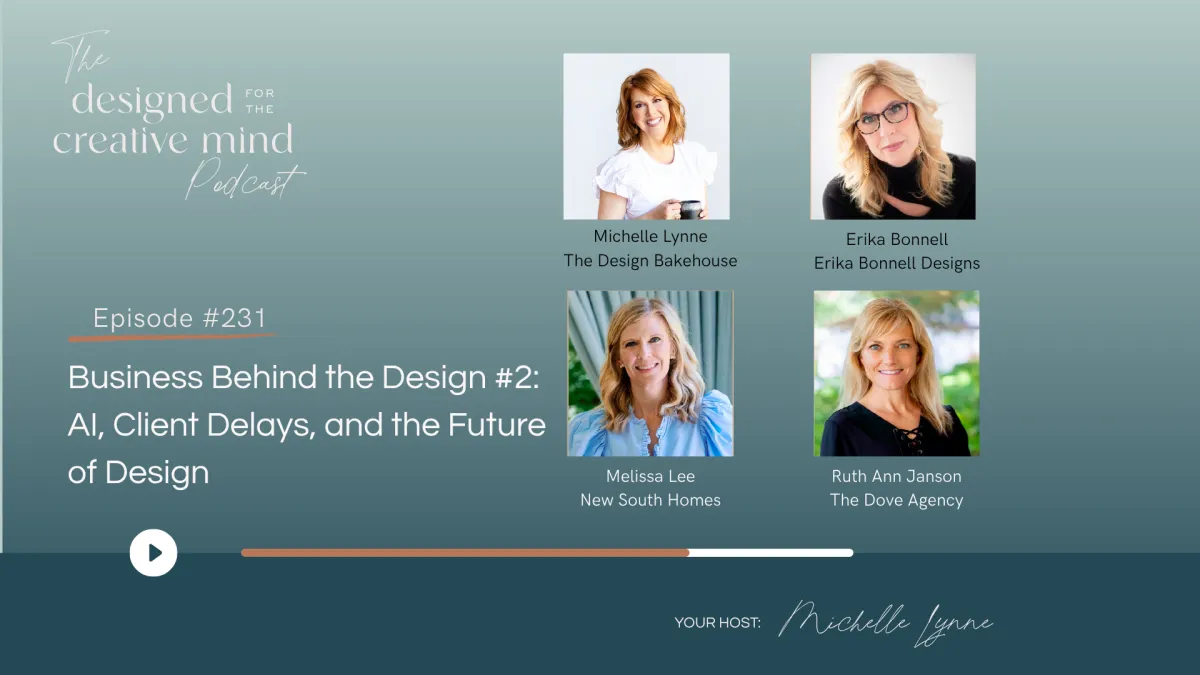
Ep 231: Business Behind the Design #2 - AI, Client Delays, and the Future of Design
Episode Description
Are your prospective clients taking longer to sign contracts? Are projects stretching across years instead of months? Are clients questioning purchases, breaking projects into phases, or running your designs through AI before making decisions?
In this episode of Business Behind the Design, Michelle Lynne is joined by Ruth Ann Jansen, Melissa Lee, and Erika Bonnell for an honest conversation about the realities interior designers are facing right now.
The panel discusses how shifting client behavior, economic uncertainty, AI, and increased competition are changing the design industry—and the strategies successful firms are using to protect their time, maintain profitability, and continue delivering exceptional client experiences.
From contract clauses and project pause fees to vendor relationships, luxury client experiences, and the growing importance of human connection in an AI-driven world, this conversation offers practical insights for designers looking to navigate today's market with confidence.
In This Episode, We Discuss:
Why clients are taking longer to make decisions than ever before
The impact of AI on the interior design industry
How designers are protecting themselves from stalled projects
Contract clauses every firm should consider
Why your design fee must stand on its own—even if furnishings never happen
The risks of relying on furniture margins to make a project profitable
How to structure fees for long-term custom home projects
The growing appeal of procurement support and outsourcing
Why relationships still matter more than technology
How luxury firms are elevating the client experience
Building stronger relationships with vendors, builders, and trades
Why some firms are becoming more selective about the projects they accept
The future of AI and interior design
Key Takeaways
Clients Are More Analytical Than Ever
Designers across the industry are seeing clients spend more time researching, comparing options, and evaluating investments before committing. Economic uncertainty, increased competition, and access to AI tools are all contributing factors.
Protect Your Time with Clear Boundaries
Several panelists share how they're implementing project pause clauses, restart fees, contract expiration dates, and payment milestones to prevent projects from lingering indefinitely.
Design Fees Should Be Profitable on Their Own
One of the biggest mistakes newer designers make is reducing design fees in anticipation of earning profit through furnishings. The panel emphasizes the importance of pricing every service as a standalone offering.
AI Can't Replace Relationships
While AI may influence how clients research designers and products, the group agrees that successful projects still depend on expertise, experience, vendor relationships, and human connection.
The Client Experience Is Becoming a Competitive Advantage
Whether it's personalized gifts, thoughtful touchpoints, or simply understanding what matters most to clients, creating memorable experiences continues to set premium firms apart.
Go Deep, Not Wide
When it comes to vendors and product partners, building stronger relationships with fewer, carefully selected partners often creates better outcomes than constantly chasing new sources.
Connect with Michelle
You can check out our designer resources on The Design Bakehouse website or follow her over on IG @byMichelleLynne
Meet the Guests
Ruth Ann Jansen
President of The Dove Agency, helping interior designers streamline operations and scale successfully. IG: @thedoveagency
Melissa Lee
Founder of New South Home, known for creating elevated, highly personalized client experiences while delivering beautifully designed homes. IG: @newsouthhome
Erika Bonnell
Founder of Erika Bonnell Interiors, specializing in luxury residential interiors and operational systems that keep projects moving efficiently. IG: erikabonnellinteriors
Transcript:
MICHELLE LYNNE (01:02)
Hey, hey, hey, welcome back to another episode of Designed for the Creative Mind podcast. This is our second episode with the lovely ladies. We are talking about the business behind the design. I want to introduce to you my guests. We have Ruth Ann Jansen with the Dove Agency. We have Melissa Lee with New South Home.
And Erica Bonnell with Erica Bonnell Interiors. this is so much fun. Last time we talked about hiring, we had so much fun together. We just said, let's just keep talking about the business behind the design. The episode got great feedback. So we're just, y'all, for those of you listening, we're just we're just winging it today. I've got a few questions prepared, but we are here raw with all sorts of information for you. So
Yay, here we go again, girls. Are you ready? Okay. So in my design firm, we are seeing clients show like strong interest, right? We we get them, we're moving them through the process, but over the last I d I don't know, 18 to 24 months probably. Like, are you guys seeing the same thing? Like they're taking a lot longer, like a lot longer to sign the contract. They're being more
Ruth Ann (01:53)
Perfect. ⁓ Yes.
Erika (01:53)
Let's do it. Yeah.
Melissa Lee (01:54)
Yay!
MICHELLE LYNNE (02:17)
Analytical, and then maybe they sign the contract, and then we're breaking it up into multiple phases, and then they're analyzing the purchases. Like, what are you guys seeing?
Erika (02:25)
All of that. Yeah, yeah, all of that. And I think we have been analyzing ourselves and wondering what might be contributing to all of this, because I feel like it's not just one thing. I think it's a lot of things contributing. I think it's financial insecurity when things seem a little unstable.
Melissa Lee (02:26)
Yeah.
MICHELLE LYNNE (02:28)
Yeah.
Mm-hmm.
Ruth Ann (02:43)
Thank you.
Erika (02:48)
I think it's the introduction of AI and everyone's popping everything into AI to see is this the right fee? Is this designer good? Can I do this myself? Like, I feel like there's a lot going on.
Ruth Ann (03:00)
Yep. I would just add to that a little bit too is the idea that I do think just interior design in general doesn't seem so unattainable anymore. Like maybe over the last X number of years, I mean, I don't have the exact amount of time here, but, to that point, because it's more of like a buyer's market around the services, there's more discernment, it's slower, there's more competition, there's...
Melissa Lee (03:01)
Mm-hmm.
Ruth Ann (03:25)
there's different aspects of it that haven't always been the case with regard to this industry as a whole. And I think that's contributing to some of it as well.
MICHELLE LYNNE (03:33)
It's great perspective.
Melissa Lee (03:33)
Yeah.
I totally agree. It's every time I turn around, there's another designer in my market on Instagram showing pretty pictures. And now your pretty pictures can be created by AI. So, you know, a lot of, I've seen a lot of accounts where they're just posting a lot of AI renderings and you don't even know if they're doing any design or not, but they're getting a lot of followers because of the renderings they're doing. So that's just something.
Erika (03:39)
Rrrrr
MICHELLE LYNNE (03:54)
Right.
Ruth Ann (03:58)
Okay.
Melissa Lee (04:00)
I think is out there as well.
MICHELLE LYNNE (04:01)
So have you guys have you guys added anything to your contract or how are you protecting yourselves? like do you have expiration dates? Like my my contract has this price is good for X amount of days and then my contract is expires on a certain date.
Erika (04:13)
Yep.
Melissa Lee (04:17)
We say that for any quotes that we give, it's 30 days is kind of like that time. And it says that at the bottom of the proposal. But we have started thinking about having like a time length and we haven't haven't implemented it yet. But it's like, if a project goes beyond a year or two years, and maybe it's just a year, like this is I'll be interested in everybody's take on this here. But you know,
Once it goes beyond a year or once it goes beyond two years, then obviously we need to revisit and rethink about that and what are the implications. I have not thought about that yet. We do have one project that we started almost three years ago and we have not even finished selections. It's just been the amount of time that's gone into architectural reviews and the clients aren't in as much of a hurry.
MICHELLE LYNNE (05:02)
Wow.
Melissa Lee (05:06)
You know, they have multiple properties. So for them, it's not like they're selling a house. They won't have a place to live. So we've had to go back to them and say, listen, you know, we need to collect more hours because we've exhausted our first portion of that because it's going on for three years at this point. So and they've been fine with that. So I think again, we've been seeing the length of time on those for sure.
Ruth Ann (05:11)
Okay.
MICHELLE LYNNE (05:28)
What if
they're not making decisions fast? Do you guys have penalties for that? We had a client a year and a half ago. Yeah. So tell me about that, Erica.
Erika (05:33)
I do. I
have something just based on history and things that have caused us some issues in the past. So in our contract, we state once design is complete, if you don't move into execution within 30 days, we automatically put your project on hold and then there's a restart fee once you're ready to kick back.
Melissa Lee (05:57)
onion
Erika (05:58)
We also in our contract state that if we never get to execution, there is a penalty for that because we only take projects that we foresee completing. We're not interested in designing and then never seeing you again. And then as far as in the design phase, we have payment blocks and if payment isn't received, we won't hold the meetings. So we try very hard to make sure that
Ruth Ann (06:10)
Yes.
Mm-hmm.
Erika (06:26)
there is an action item for the client that tells us if we're going to be spending additional time on this project or not. Because if we're not, we put it on hold. They know it's going on hold. We say, hey, it's been this many days. You're going on hold. We'll have to restart later with the restart fee and then scheduling when we're ready to put you back in.
Melissa Lee (06:34)
Mm-hmm.
I just signed up, all those ideas are great, Erica.
Ruth Ann (06:47)
I was.
They are.
Erika (06:50)
they come in handy.
Ruth Ann (06:51)
that I've seen, sorry, I didn't mean to talk over you. One of the things that we've seen with a few of our, especially newer designers is where they are planning on the project being a big one, right? Like they've got the design and then they've got all the furnishing. It's like the whole enchilada. And what happens ⁓ many times is they will get some of the design fees, but they've staggered those out and things will start to stall.
before the furnishing piece even happens. And unfortunately, some of their pricing modeling is contingent on the making the margin on the furnishings. So when that doesn't happen, they didn't make the design fees that they thought they, you know, because they were hair cutting those a little bit because they wanted to get to the other pieces, right?
MICHELLE LYNNE (07:28)
⁓
Erika (07:38)
they wanted the project.
Ruth Ann (07:39)
And so I would be interested, this is, I'm not trying to ask a question, Michelle, but I'd be interested to see if y'all have any safeguards around that. Cause that's something we've had to kind of counsel on several times with, especially, like I said, newer designers.
Melissa Lee (07:52)
Mm-hmm.
MICHELLE LYNNE (07:53)
girl, this is a conversation. I'm not the only one asking questions. I'm just facilitating so we're not sitting here staring at each other. I think that's a great question. ⁓
Ruth Ann (07:55)
Yeah.
Erika (08:01)
Yeah,
yeah. I think it's very tricky when you're a newer designer because your pipeline might not be as full. When your pipeline is fuller, you're much more comfortable saying, okay, well, we're not going to chase you, we're not going to push you because then that starts creating this really weird feeling between the client and the designer. So it's nice when you can just say, hey,
Melissa Lee (08:01)
Go ahead, Erica. I'd love to hear what your thoughts are.
Ruth Ann (08:06)
I mean...
Yeah.
Mm-hmm. Mm-hmm.
Erika (08:28)
And it also is great incentive for that slower client to say, hey, I'm popping someone else in this time slot. So you're going to get pushed back. I can guarantee oftentimes, you know, kind of like the unattainable boyfriend or what the minute they like, you know what it is? It's like, you want them even more. I don't know if I have time for you right now. But sometimes if you can just say, hey, you're coming out of the queue now because I need to keep
Ruth Ann (08:34)
Yeah.
I'm certainly unavailable. ⁓
Erika (08:53)
This is a business and I've got to keep things rolling. ⁓
Melissa Lee (08:56)
Mm-hmm.
Ruth Ann (08:56)
Yep, that's a great ⁓ point.
Melissa Lee (08:56)
Yeah. Agreed. I think one thing we've been looking at, especially with projects like that where it's new builds and then potentially furnishings, and they're going on for years and years and years, we are quoting the price to do all the finishes and the selections for the new build. And it's based on how many hours we anticipate it will take. And that is the upfront.
quote and it is based on and I know Ruthann you and I have talked about this but it's like you could do essentially quote unquote a flat thief to present the design package then you're doing hourly for all of that construction management and execution not that we're managing it but we're also kind of overseeing it and it's hourly for that but then the furnishings piece is totally separate right you're just and you are charging per room because a lot of the time
Ruth Ann (09:37)
Yeah.
Melissa Lee (09:47)
The amount of rooms that they may be furnishing may change because the selections went over budget and now they don't have much money. So then giving them quotes at that time that's based on per room, it's not necessarily saying, to do the selections for the end furnishings for the entire home is this much per square foot. We are really looking at it as two separate amounts because some houses take two to three years to five years to build.
Erika (09:52)
Windows.
Ruth Ann (10:11)
Yeah.
Melissa Lee (10:12)
And your fees could be totally different by the time you start furnishings. So I've liked that and we're starting to implement that. that's kind of the conversation we're having. We're not even talking about furnishings and how much it's going to be to furnish until we get nine months before the completion date. And then where are we at?
Erika (10:15)
absolute.
Especially with new builds because it oftentimes furnishing budget dries up before you get there. So oftentimes people need to recover before they can get to the, and then it's not, we've gone into so many custom new builds that in the end we're like, can we ever get to our furnishings? Can we ever get there? And it even has me questioning whether.
Melissa Lee (10:37)
Yeah, really.
MICHELLE LYNNE (10:38)
Yep.
Ruth Ann (10:50)
Yeah
Erika (10:53)
I want to continue with these big custom new builds because it is long and you are so in depth and sometimes surprises happen and it takes even longer and then money drains and then it's like, okay, wow, that was a lot. And then do you have a finished project ever to show for it?
Melissa Lee (11:10)
Mm-hmm.
Ruth Ann (11:11)
And that's interesting to your point, Erica. We have seen at our firm a real rise in ⁓ procurement services recently. And I think with some larger firms that have these projects that are spanning one, two, three years, and some of them are small. They're exclusive, but they're small. And I think to your point, and this is the way your firm works in some ways, is that you're wanting to
get back into design and not chasing these items for three years and doing the order trial, you know, all of those pieces of that. And we've seen a real, which has been surprising to me because procurement is very much for us, like up and down. And it's very like with the economy and with all these things that seem like it's tethered to, but for whatever reason right now, I think just like to everybody's saying this, the projects are taking longer than expected and you're getting weary and you're just like,
Erika (11:51)
absolutely.
Ruth Ann (12:07)
Please let me and my team just do these other things and get this off of our plate. And I, that's, I think that's what is driving a lot of it. It's been very.
MICHELLE LYNNE (12:15)
Think so
too. And what I teach a lot of my clients, my my design cli ⁓ interior design coaching clients, not my design clients, I know it gets kind of confusing, is that you need to price every single piece of the services that you provide as standalone. So your design fee, if they decide to take that design and go
Ruth Ann (12:25)
Yes.
Melissa Lee (12:34)
you
MICHELLE LYNNE (12:39)
Chat GPT, where can I get items that are very similar or or the same to these that you feel very well compensated for your design genius? And then you can add furniture on. But if you are haircutting it to use that's that's a great term, if you're if you're trimming your design fee so that you can get to the furniture, you're you're basically cutting your legs out from underneath you. it's hard.
Erika (12:52)
Yeah. Great.
Melissa Lee (13:03)
Mm-hmm.
Erika (13:03)
Absolutely.
Ruth Ann (13:04)
And
also, like, I mean, just, this is just, you know, kind of my view on just after working with all of y'all for so long is that, I mean, that's like you said, you already said it, that's where the genius lies. Like the genius is not in getting on the horn and getting those items into the receiver. I mean, I'm not saying there's not, that's a lot of work and you have to have very, you know, pristine processes to make that happen. But that doesn't require the three of you's creative genius to make that happen, right?
MICHELLE LYNNE (13:20)
Yeah.
Erika (13:31)
I will say though, I get very, I don't want to say upset, but kind of upset. People, if someone tries to take that design and recreate it, it will never look as if it would if we executed and installed ourselves. And that's what people need to understand is you can use whatever chat, whatever trades, whatever you want, but it is never going to be as good if we don't do the execution.
MICHELLE LYNNE (13:44)
Ever.
Ruth Ann (13:56)
No.
MICHELLE LYNNE (13:59)
Let's also talk about the processes that we have to have in place, like repeatable processes necessary to foster this efficiency. But it's in my opinion, it's the education of the client. So throughout our sales processes, like we need to have repeatable touch points with our clients where we're educating them on that, where we're educating them on the fact that it's not like HGTV and it's like
Melissa Lee (14:11)
Mm-hmm.
MICHELLE LYNNE (14:24)
you know, rainbows and fairy dust and poof the commercial's over and it's beautiful. So to your point, Erica, it will never look the same, but are we telling the client why?
Melissa Lee (14:28)
Mm-hmm. Yeah.
Erika (14:34)
So there's so many nuances within why, and it's we know that, but it's so hard to even educate all of those nuances because sometimes it's a matter of where you hang in your heart, your art when you're trying to do it yourself and your art is way off, but they don't realize how off it is. And there's just, there's so much nuance within the process and the execution on install day.
MICHELLE LYNNE (14:38)
But we know that. We know that.
Doesn't feel right.
Ruth Ann (14:57)
Thanks
Melissa Lee (15:02)
Well, part of what we're doing in our scope of work proposal, which we started doing within the last year, is like when we're presenting to them, this is our estimate on how much it's gonna cost to furnish a room, and these are the design fees and everything. We're actually going through, you know, this is what a room costs at retail.
And this is, you know, just to give you an idea of level setting. If you were to go and get this at Pottery Barn or Restoration Hardware, or whoever we want to say is kind of that nationwide retailer out there that people are familiar with. And that level sets them from the standpoint of like, well, if I'm not even getting anything truly designed and custom, this is how much you're spending. And then we go into why would you buy furnishings from us? What are we giving you? You know, it's for us being in North Carolina, they're North Carolina manufacturers. There's a lot of customization and custom detail.
MICHELLE LYNNE (15:18)
Mm-hmm.
Ruth Ann (15:34)
Hmph.
Melissa Lee (15:48)
and we're making a point as a team to do more customization and custom details than we have in the past to make sure that there is a difference and there is a reason and there's something unique about why they're purchasing through us.
The other side of it too that I've started being really wary about is this idea of them shopping us on chat, you know, shopping us on chat GPT. We used to send our design presentations to everybody throughout the process and I'm starting to think about and not do that. You know, I don't want to give that to them until they've committed to this is all the furnishings we're purchasing because I don't want them to go behind and shop us. And I do think for the most part,
Erika (16:18)
Right. Yeah.
Ruth Ann (16:18)
Yeah.
Melissa Lee (16:29)
Clients that we're working with or hiring us for a reason, you know, they do not want to do it themselves. They want somebody to handle it for them. They're not trying to shop us. But still there is that thing of like, I don't know if I want to give all this away yet. They've only paid for the design fee and they could go buy this somewhere else. So we are thinking about how much we get.
Ruth Ann (16:43)
Right.
Erika (16:45)
It's so interesting these days.
⁓ Everything has changed so much.
Ruth Ann (16:47)
And that's
something I do think that if there is more education to be had, to your point, Michelle, is I don't think that the end user is always aware of how different the furnishings are. Even if they look the same on chat, the ones that you all are getting through your trades are exponentially different quality. I just think that
Somebody has to have a real appreciation for that and be educated for these vendors that y'all have established relationships over decades, if you will. And that I don't think is always known by your end clients, right? Is that how different your product is versus what they're seeing on chat. And that's why the differential is there in the price.
MICHELLE LYNNE (17:32)
Absolutely. And I think that also sharing with them how much time we're saving. So you can go ahead, go purchase something from cheap furniture from overseas.com, right? Rock knock yourself out. But but let me tell you what I'm gonna do to save. Yeah. But I part of part of our sales process is I try to scare them. Like I'll I'll truly, I'll tell them like and we're walking through our contract, and here's a clause that says if you purchase something.
Melissa Lee (17:37)
Mm-hmm.
Erika (17:42)
It's so fun.
Ruth Ann (17:47)
Hahaha!
MICHELLE LYNNE (18:00)
that is that was presented by us that we get a fee associated with it or if you buy it and then you want me to handle some of the issues, well it's a it's a very high hourly rate for me to do that. But then I explain to them why. And it goes back to Ruth Ann's point. It's that it's that I've got these relationships and I can call my vendor, my sales rep, and say this showed up and it's broken and they handle it. So like my I think that as
Ruth Ann (18:14)
Mm-hmm.
Erika (18:19)
Mm-hmm.
Melissa Lee (18:24)
Mm-hmm.
MICHELLE LYNNE (18:27)
For the for the people listening, as you get more sophisticated and your clients get more sophisticated and your projects get more sophisticated, thankfully we're not running into that.
Erika (18:35)
correct.
MICHELLE LYNNE (18:36)
They're paying us to save time. They're not paying us to save money. Like they understand. So that has been that has been one saving grace in the back of my head. It's like it might be taking a little bit longer, but we're getting all the phases. We just need to keep that pipeline full because I need more clients.
Melissa Lee (18:40)
Mm-hmm.
Ruth Ann (18:49)
Mm-hmm.
Melissa Lee (18:49)
Mm.
Erika (18:53)
Well, agree, yes. And that is part of it. think we're probably all getting better at vetting our clients as well. I don't know about you guys, but we've had a ⁓ massive pruning and shake out lately, aligning and finding the right people. We can see some of these right off the bat. And we're like, you know what? I don't think this could be the right project for us. And we're dipping out before we get started.
Ruth Ann (19:16)
Yeah.
Melissa Lee (19:20)
We're actually actively kind of coordinating with, we just met with a contractor that's local to us who has very unique position, which I think is genius, a design services coordinator. And her job is to find designers for these people that are coming to them for remodels. They've got a few designers that they rely on, but she's the one that interviews them. She kind of figures out the needs and then she's referring them to
MICHELLE LYNNE (19:21)
Absolutely.
Ruth Ann (19:36)
up
Erika (19:37)
that's great.
Ruth Ann (19:39)
that's.
Melissa Lee (19:46)
the designer and so I just had a client come to me asking to do a project with no furnishings. We do not do remodels unless there's furnishings involved. And I said, no, that's kind of outside of the scope of we handle, but here, here, let me hand you to Sarah over here because she can do, not only can she do the construction, but she can also.
Erika (19:55)
up.
Melissa Lee (20:08)
give you a designer and then my hope is is that when the right project comes to them and they're looking for a designer that would need furnishings then they're referring us and so
Erika (20:18)
matchmaker.
Ruth Ann (20:20)
Yeah,
that's great.
Erika (20:21)
That is a cool service, yes.
Melissa Lee (20:23)
Yeah, so again, trying to network with people that we can confidently refer them to. If we don't want the project, we are going to refer you to somebody else in this idea of paying it forward in the hopes that they're going to bring us the right client that comes to them.
MICHELLE LYNNE (20:41)
So along that line, Melissa, as as we are all working to elevate our brands, right? And we're attracting, like the goal is to attract a more luxury level client over and over and over, going back to the more sophisticated we get, the more sophisticated our clients are, the more sophisticated our projects are, and it just continues to elevate us. How are you guys evaluating which vendors, which showrooms, which project project product lines are worth building relationships with?
Melissa Lee (20:52)
Mm-hmm.
We're currently in the process of that right now because as we kind of elevate our offerings and I think again, we're looking at, it may not necessarily be a shift in vendor, it's a shift in how many extra details are we adding. For instance, we've had a big business with Sierra Lane. I know this is a big upholstery manufacturer that a lot of designers work with.
Well, we don't really, we haven't done a lot of contrast bolting. They have, you can put trim on it. You know, they've got a lot of custom details that just kind of this minimalist look, you know, wasn't really catering to. And now we're seeing more of that traditional, those traditional details. So we're still using CR lane. We're just upgrading the products by adding more of this customization. But then we also are going out and trying to make.
better relationships with local craftsmen for more unique pieces, as well as just what are some of those higher-end furniture manufacturers that we are seeing that we know are big, know, Highland House and some of those that maybe in the past we haven't been buying from, but then using some time in market to go into the showrooms to understand more of what they offer so when that right client does come along, we are familiar with them.
Erika (21:59)
Mm-hmm.
MICHELLE LYNNE (22:21)
So you're taking time and truly just going and doing some reconnaissance.
Melissa Lee (22:22)
Mm-hmm.
Mm-hmm. Yep. We're
spending some extra time in market as a team, just like going antique shopping, doing some things that we haven't really done as much in the past just so that we're better educated and we'll be ready when those clients do come along to know what to present to them.
MICHELLE LYNNE (22:43)
That's fun. That's very fun. So instead of going real wide, you're going deep, but you're being intentional about who you are. That makes sense. That makes sense.
Erika (22:53)
Going deep is smarter always because the relationship is stronger then. And you have more opportunity when you build those stronger relationships to get helped the way you need to get helped when there are issues that come.
Melissa Lee (23:08)
Yeah.
MICHELLE LYNNE (23:08)
So I want to ask like more of a technology question, but this really is showing our us and myself and our listeners that technology is not going to take over. Because at the end of the day, y'all, this is a relationship built business with your vendors, with your clients, like here with us, with our colleagues, with you know, ⁓ just
Erika (23:20)
No.
with your creative. Yeah. Yes, absolutely.
Ruth Ann (23:31)
Mm-hmm.
MICHELLE LYNNE (23:33)
supporting each other and like you said, Erica, with our trades. And and if a client is going to drop your design into Chatty G, that's what I call her, ⁓ it is if they're gonna do that, they're not they're really not your clients to begin with. There was there was a wrong alignment on the front end.
Ruth Ann (23:42)
Bye.
Erika (23:42)
fatty
food.
No, they're not. ⁓
Absolutely, absolutely. that's the thing about, and I also think that right now this is the new shiny toy that everyone wants to play with. And I think people are going to, the more people that want to play with this without help of others will run into lots of barriers and it's going to turn back around. It's just a little time.
Ruth Ann (24:06)
Yes.
I do think though, and everybody's already saying this about being educated. I do think having the idea that, you know, your potential clients could be coming to you with these questions around AI and around how are you using this or are you using it? And then having that sort of arsenal of, we use it in these instances where it makes sense behind the scenes for efficiency for our own team or whatever, if you know, however that works, but basically leaning into.
the vendor side of things, your own creative experience, decades of doing this, all of those things, which are not in one iteration of a chat GPT rendering, if you will. I do think that it's not, is, there are going to be full circle, like you said, Erica, things that are going to happen with this, but people coming to you that have done this, it's more just like, sure, let me take a look at that and tell you why X, Y, and Z is the, you know what I mean? Because I.
Erika (24:50)
vote.
Ruth Ann (25:05)
I don't see that stopping. I think that people are kind of like you said, they're doing all the things in there right now. And then it's not a gotcha moment, but it's like coming back and saying, look what I did. And you guys are like, that's so terrible. Yes.
Erika (25:20)
Because you have people who aren't experienced in the
industry inputting without understanding the proper prompts to get what they really need back for it to be helpful.
Ruth Ann (25:29)
Right.
MICHELLE LYNNE (25:33)
It would be like me trying to dye my own hair. I know you guys are shocked. This is not my natural color. But I don't know the right questions to ask. I'd I'd burn my I'd burn my hair down.
Erika (25:37)
you
Ruth Ann (25:38)
You don't know that questions to ask is the key to it.
Erika (25:41)
You don't have the questions to ask, you know.
Ruth Ann (25:44)
No.
Erika (25:45)
Yes, exactly. Yeah.
Melissa Lee (25:47)
Okay.
MICHELLE LYNNE (25:47)
So so y'all with that, here's what I want to do. I want to wrap up this episode and then let's just stay here and we're gonna record another episode and I wanna talk about technology, about AI, and all of that sort of jazz. So I think that this section this session is about relationships. It's about the people, it's it's it's truly about the human aspect of it. So let's do this. Y'all
Melissa Lee (26:11)
I have some stuff to add on that before you hang up on the relationships.
MICHELLE LYNNE (26:15)
Do you okay.
Melissa Lee (26:16)
So I was just, I was going to say kind of filtering in on how are we building those relationships. We've actually been actively working for the past three years to elevate our client experience from the standpoint of like at certain points, they're getting gifts, everything that we are. you know, when they signed the design agreement, they're getting a branded floral bouquet from our team that basically says, we're so excited to work with you. All the things,
We are also personalizing a lot of the final gifts to them. We have a very specific client questionnaire that we ask, and a lot of it is like, where's your favorite place to eat? What charitable organization is important to you? And really getting into more of their personalities and their personal life. And we actually will review all of that before we even go to an initial consultation so that we're very familiar with what is the dog's name, who is, what's husband's name, who's living in the house, and all of
Ruth Ann (27:08)
Thank
Melissa Lee (27:11)
those things so that when we're showing up, it's not a computer, it's a human, have those conversations with them. And we, everything that I hear about with AI, I'm just like, we are headed in the right direction, making this more of a personalized experience and bringing the human pieces into it with everything that we're doing. Just makes, again, it's just kind of how can we just create a better
MICHELLE LYNNE (27:15)
Mm-hmm.
Melissa Lee (27:37)
more luxurious, we're bringing you lunch. It's on, you know, China. All these things that are really pulling into the human factors of it is so important.
MICHELLE LYNNE (27:40)
Mm-hmm.
Ruth Ann (27:44)
in.
MICHELLE LYNNE (27:46)
I love that. Have you read the book ⁓ Unreasonable Hospitality?
Melissa Lee (27:50)
I have not read that one. I've heard of it. But the one that I read was called The Gold Standard by Colin Cowie. That's another really good one that I read about three years ago and started doing all of this based on that. So I've heard that the two books are very similar. But yeah.
MICHELLE LYNNE (28:04)
Absolutely.
It's because people are buying experiences.
Melissa Lee (28:06)
Mm-hmm.
Erika (28:06)
Well, and you can feel free to cut this out, but I have done all of that and we stopped. Our people did not appreciate it. We would barely get thank yous at times. And you know what? I'm like, why are we killing ourselves and spending all this money and no one even says thank you? We stopped doing it. We sure did. Yeah. We used to go balls out. Yep.
Melissa Lee (28:13)
Yeah?
Really? Interesting.
MICHELLE LYNNE (28:27)
No, that makes sense. We're in the middle because we used to go balls out, like,
and then we've dialed it back to so we still have these touch points, but they're not gonna be as like we don't necessarily need to have a bloody Mary bar at the design presentation, but we will take little dog treats to their house.
Erika (28:34)
Yep.
Yeah, we did cut points. ⁓
Yes. Yep. It's small. It's much smaller than what it used to be for us because it, I don't know if it's, I think it's different regions as well. I will say up here in DC, people aren't, I just think it's like, that's cute and move along. You know, I don't think it's appreciated. You get it. Yeah. Yeah. It's totally different.
Melissa Lee (28:46)
Mm-hmm. Yeah.
Ruth Ann (28:47)
That's cute. Yeah.
Melissa Lee (29:02)
I've lived there and I've lived here. I could not agree with you more, Eric. Yeah,
Ruth Ann (29:06)
Yeah, market.
Melissa Lee (29:11)
every single time we send flowers, we're getting either an email or a text that says like, my gosh, what a lovely surprise. Thank you so much. And then it's really more of like the personal gifts and stuff. Like people will, we do have a follow-up call at the end of our projects.
Erika (29:18)
Peace out.
Melissa Lee (29:27)
and my business manager handles those and she does it to get reviews at the end of project, but they will say the personal details that they put in the gift and the design and all of those things were just really thoughtful. And so we do give them the opportunity to give us feedback and it has been very positive, but we're not like sending them to the Ritz or anything, you know?
Ruth Ann (29:31)
Good. ⁓
Erika (29:46)
How does it match? Yeah. Yeah.
Ruth Ann (29:49)
Yes.
MICHELLE LYNNE (29:50)
Yeah.
Melissa Lee (29:51)
Right? It's just more of like,
okay, you're getting flowers. We're so excited. Your gift is a little bit more personalized and all of that. But we do have a coffee bar set up in the office. We will bring some treats and lunch and stuff for them just to kind of, and it's been making an impression on the builders actually. The builders are really impressed when they are at those meetings with us. And now they're referring us to, because they're like, nobody else is doing that. And that's been huge for us from just a referral networking point.
Erika (30:03)
Yeah.
Yeah,
MICHELLE LYNNE (30:18)
I love
Erika (30:19)
those
MICHELLE LYNNE (30:19)
that.
Erika (30:19)
builders are like, we're going with them because we'll get lunch out of it.
Melissa Lee (30:22)
Exactly,
MICHELLE LYNNE (30:23)
And you make look good.
Melissa Lee (30:24)
which is fine. Keep sending me those $10,000 $30,000 square foot projects. Great.
Erika (30:26)
Absolutely.
Yep. I love it.
MICHELLE LYNNE (30:31)
Love, love, love it. All right. Well then girls, for the end of this episode, let's start with Ruth Ann and let the audience know where they can connect with you.
Ruth Ann (30:41)
I'm Ruth Ann Jansen, I'm the president of the Dove Agency and you can find us at thedoveagency.com and on Instagram, Dove Agency. We're real easy to find.
MICHELLE LYNNE (30:49)
Yay. Melissa, where can our audience find you?
Melissa Lee (30:53)
Melissa Lee with New South Home and similar to Ruthann, real easy, newsouthhome.com and we are on Instagram at New South Home.
MICHELLE LYNNE (31:01)
Yay and Erica, last but not least.
Erika (31:04)
Same, mean, I think we're all very easy to find. ErikaBonnell.com and same on Instagram, ErikaBonnellinteriors, believe. Or who knows, rolling down the aisles in the grocery store, you never know.
Ruth Ann (31:13)
Yes.
MICHELLE LYNNE (31:16)
Fantastic. Well, thank you all for being here. Y'all, that is another episode of Designed for the Creative Mind. Remember that none of this happens by accident. You need to be intentional about building your business. And if you found this episode helpful, please don't hesitate to share it with another designer who may be able to benefit and continue to elevate our industry. So until next time.
Ruth Ann (31:40)
Thanks for having us. Bye.
Melissa Lee (31:41)
Thank you!
to
