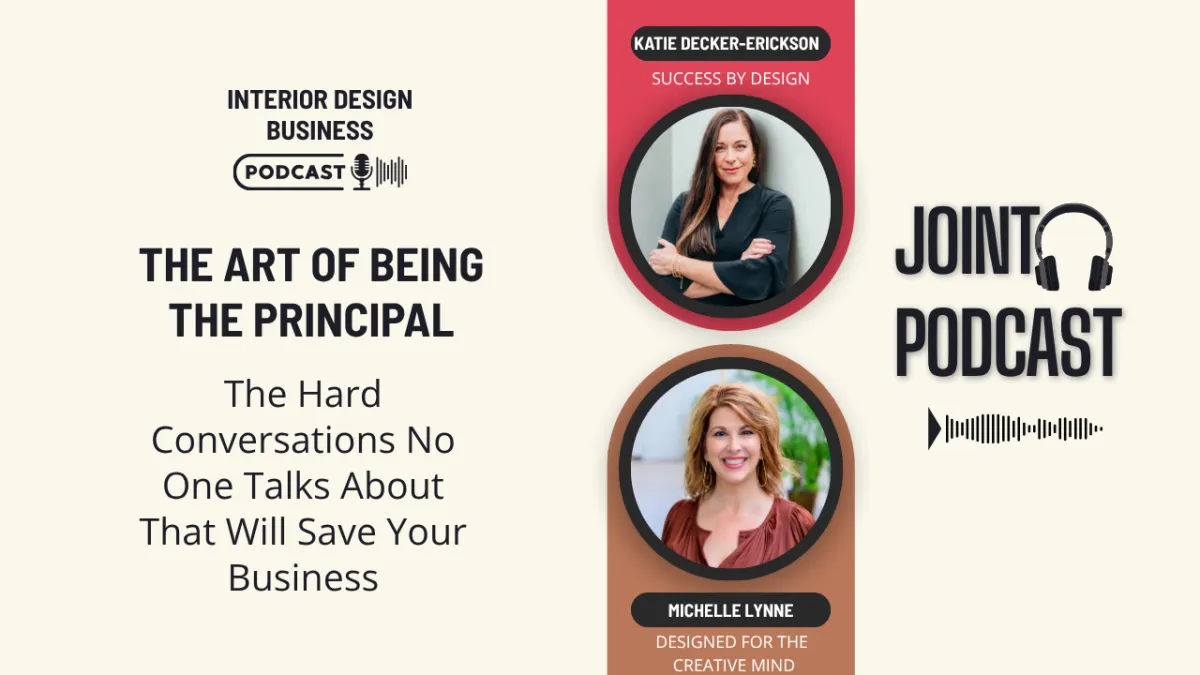
Ep 228: The Art of Being Principal: Conversation with Katie Decker-Erickson
Episode Title
The Art of Being the Principal
Episode Description
What does it really mean to be the principal of an interior design firm?
In this first episode of The Art of Being the Principal, Michelle Lynne and Katie Decker-Erickson join forces to have the candid conversations most design business owners need—but rarely hear. No fluff. No trendy buzzwords. Just honest discussion about what it takes to lead a profitable, sustainable interior design business.
Together, they explore the transition from designer to CEO, why so many firm owners get stuck operating instead of leading, and how systems, processes, and strategic hiring create the freedom to focus on what you do best.
Whether you're running a six-figure firm, building toward seven figures, or simply trying to create a business that works for you instead of the other way around, this conversation will challenge you to think differently about leadership, delegation, and your role as the principal.
In This Episode, We Discuss:
Why Michelle and Katie created The Art of Being the Principal
The difference between being a business owner and actively "CEOing"
Why most interior design firms are still very small businesses—and the unique challenges that creates
The three pillars every successful firm must master:
Marketing
Operations
Finance
Creating dedicated CEO time in your weekly schedule
How systems and processes protect your creativity
Moving from business operator to business owner
Why your first hires shouldn't necessarily be assistant designers
The importance of buying back your time strategically
Hiring people who are smarter than you in their area of expertise
Building a culture where mistakes can be acknowledged and corrected
How to know when someone is in the wrong seat on the bus
The power of finding team members who consistently give "the extra 5%"
Why leadership requires discomfort, self-awareness, and difficult conversations
The connection between leadership, motherhood, and personal growth
The importance of "winding the clock" and creating space to think strategically
Key Takeaways
CEOing Is a Verb
Owning a business and leading a business are two different things. Successful principals intentionally set aside time to focus on leadership, marketing, finances, and growth—not just project execution.
Systems Create Freedom
When processes are documented and repeatable, your business becomes less dependent on you. That creates more room for creativity, strategic thinking, and growth.
Protect Your Time
Time is your most valuable asset. Every task you continue doing yourself should be evaluated through the lens of ROI and whether someone else could do it better.
Hire for Expertise
The goal isn't to be the smartest person in the room. Strong leaders surround themselves with specialists who challenge their thinking and elevate the business.
Growth Requires Letting Go
What helped you reach six figures won't necessarily get you to seven. Scaling requires delegation, trust, and a willingness to shift from doing the work to leading the people who do the work.
Wind the Clock
Leadership isn't just about doing more. Sometimes the most important work happens when you slow down, reflect, connect with peers, and intentionally decide where you're headed next.
Mentioned in This Episode
The upcoming Art of Being the Principal Live Event (August 24 in the Dallas/Fort Worth area)
Connect With Us
Michelle and Katie want to hear from you:
What challenges are you facing as the principal of your firm?
Which pillar do you struggle with most: marketing, operations, or finance?
What topics would you like covered in future Art of Being the Principal episodes?
And settle the debate: Should it be called a Summit or a Retreat?
Leave a review, send a DM, or connect with us on social media.
Katie: @successbydesign_coach_podcast
Michelle: @by_michelle_lynne
Remember: Your business should be working for you—not you working for it.
Transcript:
DFCM (01:02)
Hey, hey, hey. If y'all have been around my world for any amount of time, you know that I don't do a lot of fluff. And we are doing a combined podcast today with Katie Decker Erickson. And y'all, she's the same. So when we decided to do something together, yeah, go ahead.
Katie Decker-Erickson (01:16)
Yeah, if fact Well, i everyone's jumping
on my channel. They're like, This isn't Katie's voice. Where is Katie today? Katie's here. I'm with Michelle. So if you're listening as Success by Design or Design for the Creative Mind, you're at the right place. Don't don't click out. You don't have a mistake. Yeah.
DFCM (01:25)
⁓ I can't see
You are at the right place.
Thank you. That is good clarification. Good clarification. So we just knew that if we were going to be combining our podcasts, and actually we are going to be doing this on a monthly basis, and we're doing it under a title of The Art of Being the Principal. So that's kind of where we're at. And we're kind of building this in public. So we don't we don't actually have everything scripted out.
We don't have ⁓ we have some basic talking points and so forth, but we we're here to serve you as the principal of your interior design firm. So Katie, what is what does that mean to you? What what are you thinking? Where are we gonna go with this?
Katie Decker-Erickson (02:11)
I love designers and if you've been listening to my show for any period of time, you know it's all about running the business and having the hard conversations. And I want to create a safe environment where we can have these conversations about being a CEO, being the principal, truly leading from the front, unapologetically, but kindly and fairly.
DFCM (02:30)
And without the fluff,
yes.
Katie Decker-Erickson (02:31)
And without
the fluff, yeah, let's have the hard conversations that nobody else is happening. There's lots of conversations going on in the world of design about what we're creating, what each of our firms looks like, what we're seeing in the marketplace. But I feel like unders yeah.
DFCM (02:43)
How AI is
Yeah.
Katie Decker-Erickson (02:45)
I'm tired
of the AI conversation. It's here if if you haven't figured it out, go figure it out. It's not going away. But like what hasn't changed is the foundation of running a really good, a really smart business that makes you the money that you want to make. And I feel like there's blips. I don't know if you see this, Michelle, but it's like we're gonna focus on profit or we're gonna focus on marketing or what did you do with X? And we wanna have a holistic conversation, I think, of what does it really mean to be a CEO and just step into that space.
face, as I said, unapologetically, authoritatively, and tackle the mindset and all of the variables that go into running an enterprise that you want to run that fits like I would say on my podcast, a business that works for you, not you working for it. What would you add to that? Yeah.
DFCM (03:30)
Well and let's talk about that because the
art of being the principal, like say in in your firm, the principal is the person who runs the firm, not the one who should be who's doing all of like for in in architecture, the principal's not the one doing all the drafting. Okay. It's not the one in every meeting managing every detail. But what heck, Katie, you were just quoting that there's that ha like most interior design businesses are for
people or less, right? You were just talking about that on a previous meeting.
Katie Decker-Erickson (03:58)
Most of them. Yeah, this is
a good statistic. I'm gonna give this to you. Yeah. sixty percent plus of the thirty-one billion dollars in revenue that gets done annually in our business flows through small firms of four or less people.
DFCM (04:14)
So what does that mean? If you're the principal, because it is four or less, designers are doing a lot of designing, even if they are a principal. So that's hard, y'all. That is a difficult role to be in because you're the one who's leading the thing.
But you're also doing a lot of the things and not always leading. It's it's it's a hard juggle. So that's what we're here to talk about. Let's let's acknowledge it.
Katie Decker-Erickson (04:36)
I often say it's like a rabid squirrel
straddling a barbed wire fence.
And you have to figure out which side of it you're gonna be on. If you and this is something I you know I haven't said in a while, but I think it's so important. If you're like, I just wanna design and clock in and clock out, that is okay. Give yourself the permission. I think sometimes we idolize running our own firm, being our own thing. There is nothing wrong with going to work for a firm so you get to create all day and clock in and clock out. That is
DFCM (04:42)
Ha ha ha
Katie Decker-Erickson (05:09)
You can be just as unapologetic about that as being a CEO. And you have our full permission, not that you need it, but I think it's really important to say that.
DFCM (05:16)
Absolutely. And because I I can tell you myself, I speaking of squirrels, I'm like a squirrel on cocaine. It's like I'm looking at this, I'm looking at that, I'm looking at this, I'm looking at that, and then I gotta go do this and then I gotta go do that. And it's just like at the end of the day, I'm exhausted sometimes. More often than not.
Katie Decker-Erickson (05:29)
A hundred percent. In fact, I was just ⁓
for sure. I was talking to a coaching client this week and she's like, Okay, Katie
Where are we going next with coaching? Because I feel like we've figured this out. What are we doing next? I'm like, we're gonna figure out how to CEO and CEO hard. We're gonna put you on a schedule for CEOing. It's like going to the gym. It's like brushing your teeth. Do you wanna do it every day? Not necessarily. But does it give you what you want and do you enjoy the byproducts of it and most of it? Yes. Okay, then you're in the right seat. You just have to sometimes put on the big girl panties and deal with it, right? And so that means one day a week you're gonna focus on marketing. It doesn't mean you're spending all day
Doing marketing. It means you're taking an hour out of the day and you're saying, I'm stepping away from the design and drafting table, and I'm stepping into being the marketer. Is our brand on point? Is our message clear? Is our story up to par? Like all of these things. Another day you're gonna do your finances. Like we're just chiseling through that because that's you put it on a cycle like everything else, and it performs.
DFCM (06:27)
that's
so interesting that you say that because that's exactly what I teach. Monday's marketing, Friday's financial, you know, Wednesday. my gosh. I
Katie Decker-Erickson (06:33)
you have them do Friday financial? you're nice. I give people
cocktails on Friday. I'm like, you have four days a week to CEO and you get a cocktail on Friday. That's hilarious. Do you?
DFCM (06:39)
I do financials on Friday. Yes. No, it's
just like because it's b I go into the weekend and I can rest easily knowing everything's taken care of. Plus Fri Financial Friday. It's it's alliteration. I like alliteration.
Katie Decker-Erickson (06:50)
That's so funny 'cause yeah.
I love you. I do it on Monday because I feel like it's
like get it over with and then I know where everything sits. So I feel empowered to make decisions all week, knowing exactly where my companies are at.
DFCM (07:04)
Well, God. So if you're listening, just pick a day. Pick a day that works for you. And that's the beauty. Yes, that's the beauty of having your own business, right? It's is you can go in that respect.
Katie Decker-Erickson (07:06)
Pick a day. The point is pick a day. Yeah. It is. You get to run it. The key
is you're running it. That's the difference. This is where we talk about CEOing is a verb. Add the ing. There's lots of business owners out there. Yeah, great. Knock them dead. But if you actually want to get back to that art of being the principal, you have to be CEO-ing.
DFCM (07:30)
Well, that and there's a bunch of business owners, but most of us, small businesses, are business operators. We want to step out of the operations and into the ownership. Because, like for ML Interiors Group, my company, our operations, the the cup the business runs itself. I've told this story a million times. Like when I went to go adopt my now daughter, Genevieve, eight years ago. Gosh, it was almost exactly eight years ago when we were driving up there.
Katie Decker-Erickson (07:36)
⁓
Love
DFCM (07:57)
And ⁓ my firm, I I called my team. I was like, Debbie, Megan, what's going on? Is everything okay? They're Yeah, we're just following our processes. I was like, sweet. I thought the building had burned down, but truly they were just navigating everything. So if you have the operations in place as the owner, you're not having to go through and answer the same question for every project over and over and over again. They're standard operating procedures.
Katie Decker-Erickson (08:12)
Yeah.
Yeah.
And they should be. It's not fun to reinvent a procedure every time. What's fun is to create new designs every time. And I think what we miss in the design world is understanding that when those processes are in place, it gives you back the creativity you so long for and crave. Because you're not sitting there trying to tell someone for the eighty-fifth time why the fifth window treatment didn't go well and trying to f still fix it. That should have been fixed back on time number one so you could get back to doing what you love.
DFCM (08:38)
Absolutely.
Mm-hmm.
Katie Decker-Erickson (08:51)
Just creating.
DFCM (08:51)
Well, and technically
you should have a process for those window treatments. And everybody on your team, including yourself, should know who you call when it's time to create window treatments and have them do the measurements. So you're not the one out there doing it. But Katie, we could talk about this all day. you know what I wanna ⁓ so yes, I know, right? With cocktails. One thing that I do wanna bring up to our audience.
Katie Decker-Erickson (09:05)
Yeah.
True story.
Yeah.
DFCM (09:14)
We're recording this at the end of May. It should be coming out the first week of June.
We will have a couple more episodes, but Katie and I are planning an event on August 24th here in the Dallas Fort Worth area. We're still putting it together. So one of the reasons why we wanted to get this podcast done so quickly, because we literally just threw it together, is so that we can ask y'all, what like where are you in your world right now? We're look we're looking at three pillars marketing, operations, and finance.
Right. Those are kind of the three big things in any business. You have to market in order to get business. Once you get the business, you have to be able to operate and and execute. And then of course we're all here to make money, right? So
Katie Decker-Erickson (09:56)
Unapologetically and understanding
your finances so you can again complete that loop and go back to investing in marketing so you get more business, so you make more money. It's really a cycle. And yeah, I'm really excited. I'm I love that we're doing this. It's a one-day seminar with cocktails. so that we get to have the conversation around these three pillars that really what I love is calling it the art of the principle because there's a science to this. Like we know these are the three pillars, but there's also an art form. Like you do find
DFCM (10:06)
Mm.
Katie Decker-Erickson (10:25)
I do finances on Friday. I do finances on Monday. There is still an art and a science to this. We want to give you the foundations so then you can get busy designing the business that you really want rather than feeling like your business is dragging you around by the tail half the time.
DFCM (10:40)
Absolutely, or the tail wagging the dog. So so we want to know do you want to dive into the three pillars and pull those apart? Is that the format that works? Or is it also going to be along the lines of how do you pull yourself out of all of that framework so that you're not the one who's having to do all of it? So there's different there's different takes on how Katie and I can present these things, how we can address it, or is it something completely different? So
Katie Decker-Erickson (11:07)
Yeah. We want to hear from you. A hundred percent.
DFCM (11:07)
We're inviting you to give us feedback. Yeah. So you can either
leave a comment and a review wherever you listen to podcasts, just by the way, or find us absolutely, or or find us on social media. And just drop us a line. Anyway. Yeah. Smoke signals don't work. So yeah, smoke signals do not work. My psychic ability doesn't work.
Katie Decker-Erickson (11:16)
We really appreciate that.
A hundred percent. Come find us. DM us, whatever. Yeah, don't send carrier pigeons. Okay. It's sure broken after my hormones.
It went out the door with my hormones. Let's just talk about that for a minute. Okay, so Michelle.
DFCM (11:34)
Ha ha ha
So you were able to read
minds.
Katie Decker-Erickson (11:40)
Yeah,
well I was. Yeah, I or so I thought. Let's be really honest, the beauty of youth. ⁓ who is this for, Michelle? Who who do we want to hear from? Like what if someone's sitting out there and they're like, I don't know, is this for me? Is this not for me? Do I make enough money for this to be for me? I think that's something we struggle with as designers. Is that insecurity or imposter syndrome? What would you say to that?
DFCM (11:42)
Yes.
Yeah.
Say if you are bringing in six figures in your interior design firm, this is for you. Whether it's 101,000, whether it's 999,000, there's something for everybody in between. my market used to be the baby designers who were in the you know five figures.
But I really think that this is going to be a little bit more involved than that. Can you get some stuff from it? Absolutely. 100%. But I really think the sweet spot will be for the designers anywhere between 101,999. And probably 750 is actually probably where the top.
Katie Decker-Erickson (12:21)
Yeah.
Yeah, I would say anybody.
Yeah, a hundred percent. Because we've got the baseline, we have some things going on, we figured out how to get to six figures. Now the question becomes, how do you really get to seven? And I think that is a Yeah. I know. How many sweet coaching clients haven't we had, Michelle, that like hop on the call and there's tears?
DFCM (12:46)
Without burning yourself out, like, 'cause that's hard.
Katie Decker-Erickson (12:54)
And they're just fried. They're 100% fried. And I'm like, I get it. I get that you're fried. I see you. We gotta fix the fry. Because you need to get to a lifestyle that really does allow you to succeed, but also allows your team to succeed. I think it's so easy for designers to give up the thing that made them great first, which is their designing. That should be the last thing you give up in your firm. That is your brand, that is your look, that is your eye. Go hire the bookkeeper first. I talk about this all the time.
DFCM (13:23)
And that's what I was gonna say is that when you have a team, it does not have to be employees. So Katie just said it it it lets your team shine as well. You know what? This could be some an overseas designer, it could be your outsource bookkeeper, it could be your social media manager. Like there's a lot of people that support your business when you get strategic about addressing it, not doing it all yourself. And I'll be the first to say, y'all, there are so many things that I love to do.
Katie Decker-Erickson (13:29)
Yeah.
DFCM (13:51)
But I need to outsource them so that I can do what makes me money. Like I'm not a I'm not gonna go be a s like I think another I think another career that I could have be like website design, social media man management. Like I love doing those things, but that's not where I make the money. That's not where I'm best at in this industry.
Katie Decker-Erickson (14:09)
That's so wisely said. I mean, to your point, which is such a wise one, the world is your oyster right now. I mean, w however you feel about covet and I roll my eyes 'cause I was in a state that really went
off the deep end about it. But wherever you're at, it's taught us that our world is very small. So to go find someone in the Philippines, to go find someone in X, Y, or Z, extremely doable. I mean, we have a multi million dollar firm. I don't have one employee. Everyone's a contractor. But you know why it works? Because we have systems and processes and they know where they plug in and they know what their lane is, they know what their due dates are, they know what the expectation is and they know where to find me if they get stuck. Okay.
Then all of a sudden we've created a repeatable process. Like I love this idea. If you're doing something twice, stop and ask yourself, why am I still doing this? Because it probably needs a system, a process, or a procedure. If you're doing something twice, then why are we back at this again? There's usually a reason why.
And like when you start thinking about that, and I think too just realizing time, especially as we get out of this business operator mode, which I think is such a great distinction you made, Michelle, when we leave business operations and we go into CEOing and principaling and doing these things, it's starting to say, How do I buy back my time? Because your time is your most valuable asset. I can give you more people, I can give you more money, I can give you more ideas, I can give you more marketing.
I cannot give you more time. So really guarded is the holy grail. And to your point, just because you can doesn't mean you should. Just because you can do the social media and you can do all this stuff, it doesn't mean you should be doing it, right? Because where's your ROI? Where's your the return on your investment? And that investment is your time and it's the most valuable thing you got. My time has to work freaking hard for me, or it's a no-go.
DFCM (15:40)
Yeah.
And I also think that it takes away just it's sometimes it's not just the physical presence, but it's the mental presence. So if you're always thinking about what's going wrong at work, or I had to do this twice, or you're just repeating conversations that you had because you had to make something up as you go, that is also time. That is time mentally taken away from your family, taken away from your dog, like whoever you love to spend time with.
Katie Decker-Erickson (16:00)
Yes.
DFCM (16:20)
Right? Or it's time that you can be just rr something.
Katie Decker-Erickson (16:21)
my gosh, I don't have time for a dog, which is why I'm laughing. I'm like, I'm just trying to raise
children out here. A dog? No, I have three snails. I think we're up to five snails in the snail jar on my counter. my gosh, it's real. My kids love the snails. Michelle, I don't even know how we got snails, but I have snails. That my capacity is for snails, not even dogs. ⁓ gosh, it's a thing. You pick.
DFCM (16:27)
⁓
There you go. So but it's time. It's time. So
the art of being the principal, I think, is something that oftentimes we get into business thinking that we're gonna be a designer. But in truth, you are a business owner that runs a design firm. You're a businesswoman who owns an interior design firm. So we have to switch that thought process. And I'll tell you.
Katie Decker-Erickson (17:01)
Yeah.
DFCM (17:08)
That like even myself, like there's there's times where I find I catch myself and it might be weeks at a time, where I'm truly just in the weeds. I am not leading anything. And I catch myself and I'm like, Holy crap, I have been the operator, not the owner.
Katie Decker-Erickson (17:24)
It's so easy to do because here's this critical moment. What made you and got you to this point isn't going to get you to the next one. It's not going to get you to the next one. So being the operator got you to six figures, and that's amazing because you learned the ins and outs of your business because you had to do it all. That's not gonna get you, huh?
DFCM (17:41)
And then you can manage people
doing it. You can manage people doing it now because you know how it needs to be done, what works, what doesn't work.
Katie Decker-Erickson (17:50)
A hundred percent. And making that transition is what gets you to the seven figures. But you have to be willing to let go. And I think that is exceptionally hard. Now it's not letting go of what made you great, which is don't go hire an assistant designer the first time you get stressed out. It's the worst decision you can make.
Go hire the bookkeeper. Go hire the marketing person. Go hire all the peripheral tasks before you take away one, what you love, but two, what your clients are expecting to see. Like I just did this with the designer last week. They're like, okay, but how do I still stay involved in design? I've hired everybody else in my ecosystem. I really actually do need an assistant designer. I said, yeah, you do, but here's the thing: you're creating the mood board.
You're doing the client meetings, the assistant designer's coming along to hear the feedback, and then you're turning them loose to go populate the sourcing and start rendering it out and doing it. There's touch points along the way where it's still got your thumbprint on it and it feels completely cohesive to the client. But the legwork to your point, Michelle, is being done by the assistant designer.
DFCM (18:51)
Absolutely. Go get me a purple velvet Chesterfield. That's what I want. Okay. Let them go find it. Let them bring you the three hundred shades of purple. Narrow it down to three and let me choose the third the which one we're going to use. Absolutely. Absolutely. And I also think that, but it's also about being confident enough to hire people smarter than you.
Katie Decker-Erickson (19:07)
Get out of the weeds.
Michelle Lynne (19:13)
If your design firm is running on spreadsheets, inbox flags, sticky notes, and pure adrenaline, listen up. The Profit Mixer was built specifically for interior designers and includes the same operational workflows that I've taught for years inside the Interior Design Business Bakery. Now, those features are built directly into the platform itself. Proposals, purchase orders, invoicing without double entry, procurement workflows, vendor communication, team collaboration, and
project organization all working together in one place. This isn't just software where you're left to figure it out on your own. With built-in workflows, AI support from GiGi, optional human help, and access to procurement support from a real team that understands the design industry, the Profit Mixer helps simplify the backend of your business so that you can focus on designing, not the operational chaos. Learn more at the Design Bakehouse
dot com.
Katie Decker-Erickson (20:07)
Hmm. You shouldn't be hiring anyone dumber than you or you're wasting your money. You're hiring specialists to come in, right? And I love that, Michelle. 100%. 150%. The reason you're paying them is because hopefully they're better at it than you are. Can you do it? Yes. Back to social media. Can you do it? Yes. I want somebody who does it better, smarter, faster, who's keeping tabs on algorithms changing.
DFCM (20:08)
Right? Like you it
If you're the smartest one in the room, you're in the wrong room.
Katie Decker-Erickson (20:33)
And mini chats and all these words that like as I approach fifty I just roll my eyes about and don't care even though I know they're important. I wanna go find somebody where that is their heartbeat and their passion and they do care and be like, go get them, Tiger.
DFCM (20:44)
Go get Tiger. That might be the title of our That might be the title of this podcast. The art of the principle. Go get Tiger.
Katie Decker-Erickson (20:45)
I mean, don't you kind of feel that way?
Go get Tiger. Like,
hire the people brighter, smarter, and let them do what they should be doing. And there's also something that happens magically. At first it feels scary. It's probably like learning to like do anything new, right? First it's scary. Then there's this moment of it might be working. And then it's great. Look at it go. And like approaching this point in the career, like, I don't know, after almost 20 years of doing this, I'm like, great, look at them go. I mean, they're doing stuff better than I do it.
That means I've made the right hire for whatever that position is. They're coming up with new ideas of how to refine your processes. You made the right hire. They're finding things you're like, dang, that looks good. You made the right hire. Like that's what you're looking for. And if you feel like all you're doing is correcting mistakes, you need to revisit who's in what seat on the bus in your firm.
if you're constantly dealing with mistakes, you don't have the right people on the right bus in your firm.
they should be as interested in your success as you are. And they should be so good at what they do, they're blowing your mind, not you constantly having to rectify what they're creating and fixing and you taking over. If you find you're constantly taking it over, you get a mood board and you're like, gosh, you've got to be kidding me and you spend two hours on a Sunday fixing it, there's a problem. There's a disconnect. Either it's a coachable moment or it's the wrong fit. And being the CEO, being the principal, the art is having the courage to call it.
I mean, the art of sitting in the seat of your intuition and going, This isn't a good fit, this isn't the right person in this slot. It's not to say there's not another spot on the bus for them. But I also like contractors for that reason. Because usually they're coming at it as they know what they're good at, they know what they want to hone in on. ⁓ and you're providing them a platform to do that. And if it doesn't work, you can walk away.
DFCM (22:31)
And nobody's worse for where. Nobody is worse for where. But again, like you're saying.
Katie Decker-Erickson (22:35)
Yeah, you fire an employee, they're
they got nothing. Right? Like you fire a contractor. Yeah. You fire a contractor or you just say this isn't a good fit or we need to go in a different direction. You know, at least they have one other client. You're not leaving them high and dry either. Not that I enjoy firing, but I think like as women, we take these things really to heart and you don't want to feel like you're leaving someone high and dry. You leave on the bus too long. The firm starts to suffer.
DFCM (22:38)
And he might even have to pay them unemployed unemployment.
Katie Decker-Erickson (22:59)
your margins aren't where they need to be. You're repeating work. You're getting frustrated. Like all of those things start coming into play. That like that's not the art of being the principal. The art of being the principal is having the hard conversations in love too.
DFCM (23:12)
Well that and the art of being the principal is your business is your first priority. And it's hard. Your people are not your first priority because without a business you don't have people. So you have to take a look. Mm-hmm.
Katie Decker-Erickson (23:22)
And I would flip that too. And
without people, you don't have a business. This is like the classic case model of like what matters more is one of my favorite questions I used to ask my grad students in business school. Is like, is your internal stakeholder or your external stakeholder more important? It's a false dichotomy. They're both equally as important. Like you take care of the people that made you, and they take care of the people that write your paycheck, but it has to be a fair and transparent relationship.
DFCM (23:43)
Absolutely.
That's a valid point. And I'm not saying not to take care of your people. But and and to your point, without your people, you don't have your business. But I also believe, and this is gonna sound kind of callous. Anybody can be re this is here's this is what my dad used to tell me. So let me let this is gonna give you some insight. Anybody, any employee exactly, anybody can be replaced by a white button.
Katie Decker-Erickson (24:00)
No, go for it.
I'm glad I'm holding my coffee cup. Yeah.
DFCM (24:13)
And what he meant by that is that there's nothing that an employee brings to a business that cannot be replaceable.
None of my employees, and I've had many, I love them all, they they're all replaceable. I c I can hire another designer. I can hire another bookkeeper. I can hire another social media person. But at the end of the day, your business relies on them, yes. But you have to take care of yourself and your business in order to employ the best people.
How are you gonna pay the best people if you're not making any money?
Katie Decker-Erickson (24:44)
Yeah.
So true. I'm thinking as you're saying that, I'm like, I have one unicorn that if she went away I would die. when you find those people, don't let go of them, by the way. That's a bad life decision. I mean, don't let go of And that's probably something where I'm like, we probably need to diversify some of that, but I just adore her and she's amazing. But yeah, it's a really, really good point, Michelle. That like and two, there are these people that show up and I think it's the job of them
DFCM (24:50)
Amen to that, yes.
Katie Decker-Erickson (25:10)
of these contractors, employees, whatever you have on your team to show the value they add to. Do they genuinely care? There's one thing I talk about a lot in coaching. I can't coach care. And with our contractors, like I can't teach them to care about our projects, to care about our client, to do the five percent more.
We talk about the five percent more a lot. There's there's the people that show up and do five percent more. That five percent is a tipping point between us and our competitors. It's asking that one other question or it's taking the initiative to solve one more problem and be one step ahead. That is so incredibly invaluable. Like if you're listening to this and you're on the other side of it as someone working for a firm or someone who's thinking about hanging out their own shingle and doing that, and I realize that's not really our target market today, but if you're listening to this, like
Think about what is the five percent more in the value add you're bringing to your organization that's your market differentiator for your own brand. because that's gonna help drive when you do hang out your own shingle, what you end up creating and what you end up doing, which is really important. Yeah.
DFCM (26:05)
And or if because like you said,
like going all the way back to the beginning of this episode, there's no shame in not doing that. But t go Katie has this unicorn. I I love I love my unicorns as well. In regards to the fact what am I trying to say? I'm trying to say that if you are working for somebody and you take the five percent and you continue adding that, then you become more valuable to that team.
Katie Decker-Erickson (26:24)
No, work it out.
DFCM (26:32)
And then you're gonna get more responsibility and things that you want to do because you can leverage your value to really go in the direction that you wanna go in. So just a a an easy example is if you want to do all new construction. Like let's say that's what you love doing. Well, if that's what you're best at and you are so valuable to the team, you have a little bit more leverage to come to the owner and basically say,
This is where this is the direction I want to take the company. Like let me lead this, let me do this. And then you get to have some ownership without the risk. Right?
Katie Decker-Erickson (27:06)
Which is so
great. And that's a great spot to be too. I mean, yeah, being a business owner, it does come with a lot of risk. Being a CEO comes with risk. It's making gussy decisions. I mean, Michelle and I were on a call this morning and I'm like, I don't know how I feel about that. And Michelle's like, I'm okay with that. Like, I think that's actually a good thing to do. And I'm like, tell me more. Like, find those people that challenge and push you in different ways, but also risk risk is just part of it.
DFCM (27:32)
So let's bring that back to the art of being the principal. Like you were so open, you were so open on that conversation to say push back. Like I don't understand it. So I feel this way, and this is how I feel, completely legit. But as the as the principal, if you're in that seat, you don't want to surround yourself with people that are just gonna agree with you.
Katie Decker-Erickson (27:35)
Yeah.
Yeah.
It's the quickest way. Yeah.
DFCM (27:54)
Right? Isn't that what Chat GPT does? Chat GPT is always
you're absolutely right. That's a great perspective. Like shut the hell up.
Katie Decker-Erickson (28:03)
I'm like dying laughing. If my if
my chat came back and was like, Hell no, Katie, you're an idiot. I mean, like, I'd be like, Wait, what? What just happened? I mean, i yeah, what? But you need those people in your life. You need if you're surrounded by yes people, they will yes you straight into the hell of losing your business. Like
DFCM (28:11)
Right.
Katie Decker-Erickson (28:21)
You cannot do that. You have to have people push back and challenge you. And if you're not getting it, you that should be a red flag right there in my business. Like no one's pushing back. Why is that? Have I created a culture that doesn't allow for it?
Do I have people who don't know how to ask better questions? Because I haven't hired people better, smarter, more capable than me. What's going on in my firm? And just sit in that for a minute. You gotta be okay with the discomfort and CEOing, this is the art of principling, is sitting in the discomfort to figure out why is there discomfort? Because you cannot solve what you do not know. And until you can identify it, you can't move through it.
DFCM (28:33)
That's
Love that. And it's so funny that you're saying that because I'm it's like parenthood. Yes, I was thinking about I was thinking about an incident last night. Like my husband and I have been playing board games with Genevieve, right? And well, so do we, but at the like towards the middle to the end, it becomes a thing where my my husband and I get so frustrated with her because she's just not following the rules. And so we were like, okay, we this is us, this is us.
Katie Decker-Erickson (28:57)
Are you thinking for a moment?
Yeah.
DFCM (29:20)
Like we are the leaders. Why is this becoming a thing with our eight year old? So you have to look into yourself and say, okay, is it really that important? Like, is it really that important that my kid skipped over on shoots and ladder and went up the ladder and was cheating, essentially? Okay. Does it have to become a thing?
Katie Decker-Erickson (29:38)
Yeah, yeah,
yeah.
DFCM (29:41)
Okay,
it doesn't have to become a thing at that very moment. You can still have a learning moment, but my point is is not to figure out what the hell's going on with my husband and I and the kid when we're playing board games, but my point is is that when it comes to a business, it's very similar to motherhood in relation to how you lead your team, but how you have to look internally to see if you are the root of the problem.
Katie Decker-Erickson (30:04)
Girl. Yeah, it's my least favorite part of motherhood.
DFCM (30:06)
Ha ⁓
Katie Decker-Erickson (30:08)
It is. Well,
and to your point, yes. So I have a kiddo who hates to lose board games. Shoots and ladders is on the list, clues on the list, life is on the list, junior detective, Uno. It doesn't matter. Yeah, PTSD response over here. It doesn't matter what it is. She hates to lose board games. In that moment, I want to be like, you're an Ericsson. That is not how Ericssons play board games. We do not do that. You will show up with character and you will be a humble and good loser, right?
DFCM (30:18)
Sorry.
Katie Decker-Erickson (30:34)
And in the moment she's like, I'm gonna lose, and this is horrible, mommy, and I don't wanna play anymore. And all of a sudden the game pieces start flying and like we have a total meltdown. And so like taking the deep breath to say, okay, I just have to sit in this moment, which is such a good point you made, Michelle. I can come back to this at a different time and solve this problem in a more meaningful and productive way. I love what's on your board back there.
DFCM (30:35)
Yeah.
Katie Decker-Erickson (30:57)
By the way, that I'm secretly reading as you're talking. Slow is smooth, smooth is fast. And that is so true, especially in a culture where we value disposable silverware, disposable pampers, disposable plates, disposable floss, disposable. I don't know, I'd want to recycle my floss, but you know what I mean? Like everything is disposable. And sometimes I think if we just slow it down enough to sit in the discomfort or realize it's maybe not in this moment, but I see it.
And timing timing as a CEO is really important. Like I think there's some yeah, run down that path with me because I think a lot of times we don't talk about the intangibles as much. And back to timing, not just time.
DFCM (31:37)
Well, I think it's bec
well, it's we're in this hustle c culture. And I think hustle's a bullshit story that we've been sold. Right? I don't think we have to hustle. ⁓ in my opinion, work smart. Like I've hustled and I've gotten a lot of stuff done, but could I have done it better differently? Absolutely. But I thought, I'm hustling.
Katie Decker-Erickson (31:47)
Mm. Tell me more.
DFCM (32:00)
I'm hustling. I'm a boss babe. I'm all of this sort of BS. And it's I'm not. I'm not. Do you think men call themselves boss boss boss dudes? No. Right? Boss boy. Thank you. That's much better. Boss dude, boss boy. No. Here's the thing is like slowing down and being intentional. And that includes not having to address a problem immediately. So going back to playing.
Katie Decker-Erickson (32:11)
Boss Boy. Boss Boy, yeah. Yeah, there you go. There's your alliteration. Yeah. Yeah.
DFCM (32:26)
shoots and ladders with my kid last night. I'm gonna talk to her about it Saturday morning. And just and refer back to it. There's nothing wrong, Genevieve, but look, like to your point, y this is not how we show up. This is not our character. And that's fine. You're playing with mom and dad. It's safe, all of that sort of stuff. But it's the same thing with my team. You know, if if if this gets messed up and just recently we accidentally
ordered something. It it got procured because it was not taken off of the proposal by the designer because she knew it in the back of her head, but she didn't take it off of the the PO. It was it it went from the proposal to the invoice to the PO.
And okay, now I own this beautiful but very expensive trim for some curtains that don't actually match my house. Right? So yeah, but at the same time, do I need to address it with her right there when she's feeling really shitty? No, but I I'm gonna go back and I'm gonna address it with her and say, Okay, so what do we need to do next time? And actually she already figured it out. She Oops, this is where I this is where I dropped the ball.
But I also don't need to pound it into her. Like, yeah, you suck.
Katie Decker-Erickson (33:26)
I love that.
When someone shows
up like that and says, Yeah, when there's a moment of Ugh whenever someone's remorseful, I'm like, my work here's done. Let's just find a better process. Like my goal is not to guilt and shame you. When you have self-awareness enough to go stick your hand up, first of all, create a culture as a CEO and a principle where people can make mistakes and stick their hand up and be like, I screwed this up. It's gotta be because otherwise you're gonna find money missing, you're gonna find mistakes made eventually six months later. Like you can't be doing that.
DFCM (33:48)
it needs to be a safe place.
You're gonna go visit their house
and find that slab of granite that you paid for, or slab of marble that you paid for that you didn't know. Yeah. That looks so much like that project. yeah, well I kinda Oops, yeah.
Katie Decker-Erickson (34:04)
A hundred and fifty percent.
Double ordered that bad boy. Yeah,
you've got to create that. But I think what's neat, like coming full circle and thinking about like what we're gonna do in Dallas and like putting this together for August is I mean, we jokingly said and cocktails, but it's real. And here's the reason why. And stick with me on this. But at the end of the day, too, there also has to be this idea of you nurturing the one who's keeping it all going.
And you have to take care of yourself. You have to, to your point of being the boss babe and white knuckling it and like it's not cool and it's not sustainable. And you will show up with Michelle and I crying at some point for a coaching call, and we will hug you and love you anyway. But you have to, it's not necessary. I'll never forget during COVID, I was climbing the walls, literally, and I told my husband, I have just got to get
DFCM (34:53)
But but because it's not necessary.
Katie Decker-Erickson (35:02)
something else going on. So we got into boating.
We live three and a half hours off the Salish Sea. And I was like, Great, we can be alone together. This is perfect. Let's go boating. So I went and got my ability to pilot boats and got my certificate. But I'll never forget what my instructor said. And I love this. She was in her sixties and you we were learning on boats that go seven knots, basically, which for any of you in the boating world is quite slow. It's a different pace of life on the water. Like we're not doing Floridian boating here, folks. We are like
slow boating. And she said, Well, I think we've done enough for today. We're gonna wind the clock. And I was like, What? We're here to learn. I've got forty-eight hours. I've got my husband at home with my kids. I'm gonna learn how to totally captain this boat and we're gonna figure this out. And she's like, No, we've done enough for today. We're gonna wind the clock.
And she pulled out a bottle of wine and some crackers and cheese and we chakutered and it was great. And I just remember thinking like in that moment, and then we then we started talking about all these boating terms and we got into stories and the learning that happened around that. It is so important that as the principal, you wind the clock. This is why we're gonna take a beat in Dallas and we're gonna wind the clock too.
DFCM (36:05)
Hmm.
Katie Decker-Erickson (36:09)
Because even when I sit with you, Michelle, it's a clock winding moment for me 'cause it's somebody else in my space, seeing what I see, hearing what I hear, doing what I do. And it can feel so lonely out there by yourself. You need a moment to wind the clock with others. They're in the same position.
DFCM (36:14)
Yes.
Katie Decker-Erickson (36:25)
And also to get out of this operator mindset. Cause like you said earlier, I could be three weeks in the weeds and I'm still grinding away over and then I'm like, what am I doing? Right? It's so easy to default to that. So how do we pull out of that to wind the clock, to have the self-reflective moment, to say, this is where I want to take my business with intentionality.
DFCM (36:42)
I think that's a great way to wrap up this episode.
Katie Decker-Erickson (36:42)
Yeah.
Love you lady. I love you. This is gonna be fun. We need to hear from our people and I wanna know. I wanna or if you guys think this is horrible a horrible idea, tell us it's a horrible idea. We we've been doing this a while. We're gonna be fine with that.
DFCM (36:56)
Yeah, don't don't just DM that. Don't don't put that facing publicly.
You're an idiot. This is a stupid idea. Please do not put that on my Spotify podcast. right back at you, Katie. Big smooches. This is so much fun. So we are going to be doing the art of the principal. Like keep keep your eyes open for that. We're gonna be doing more podcasts. We're gonna have this event in August 24th.
Katie Decker-Erickson (37:06)
no one's gonna do that. We adore you, Michelle. We adore you.
Same Zeus.
Yes.
DFCM (37:24)
in
Dallas, Texas. We're looking to bring it on the road in High Point and possibly a full retreat. So there's there's there's some momentum that we're building here. I know, right?
Katie Decker-Erickson (37:32)
Yeah. I wanna retreat. We maybe we should call it
summit. Maybe we should do a summit. Retreat always feels like is like you're backing off and not doing anything. Is that just me?
DFCM (37:43)
Interesting
because I used to do a summit and people were like, No, it needs to be more like a retreat. So
Katie Decker-Erickson (37:48)
Maybe we need to retreat. Maybe
that's back to winding the clock. See, let us know. What do you think? Summit or retreat? Let us know. We want to hear from you. I know I have mixed feelings about both terms. I'm like, are we having a bad case of overachieveritis if we summit? And then I'm like, but if we retreat, are we doing self care and winding our clock? I don't know. Let's do it. Maybe we're retreating to our summit. Okay, we're done here.
DFCM (37:51)
⁓ retreating. We're
I think we can do both. Maybe that's our next episode.
Ha ha ha ha.
Thanks for listening, y'all. Please reach out to us. Please join us in August. And thanks for being here, Katie. Thanks for being here, Michelle. This is so much fun to do it together.
Katie Decker-Erickson (38:22)
⁓ I was just
It's fun to do it together. I enjoy these episodes. Yes. And as we always say, remember your business should be working for you, not you working for it.
