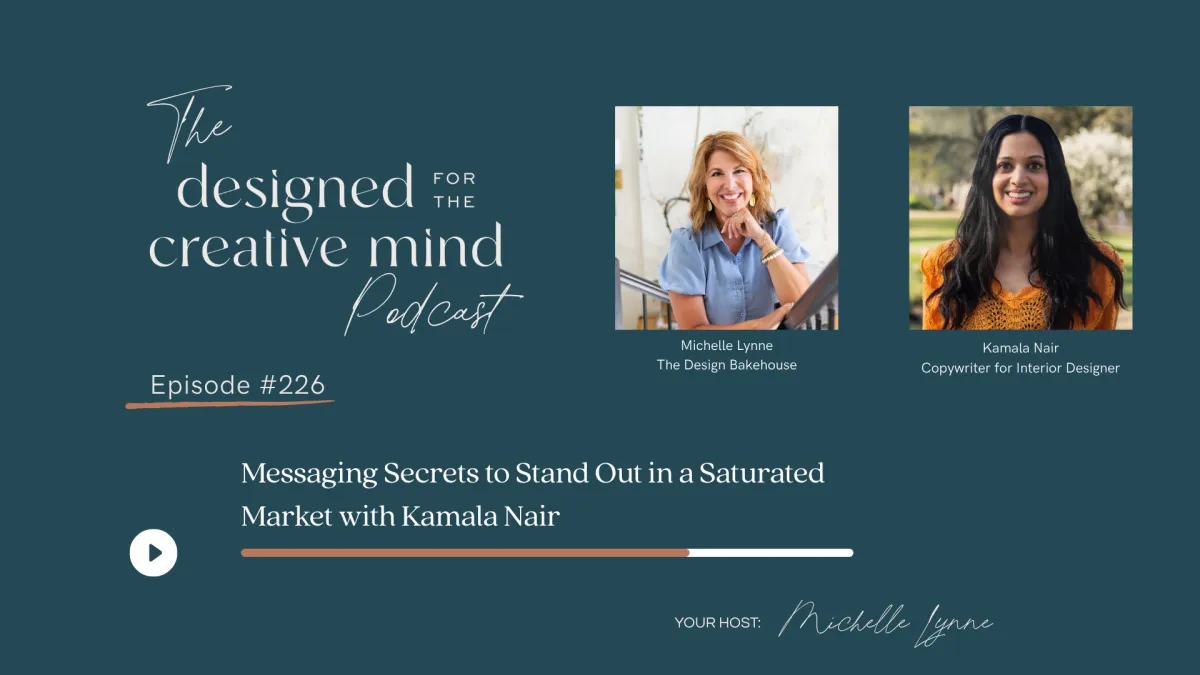
Ep 226: Messaging Secrets to Stand Out in a Saturated Market with Kamala Nair
Messaging Secrets to Stand Out in a Saturated Market with Kamala Nair
In this episode of Designed for the Creative Mind, Michelle sits down with copywriter and brand voice expert Kamala Nair to talk about the missing piece in so many interior design businesses: messaging that actually connects.
Kamala shares why stunning portfolios alone are no longer enough to stand out in a saturated market and explains how strategic storytelling can help designers attract the right clients, communicate their value, and create a brand that feels memorable and magnetic.
From finding your “hook” to embracing authenticity in the age of AI-generated content, this conversation is packed with insights for designers who want their words to work just as hard as their visuals.
In This Episode, We Cover:
Why beautiful images alone don’t convert clients
The biggest messaging mistake interior designers make
How generic copy creates distrust with potential clients
What a strong brand “hook” really is
Why authenticity matters more than polished perfection
How to communicate transformation instead of just services
Using storytelling to create emotional connection
Why your website should speak to clients, not other designers
How AI-generated copy can dilute your brand voice
Ways to use your messaging across your website, social media, proposals, and discovery calls
The importance of getting specific about your ideal client
How Kamala built a niche copywriting business exclusively for interior designers
Strategies for making time for business growth and strategic thinking
The role discomfort and risk-taking play in entrepreneurship
Key Takeaways
Your portfolio gets attention. Your messaging builds connection.
Clients may initially be drawn in by beautiful photos, but it’s the story behind the work that creates emotional resonance and trust.
Specificity is what makes brands memorable.
Generic phrases like “timeless interiors” or “luxury living” aren’t enough to differentiate you. Kamala explains how designers can uncover what truly makes them different and communicate it clearly.
Authenticity converts better than perfection.
In a world full of AI-generated content and copy that sounds the same, imperfect but genuine messaging often connects more deeply than polished generic language.
Great marketing sells the feeling, not the product.
Kamala shares the famous Rolls-Royce advertising example to illustrate how successful brands sell transformation and experience rather than just features.
Favorite Quote
“Your specificity and your authenticity are what sell you.”
Resources Mentioned
An American Marriage by Tayari Jones
The “Alice Audit” brand messaging intensive with Kamala Nair
Connect with Kamala Nair
Website: Kamala Nair Inc.
Instagram: @kamalanair
Connect with Michelle
If you enjoyed this episode, share it with a fellow designer and leave a review to help more creatives discover the show.
Transcript:
Well, hello there. Hey there, everybody. Welcome back to the podcast Designed for the Creative Mind. I'm Michelle Lynne. And today I'm really excited to introduce you to my guest, Kamala Nair. Kamala is a copywriter and brand voice expert. She helps interior designers stand apart. And that's through strategic storytelling and high impact messaging. Kamala is a former editor at El Decor.
and a copywriter at West Elm and Blue Apron. And her work has appeared in Architectural Digest, Lux, Interiors and Design, and First Dibs' Introspective. Well, now this busy woman runs a boutique copywriting and brand messaging agency specifically for interior designers. So Kamala, thank you for being here. Welcome. Thank you. Thanks so much for having me, Michelle.
Oh my gosh, it's so good to see you again. I've had the pleasure. when I'm trying to put a little bit of background, how you and I connected is Julie, who was doing my copywriting for the interior design business bakery when I launched that back in 2020, think, introduced us and then we did a previous podcast. I don't remember which one it was, but I'm going to go back and put that one in the notes. You had just published a book.
Yes, yeah. Unrelated to interior design, but on the side, I also am a novelist. So I remember we chatted about that last time. that was so fun. And then we connected again this past year in New Orleans for the Interior Design Society conference, which you gave such a, you gave two fantastic presentations. Thank you.
Those were such, such good takeaways. yeah, it's been, golly, it's been five years since we have met. I think, yeah, I think so. I think you're right. How crazy is that? It's so fun to be able to sit back and watch other women just continue to grow and blossom. Let's just dive right in.
I remember one of the things that you were saying when you were in, when we were in New Orleans and you were up on stage and it caught a lot of designers attention, I'm sure. And that is that why beautiful work or a stunning portfolio is not enough to drive business. And can you expand on that for the people listening? Because come on, I mean, we're interior designers. doesn't...
why don't pretty pictures do enough? Absolutely. beautiful pictures and beautiful work are obviously an essential component and I would never underplay that. It's so important and I want to make that clear. But great copy is designed to support and elevate that beautiful work because when you just look at a beautiful image of a room
There's so many stories in that picture that visuals alone cannot tell. And without context, it's often difficult for a viewer to actually grasp what they're seeing. And words and messaging are what bring those stories to the surface. And they're really what show your potential clients how you work,
and all of the things that you do that are so amazing that are beyond what you're just seeing in an image. So you know, Michelle, and all of the designers who are listening today, you know that what you do is so much more than picking out beautiful furniture and fabrics. There are so many intricate decisions and details that go into interior design, and words are really what bring that forward.
Yeah, and the reader or the audience, the person who's looking at the images and learning about them, I've I have heard many people who call M.L. Interior's group say. I totally can relate to whatever project they were they were drawn to, because our website, we don't have an aesthetic, they all look completely different, all of our all of our images, but.
when somebody reads it and reads like, Hey, this is the story of such and such that it resonates. It's not just a pretty picture, but they feel themselves in that story. And I thought that was really interesting, especially when I was a younger designer. I thought it was just all about having beautiful pictures. Kamala, how did you get started in this industry? So, right after college, I decided that I wanted to work in magazine editorial. So I moved to New York city.
and I got really lucky. Were you living in the States at the time? I was, yes. Okay, so now you're overseas. Yes, now I live in the UK, but I'm originally from the US and I was living in the US. I went to college there and I decided I wanted to work in magazines and so I moved to New York and
I got really lucky in that one of my early jobs was as an assistant editor at El Decor. Yeah, that's so cool. Yeah, and it was really a master class in interior design and writing for interior design and drawing out those kinds of stories that we were just talking about and really figuring out how storytelling can elevate great design. That makes sense. And so you just stated,
in that vein? Yeah, so I decided from there that I wanted to get more of a marketing background. So I moved to West Elm and I was a copywriter there. And then I took a slight detour away and I was the head of copy at Blue Apron. And that's when I at that point is when I moved to the UK and I started to I started my own business.
And at first I hadn't niched down. I was taking all kinds of client work and I was working for a lot of big brands. But I found that whenever I got a job that was related to interior design or to the home, that was when I really lit up. That was when I felt the most excited. And so I decided a few years ago that I was just gonna draw a line in the sand and focus exclusively on interior design.
And lucky us lucky us. Well, so what is, what's one of the biggest mistakes like the interior designers make in regards to their messaging and what I mean by that? Yeah. Is like, what are we screwing up? Kamala? Yeah. So I think the biggest mistake that I see is
sounding the same as everybody else. Yeah, but I'm looking at Instagram and I see how good it looks over here and over there, so I just want to go ahead and mimic them. Yeah, and I remember I saw once something on Instagram about a designer saying that they were looking at other designer sites to figure out what they should say, and that's a totally reasonable impulse and instinct.
But the problem is I'm just seeing the same phrases and words being used across all of these sites. And if you actually look at the work, the work is quite different. the words, because the words sound the same and there's a disconnect between the beauty and the specialness of the actual portfolio. And then the messaging is very generic that a real sense of distrust.
between the potential client and the designer. That makes sense because the images and the words are not congruent. Exactly. and there's so
Is that just like, it's create, I would imagine it creates a tension that the reader or the potential client can't put their finger on so they don't pursue that particular designer because something just feels off, but they don't know what. Exactly, exactly. And even going back to what we were saying earlier about why beautiful photos alone aren't enough, so many designers now have amazing portfolios.
So when you're competing, if somebody is Googling interior designers in your area and 10 people come up and they're looking through all of your websites and all of you have beautiful work, your words are that opportunity to stand apart and to make someone stop and say, ⁓ this person actually sounds right for me. So when you sound exactly like everyone else, you're really doing yourself a disservice. I love that.
because it's just so many designers that I speak to on a regular basis compare themselves to the highlight reel that they see on Instagram for other designers or their website and their portfolios. And it's just such an unfair measure in that regard. How do we stand out in the saturated market? Because I mean, we're all good designers.
Some of us are just are different, but how do we stand out? Yeah, so one of the most important ways that I recommend interior designers stand out is you absolutely need to you need a hook and a hook is something that really captures what makes you special, what makes you different, what your X factor is.
and then puts it front and center across all of your messaging. So when I land on your website, Michelle, I should see without having to scroll, I should see in a few words, some kind of bold statement that's gonna stop me in my tracks. And that's gonna tell me right away why I need to hire you. And that's something I don't see very often. I see a lot of modern interiors for the way you live or
timeless, beautiful and sophisticated. And while there's nothing wrong with those words or those phrases, they're not going to capture someone's attention and they're not going to tell a potential client why they should hire you. You know, what's interesting is as you were saying that, I wonder how many interior designers are creating their website for other designers and not for their clients. Yes.
I think you're right. You're so right. Yeah. my gosh. That was like a flash of genius. Yeah. It's so true. And I think you have to make that shift when you're creating any kind of marketing messaging. You're not talking to other designers. You're not trying to impress other designers. You're trying to speak directly to your ideal client. And the other way to stand out is
is through this exactly, instead of trying to speak to everyone and not alienate everybody, you want to really zero in on who your ideal client is. And if that means that you might scare away some other people, that's perfectly okay, because you're not looking to work with everybody. You're looking to work with the right people. And if your messaging is speaking to them directly, then they're going to come to you. I love that.
I think that was one of the hardest lessons for me to learn as a designer is that I am for everybody. Like, why wouldn't everybody like me? Well, they might all like me, but that doesn't necessarily mean that we're going to be a good match together. It's kind of like dating, right? Yes. Yeah, that's a good analogy. kind of, yeah, just just because every boy or you didn't go out to dinner with every boy that asked you. And if you did, there's no judgment.
But in that respect, sometimes it's just not the right fit. You're gonna marry the one that works best. Yes, and I do hear from a lot of designers that they're getting so many requests and then they're getting on these discovery calls and finding out that there is a total misalignment and they're ending up wasting their time and spinning their wheels and getting your messaging dialed in helps so much with that. It makes sure that you're getting those right people in.
and filtering out the wrong ones. But you and I have similar avatars in that respect. How do you go about learning?
for a designer, who are you writing their copy for? Because my copy is going to be different than the designer next door to me. Yeah. So I always ask a designer when I'm working with them to talk about what's their favorite project that they've worked on. What made it fulfilling? What about the client made it fulfilling?
What was that chemistry? What was kind of the magic behind that project? And that's kind of a good way to start figuring out who your ideal client is. And often you'll find that you already have worked with that person and you just want more of that person. and also thinking about just being yourself and authenticity because it really is an intimate
experience, you know, hiring an interior designer for both of you, because you're going into someone's home, you're going into their most intimate space, and you're helping them really figure out how to live and the best way to live. And for them, it's also a huge emotional and financial investment. And there really needs to be a personality click. And so when you're showing your personality in your copy, when that's shining through, then
people on the other side are gonna respond to that and they're gonna be magnetized to you. I love that Kamala. And I think that if there's one takeaway from this entire conversation, other than calling you to get help with copy, I think that that is just such a mic drop moment. And that is just be yourself. Don't try to step into some sort of a designer-y
persona that's not comfortable. It's like putting on uncomfortable shoes. You're not going to wear them long and you're going to look really awkward trying to walk in them. Exactly. And I think especially in this AI time, you know, moment in society, so many people are relying on AI now to write their copy. And I get it. I get that everyone's busy and you need help. But I think that's also contributing to that sameness and that
of generic language that we're seeing. And I would say to an interior designer who's maybe not at a place yet where they're ready to invest in working with a professional, it's much better to have imperfect copy that sounds like you and that feels like you than to have perfectly polished grammatical chat GPT copy that sounds like everybody else. Amen. Amen. Especially like with the
with the M dashes and the, there's just some certain words. I do love M dashes. I've loved them long before. I refuse to let them go. Yeah, but it's not like you're using them every third sentence. Yeah. Yeah, that's true. Yeah. Yes. I think that that's a really good point. So, okay. So going back to that, I think that that's something to really dial in on is instead of
using chat GPT or somebody to write your copy. You're saying that I as the designer should still write my own copy until I can afford to hire somebody. Okay. Or
imperfect copy is better than perfectly AI generated copy. Yes, I really think so. And I was actually talking to a client a few days ago, and she was talking about how her style is really about embracing imperfection. And, you know, the perfect imperfection of antiques and, know, vintage pieces and how those cracks and that patina that develops over time.
is what makes the piece beautiful. And I think that same philosophy can be applied to your messaging. I think if it's perfectly imperfect, but it feels like you, that is gonna actually attract the right people. And that message is gonna resonate so much more powerfully than something generic. Exactly. So how do you translate something that is so like,
Our services, yes, we deliver a photo ready living room, but it's more of a feeling or a lifestyle. Like how do you translate that into words? Yeah, that's a great question. And I want to give you an example that I gave actually in New Orleans, which I think really resonated with people. So.
We all know the brand Rolls Royce and back in the fifties Rolls Royce rolled out an ad that I'm going to read it to you. It's at 60 miles an hour. The loudest noise in this new Rolls Royce comes from the electric clock and that single line doubled their us sales and it's gone down in history as one of the most iconic ads in
you know, history. And the reason for that, speaks directly to what you just asked me. The reason is that the copywriter, his name was David Ogilvy, he pulled a single detail from an engineering report and he turned it into an ad. And instead of trying to sell a car and sell a product and sell, you know, this pretty machine, he sold silence.
He sold an experience and that is the ultimate luxury. That is what elevated Rolls-Royce beyond all the other luxury cars in that space. at that time, Rolls-Royce is now considered, you know, one of the most elite brands of our time. And it was largely due to that transformative copy. So it's really about zeroing in on specificity and
on figuring out what is that transformation. Like it's not just a velvet upholstered sofa. It's the sofa where, you know, you're gonna gather with your family and, you know, your family used to all scatter to different corners on the weekends. But because of this amazing sofa, everyone comes together now. Like it's about selling that experience and the luxury of that experience and not just the thing itself.
So that's really cool, Kamala, because what you're doing is you're basically you're selling that feeling instead of the sofa. Exactly. And that's what clients, that's what your clients want. They don't just want. We all know that they want more than just a beautiful room. They want that feeling. They want the emotions. They want the life transformation. So it's like a beautiful pair of jeans is going to my aspiration.
is for it to make my butt look just as good as the model. So if I buy that pair of jeans, my butt's gonna look as good as hers. So yes, and then the transformation is in your confidence and in the way you present yourself and the way you walk through your world. Like it all transforms because of that pair of jeans. Okay, so, okay, so this is what we're gonna be putting on our website. So we've got messaging.
on the website. How do you translate this into?
other areas to drive results? Like where else can we use this messaging? Yeah, so going back to that idea of the hook that we just talked about, that hook is gonna go on every piece of marketing material that you have. So it's not just for your website, it's gonna be on your Instagram, it's gonna be on your LinkedIn, it's gonna be on your proposals, it's gonna be on
your emails. So you're going to use that messaging across all channels. And when you really figure out how to talk about your brand, how to define your brand, it's not only something that you can use in written materials. It's something that you can also use when you're talking to clients, when you're meeting people out in the world, when you're on a discovery call, being able to pinpoint what makes your brand different and special.
And to be able to talk about it in a way that elevates your work is something that basically is going to help you in every aspect of your communications, both written and spoken. I would also imagine that for designers who struggle with, let's just say social media or blogs, because this is where, you know, designers aren't necessarily writers. And what I have found is that they oftentimes shy away from it because they don't feel very good at it.
But if you have this hook or the central storyline per se, you can always come back to that in your content. Maybe you just take that as your foundation and you can go a little bit left, a little bit right, but you're always talking about that. For sure. So can you talk about it too much? I don't think so. I really don't think so. mean, yeah. You want to be shouting it from the rooftops.
And be known for it. Yes, exactly. Interesting. So basically the specificity of who you are is what sells you. Yes. And your authenticity. Yes. specific authenticity is what sells. Yeah. And I found that even in my own experience, because when I was trying to sell to everybody and I was working with all kinds of brands,
I wasn't doing as well because I wasn't being authentic. wasn't being true to what I really cared about. And then when I actually zeroed in on what I cared about and what made me different and special, my business transformed. And you know what? It's kind of like, it's the energy. It's because when you get excited about something, it energizes the people around you. Yes. And I think that like,
When when we're like just talking right now, like I hear your excitement. I can see it on your face. It's like this is what really lights you up. It reminds me of my kid. You know, it's like, do you want broccoli or do you want spaghetti? I mean, she's really excited about spaghetti. Exactly. But at the same time, you know what, though, she did have broccoli a couple of weeks ago. I was quite impressed. Yeah, so that makes sense, though.
because people are really going to know that you enjoy working with them. They can feel it and they're gonna wanna work with you because of that engagement. Yeah, and you know, it might even be like, you might even not be a really warm, engaging, friendly person. Maybe you're a little more formal and you're a little more reserved, but if you're,
copy sounds the opposite of that. And then a client gets on a call with you. They're going to feel that disconnect. Absolutely. So it really is about, it's not about trying to be, to, you know, put a false front out there. It's about just being authentic and really embracing who you are. And it's so simple. I think we'd complicate things. Yes. I think we really complicate things. Hmm. So let's, let's talk about.
the Alice Audit, because I know that before we hit record, that was something that we were talking about and it's something that you're going to offer. Bring that up to the audience, please. Yeah. So I offer a very limited time intensive called the Alice Audit. And just quickly, the background of that name is that I came up with it last year for the IDS conference in New Orleans.
And my whole talk was around, it was using Alice in Wonderland and walking through that. so then I came up with this idea of the Alice audit and the name has kind of stuck. And what it is is it's a 60 minute deep dive where I help designers translate what makes their work exceptional into clear high impact messaging
and you walk away with ready to use messaging that can be used across all your marketing channels from your website to your social media, to your emails. And since I offered this last year in New Orleans, it had such, I was actually just planning to do it as a one-time thing, but it had such a tremendous response that I've decided to bring it back and I've refined it and made it even better. And I'm offering it to listeners.
until the end of July. I love that. And y'all, like I said earlier, I took advantage of this offer when I was in New Orleans and I used it for my coaching business, not my design business, but now that she's mentioning it, I might be going back to the design business. So I highly, I would highly recommend it. No, I'm not getting any kickbacks for saying that. would just not, would not tout something.
that I didn't believe in and Kamala's work is fantastic. Fantastic. So we will make sure that the link for the Alice audit is in the show notes. Yes. And I'll also include it in my Instagram so people can find me on there and they can find the link on there as well. Fantastic.
So I love talking to other entrepreneurs. And like you said, you run your your own boutique copywriting firm.
When do you find time to think about your business strategy? Like how do you go about, do you set aside a day? Does it just marinate in the back of your head? Do you wake up at three in the morning with ideas? How does it work for you? That's such a good question. And it's something that I really struggled with in my first couple of years because I was so busy delivering client work.
that I wasn't actually focusing on my own brand and my own business. So one big thing that I've implemented is, so it's just me. I don't have anyone else working with me, but I have a very smart entrepreneurial minded husband who I've recruited to help me. And we do an offsite once a year where we just, basically, it's like,
a brainstorming blue sky, just throwing everything out there session. And it's also a review of what's happened in the previous year. And that has really helped to set the tone. So I walk into the new year with a vision of what I want to accomplish. And I also set goals at the beginning of every quarter, I set smart goals.
And one of those goals is always a higher level strategic goal. And I will literally block time in my calendar to spend time focusing on it. Because otherwise I won't. It's really easy to just shove that stuff aside and just focus on the things that you immediately need to get done. But putting that time in my calendar and blocking it off has made all the difference. Interesting. Yeah.
I've been so busy with so many projects over the past couple of years that I don't feel like I've been as strategic as I know that I can be. And that's, it's kind of like you said, put it on the calendar. I think that's what I have not been consistent with. It's like going to the gym. If I don't have it on the calendar, there's always something that's going to take precedence over that. Yes. Yeah.
There's something about seeing that block pop up in your calendar that makes it just feel like set in stone. Absolutely. can't get rid of it. And would you say as a business owner, who do you need to be in order to be successful? And what I mean by that is are there certain practices, certain traits, certain things that you do?
certain maybe personas that you put on in order to step into that next level of you? Does that question make sense? Yeah, I think for me, every success has come from pushing myself out of my comfort zone. I think that's the number one thing. Whenever I stay within, you know, whatever feels safe or what I know and I'm comfortable with, I don't grow.
I've made any kind of leap in my business. It's come from leaning into fear and pushing myself and challenging myself to do something that I'm not inherently comfortable with. Well, what if you fail?
That's a good question. I think at least I don't have regrets. just, don't regret ever pushing myself out of my comfort zone. Because that in itself is not a failure. Exactly. I think that I would feel much worse if I was failing and I was just staying in the safe zone all the time. Cause then I would know I wasn't trying my hardest. Yeah. One of the, ⁓
I was at a Tony Robbins event and this was back before Genevieve was born. And basically he said, if you could meet the person that you could have become at the end of your life, what would you regret not doing? And that in itself was like a huge eye opener because for me it was like being a mom. And so that's kind of how we ended up going. That's part of the story of how we went down the path of adoption, but it's like,
It's true. It's like, if you could meet the person that you could have become, wouldn't you be pissed off that you didn't try something? Yeah. Even if you didn't execute it perfectly. Yeah. Yeah. You have to imagine yourself on your death bed. As morbid as that sounds. Exactly. No, it's true. was at a hard your answer? I'm curious. What's my answer of who do I need to be? I need to be the person.
Again, that's uncomfortable and that is stretched into a zone that I don't know anything about and learn how to navigate it. But a lot of it is also just being the person who is true to her word and who leads even when I'm afraid. So I think that that goes back to being uncomfortable. Who do I need to be to lead it? It's like
and also somebody who keeps blinders on. I used to compare myself to other designers and like you said, just being authentic, girl, that is so much easier. And just doing what I know is right and not trying to be all things for all people, because that's just exhausting. my gosh. So exhausting. Yeah. Well, is there any piece of wisdom or advice that you would like to leave with our listeners?
I feel like a little bit like a broken record, but I just, I feel that the authenticity piece is so important that I just want to come back to it. And I think that's it. think above all else, when it comes to branding, when it comes to messaging, the most important piece is to be yourself and to be authentic and to not try to.
sound like anyone else or be like anyone else, even if you admire them, it's not gonna come off in the same way that it might for someone else if it doesn't feel right for you. So, I'm just being. Yeah, boy, I wish I would have learned that lesson earlier in my career. Me too. So if y'all are listening, take it. Take it.
Okay, last question. And this is my selfish one. I love asking when I have guests on the podcast, what book do you recommend? So this is not business related, but I love reading fiction. So I'm going to share a fiction recommendation.
I'm not finished with it yet, but I'm like 75 % of the way through and it's amazing. It's called An American Marriage by Tayari Jones. And it came out a few years ago. It's not new, but it's been on my Kindle for like the last five years. And I just realized I had never read it. So I picked it up and it's just blowing my mind. It's so good. and don't you just love that? That's an unexpected surprise because it was on my Kindle.
Exactly. ⁓ good. Good, good, good. Well, I wrote that down. I'll add that to my list. I love just getting that insight and different perspectives. So thank you. Well, then, Kamala, I know everybody has loved everything that you've had to say and are probably very interested in connecting with you. Where can they do so? Where can we find you? Yeah. So you can find me on my website, which is Kamala Nair Inc. Dotcom.
Nair, I always call you Nair. That's okay. Kamala Nair. It's a common mistake. And I'll share that link with you so people can find it in the show notes. And you can also find me on Instagram. My handle is just my name, Kamala Nair. And yeah, those are the best ways to reach out to me. And I'd love to hear from your listeners. fantastic. Well, y'all make sure that you go follow.
and take advantage of the Alice audit. I cannot say enough good things about it. And it's just a really easy way to stick your toe into the copywriting experience it's an investment. Investing in a copywriter makes you money.
You are investing money on a copywriter and it will in turn convert your prospects into clients a lot faster or at least inquiries and then the sales process that you have takes it from there. Yes. Thank you so much for being here. Kamala Nair. Yes. I butchered it in the introduction. I'm so sorry.
That's okay. Thank you so much for having me. This is as always, this has been really fun. it's always so good to see you. Always so good to see you. So y'all, that's a wrap on today's episode. If you loved what you heard, don't keep it to yourself. Share it with a fellow designer who could use a little bit of inspiration and let's keep the conversation going. So we will see you next week and remember that success does not happen by chance. It happens by design.
