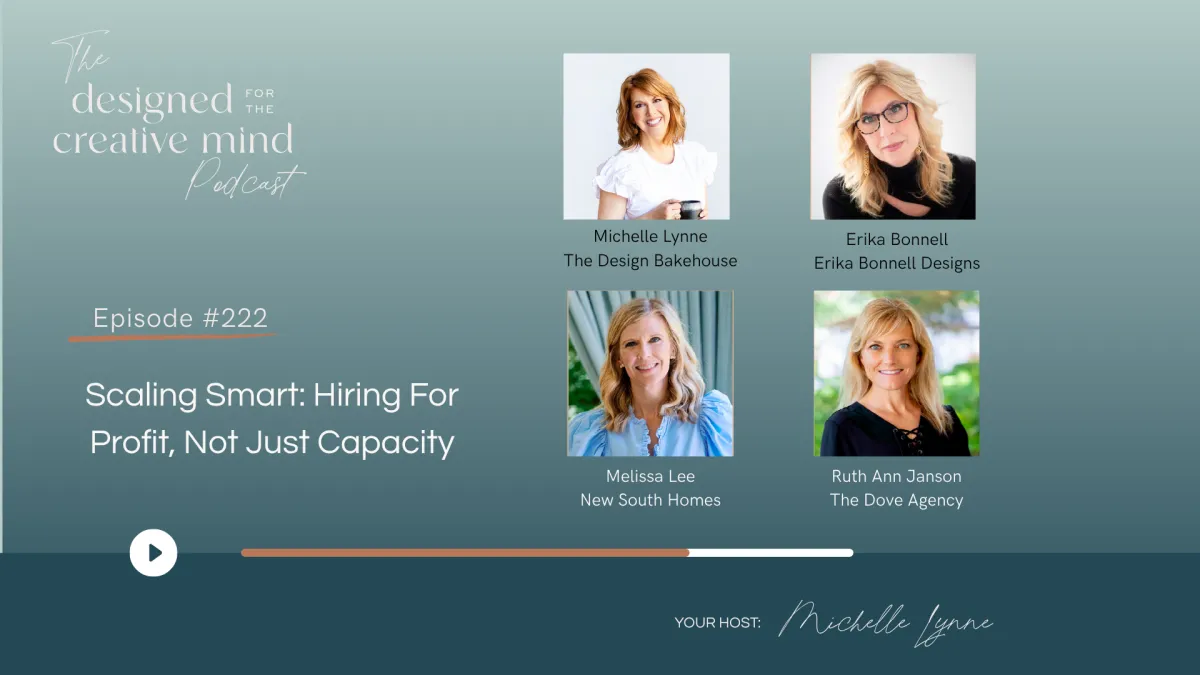
Ep 222: Scaling Smart: Hiring For Profit, Not Just Capacity
What You’ll Learn
Why hiring doesn’t automatically fix overwhelm
The biggest misconception designers have about growing a team
How to determine who you actually need to hire (hint: it’s often not a junior designer)
The difference between managing people vs. leading them
Why more team members ≠ more profit
How to think about scaling based on your desired lifestyle, not industry expectations
When to hire vs. outsource vs. use contractors (1099s)
What roles actually “move the needle” in a design firm
Why operations hires are often the most impactful
How to measure if a team member is truly contributing financially
The role AI is starting to play in design firms (and hiring decisions)
Why tracking time is critical—even if you charge flat fees
How to avoid costly hiring mistakes
Key Takeaways
1. You might be hiring the wrong role.
Many designers think they need a junior designer—but what they actually need is administrative or operational support.
2. Hiring creates new problems (not just solutions).
Managing people, training, and leadership all require time and energy—often more than expected.
3. Smaller teams can be more profitable.
Scaling down doesn’t mean failure. It can mean better margins, less stress, and more intentional growth.
4. Operations support is often the biggest game-changer.
Getting procurement, invoicing, and admin off your plate frees you up to design and generate revenue.
5. Hire for values, not just skill.
Skills can be taught. Cultural fit and alignment are what make team members stay and thrive.
6. Not every season requires full-time hires.
Contractors, freelancers, and outsourcing can reduce risk and increase flexibility.
7. You need financial clarity before hiring.
Understand how a role contributes to revenue—or how it frees you up to generate more.
8. AI is shifting how firms operate.
From client communication to renderings to internal systems, AI is reducing admin load—but requires intentional implementation.
9. Time tracking is non-negotiable.
Even experienced firms are surprised by how long projects actually take—and that data is critical for pricing.
10. Business first, always.
You can care deeply about your team—but not at the expense of the health of your business.
Notable Quotes
“Hiring someone does not automatically fix the overwhelm.”
“Sometimes you don’t actually need the role you think you need.”
“Smaller does not mean less profitable.”
“People don’t follow managers. They follow leaders.”
“Find your zone of genius—and build around it.”
“Nobody will care about your business as much as you do.”
Practical Next Steps
If you’re wondering whether it’s time to hire:
List out everything you want off your plate
Identify patterns (admin vs. design vs. operations)
Decide what actually drives revenue
Run the numbers before hiring
Consider outsourcing before committing to full-time
Final Advice from the Panel
Erika Bonnell - Erika Bonnell Interiors https://erikabonnell.com/ Hire to free up revenue-generating time—and let go quickly if it’s not workingt
Melissa Lee - New South Home Interiors https://www.newsouthhome.com/ Align hires with your long-term vision and strengths
Ruth Ann - The Dove Agency https://www.thedoveagency.com/: Scope the role clearly and track profitability from day one
Closing Thought
There is no one “right” way to build a team. The best business model is the one that supports your goals, your lifestyle, and your definition of success.
To work with Michelle, email us at [email protected] and set up a discovery call or visit https://thedesignbakehouse.com/ to learn more.
Transcript:
Michelle Lynne (00:05)
Okay, before we get into this episode, I want to give you a little context for where this conversation came from. This actually started back at High Point. We were sitting on a panel talking about hiring and scaling and building teams, all the things that sound really exciting when you say them out loud. And then we got into it and it was like, okay, this is a lot more layered than people make it seem. Because hiring feels like a milestone, right?
Like you've made it to the next level, your business is growing, it's time to bring people in. But what doesn't get talked about enough is what happens after that decision. Managing people, being responsible for somebody else's paycheck, realizing that bringing someone on does not automatically fix the overwhelm. And sometimes you don't actually need the role you think you need. That came up a lot in this conversation.
So what you're about to hear is really just a continuation of that discussion. Different perspectives, different team sizes, different ways of thinking about growth. A lot of
this is what I thought it would be, and then what it actually looked like in real life. Take what fits, leave what doesn't, and think about what actually makes sense for your business. All right, let's get into it.
DFCM (02:05)
I'm Erica Bonnell. I run Erica Bonnell Interiors in the DC area. Okay. My name is Melissa Lee. I am the principal designer at New South Home in Charlotte, North Carolina. Hi, I'm Ruth Ann Jansen. I'm the president and one of the principals at the Dove agency DallasBase, but all across the nation.
DFCM (02:25)
so excited you guys are here. This is gonna be so much fun. I haven't seen you since, we haven't seen each other since the panel in the fall. So hello. So exciting. Hi. So happy to be here. This is gonna be so much fun. So much fun. Okay. So y'all, let's, let's, we talked about this back in the fall.
DFCM (02:45)
at High Point talking about scaling smart hiring for profit and not just capacity. So we're trying to hire intelligently. So with that, I want to talk about artificial intelligence in a minute, but let's just dig in first about how hiring like it can be exciting because it's like our firms are growing. We're becoming legit and all that sort of stuff. But then it's also kind of intimidating.
DFCM (03:09)
because now we're responsible for somebody else and we're growing and we're a legit business and we can't really play too small. But what has been the biggest misconception that you guys like might've experienced? Like you thought it was gonna be one thing and then it was another when you did hire. And this is a free for all. I'm not gonna say, Erica, okay, Melissa, okay, Ruth Ann, let's just have this conversation like we did in person. Perfect.
DFCM (03:33)
I mean, I can jump in, like I just from my perspective, you know, obviously different perspective weighing in here as the dove agency versus a designer at the table. I think that whether it's our firm and hiring or whether I'm helping some of our clients kind of make those hiring decisions. The biggest thing is that I often see is that going into that conversation.
DFCM (03:56)
is you think you need to go a direction in terms of this is the type of talent or this is the type of individual I need to fill the gaps. But when you actually put pen to paper, it's not that type of a person. Like the best example is so many designers come to me, can I afford to hire a junior designer? I'm just so overwhelmed. And I'm always very cautiously advising them, please put all the tasks that you actually want off your plate onto a list.
DFCM (04:25)
and decide if that's actually a junior designer or possibly an executive admin. So I think that's what I see. And that's happened at the Dove agency too, where we think we might need to hire X, but it's actually Y when you really scope out what needs to happen. It's just not what you think it is in terms of the type of individual. Yeah. You're so right. I see so many designers who want to hire somebody in that respect when it's truly, like, it's the office stuff that you don't want to do.
DFCM (04:52)
And all the running around and the email management and the communication management and all of that. It's funny Ruth Ann that you say that because from where we talked in fall to where we are now, I'm now looking for another person and it is exactly what you just described. I'm looking for an executive assistant to me because I'm so bogged down all the time running a business. I also am
DFCM (05:19)
creative leader. So my brain is pulled into two different places all the time and I need to get this this side taken care of so that I can focus on all of those creatives. The other thing that I found over the years of just hiring multiple team members and changing team members and it's just just because
DFCM (05:38)
We're good at designing and managing clients and running a business doesn't necessarily mean that we know how to manage people and be a great leader. And so that's something that I've been learning along the way as just my, you know, my own business as a business owner and everything is just how to be a good leader for my team and knowing that there's been training on my part that I've had to do to be better at that. And so there's a lot that comes with managing people that you don't necessarily.
DFCM (06:06)
think of when you start trying to hire people. And I think the secondly is just because you hire people doesn't mean it's going to save time. There's other things that go into it with managing people that take time that you don't necessarily have to do when you're not. just understanding all those things. that's a great point. What have you done to improve in leadership? Because I think
DFCM (06:30)
Well, you nailed it. There's a difference between being a manager, right? Because you are managing people, but people don't really follow managers. They follow leaders. What have you done to for that training? I've been reading a lot of books and trying to understand a little bit more of the mentality of like my team members versus, you know, and how to kind of create like a great culture within my team.
DFCM (06:55)
And so I've been reading a lot of different books. I know I mentioned this on the panel, but I've also hired a third party HR team to kind of assist with a lot of just regular touch bases that we need to have that a lot of business owners don't think of. And so we have quarterly touch bases that we do with our team members. We're focusing on development for our team members too, so that they feel like they're not in a dead end in their position, that they are growing as our company grows.
DFCM (07:23)
And I also think too, just getting outside of my mindset of like, I'm so busy. I don't have time to do these things. And knowing that it's really important for me to kind of understand that my team doesn't understand that they don't understand my day to day. They don't understand what I'm dealing with. Even though they're working with me every single day, they don't necessarily understand that. And so I've had to really step outside of this, like I'm way too busy to deal with this mode and unders and realize that.
DFCM (07:51)
I need to show my appreciation. I need to show that I'm generally interested in what's going on with them and not hide behind this veil of I'm too busy running the business and I don't have time for it. Right. I'm so curious, Melissa, how many people are on your team? So there's four plus me on my team now. There's five of us. But I did have a team of eight last year and we've scaled down. Refined, yeah. I do think it is very interesting to hear
DFCM (08:19)
how different size teams approach their hiring and all of that across the board. It's very interesting. I want to talk about that Erica because Ruth Ann, like from your vantage point, you see, you, mean, you work with so many different interior designers. What are some of the like indicators that it's time to hire or
DFCM (08:41)
that maybe people come to you and say, Ruth Ann, I think I want to hire. And you're like, Whoa, Whoa, Whoa, hold on. Let's, let's evaluate that from a financial standpoint, because like Melissa was saying, sometimes we're just so busy. It's hard to see the forest through the trees. Yeah. think I have a couple of comments on that. think first of all, there's an immediate kind of panic when a couple of big projects come in and designers immediately think I've got to hire, hire, hire. And that's when I'm kind of like, okay, let's assess like,
DFCM (09:10)
How long is this lasting? there other, are there other things in the pipeline that are going to support and sustain an employee long-term? And I think the other piece of that, and Melissa kind of hit the nail on the head is that I think it's, you know, as a business owner, as a designer, there are a lot of different ways to define success. And success doesn't necessarily mean I'm managing a team of 15 people. Success can be defined by
DFCM (09:36)
I, as a business owner, I want to only be doing three marquee projects a year or something of that nature, which doesn't lend itself. You don't need a big team for that, right? You maybe need two other people. So I think it's also kind of just deciding what your goals and objectives are. And it almost gets down to then bleeding into like your brand. Like what is your brand? Are you trying to be this thing that's all things to all people? Are you trying to be super niche-y and just
DFCM (10:05)
Like I said, do the three projects a year. There's so much that goes into it. That's not, it's like the psychology of all of it that isn't just about the black and white of the numbers, which of course we, that's kind of where you start. But there's a lot of other kinds of ancillary questions just that you all need to be able to answer as the business owners, right? Well, it's interesting because my approach is very different to Melissa's. I'm all about smaller.
DFCM (10:32)
less projects, filling the pipeline by scheduling as we're able, taking the projects, taking deposits, and then scheduling when we're ready versus reacting to, we just got a big project. It doesn't really work like that for us because we're very intentional with when we start what we do so that the people on the team can manage the work. Um, I w I am at a point in my career where smaller is better. I need autonomy. I want staff that also works well with autonomy.
DFCM (11:01)
⁓ so it's, it's so can be so built to that specific leader or team. It's so cool that we can do that. And it also can ebb and flow, right? Like it can be something you're at a different point. Obviously there's, there's a whole bunch of different factors, but it can ebb and flow. You can be one thing for five years and decide, I want to go in a different direction after the next five. Right. That's the right thing about life. It's like different phases and you can shape it however you need to shape it, which is beautiful.
DFCM (11:29)
And Erica, I totally agree with you. That's why we're at five now. realized I didn't love managing a huge group of people. That was just not something that I wanted to do. um, the other thing too, I know Erica, you're really good about is like thinking about 10 99s and like, how can we just fill when we have those big projects come in? I have started, um, using a pre past team member of mine.
DFCM (11:57)
that she can just work hourly for me when I need her to. She just kind of chips in. have her help sourcing and she's done that. And so I can kind of call on her when I need her to versus saying like, hey, I need to hire another person. And I'm really grateful that I did that because things have changed just in the past month with how people are feeling about their money and what they want to spend with gas prices and the war going on. So again, I feel like what I was thinking
four weeks ago, six weeks ago is very different than what I'm thinking looking at the rest of the year. I think that's such a good point that you bring up ⁓ regarding 1099s and then obviously just outsourcing in general, like whether that's your bookkeeping or your procurement or whatever that looks like. I mean, it does put the risk on the other firm. Like you don't have to worry about keeping anybody busy. It's just when you have the work, that firm is doing the work for you.
DFCM (12:53)
whether it's an individual that you're contracting or a firm like ours, that should play into your decision-making with the hiring as well. It's just in terms of other options. Yeah. And I love for the audience, I think that they can hear the fact that there's no specific definition of success. At one point I had 10 on my team.
DFCM (13:14)
And that was ridiculous. And then now I'm down to literally like one and a half and it's fantastic. And then there's the outsourcing, but there's the whole, there's that whole swing in between. So for those of you listening, the cool thing about being a business owner is that you make it what you want it to be, not what you think others are going to perceive you as, right? we don't feel like learning.
DFCM (13:39)
until we go through it, when we feel the pain is when we're like, Oh, I'm changing that. it is adaptable. Like this is a business. You have to be so adaptable to everything around you. And yeah, when it hurts, heck yeah, I'm going to sit down and reassess and change. And, and, and that's not a failure. Like that is so not a failure to change to downsize. Like it's not a fail. Like
DFCM (14:05)
And I'm talking to designers all the time. It's like well, you know, does that mean that I'm doing something wrong? Y'all it's like it's like our clients who move out of a giant house they downsize it's because it's more comfortable because it's more efficient because it fits their lifestyle at the time. It's the same thing with a business, right?
DFCM (14:21)
Just because you're smaller doesn't mean you're bringing home less cash into your own pocket, right? Like there's a whole bunch of different things that go into these decisions, but smaller does not mean less profitable. And that's what we're all concerned with. Yeah, absolutely. And I'm imagining that that's part of where Melissa's coming from is like she went from what you said, eight to five. And it's probably, you're probably just as profitable to a certain extent. Yeah, we're doing just as much business.
DFCM (14:47)
Yeah. You know, 40 % less in payroll. Um, and we did outsource some team members as well to Ruth Ann's point, you know, with marketing and HR, and I didn't necessarily have an HR representative, but just having another team that that's their specialty and that we kind of use them on an as needed basis is also very, helpful. I think it's a beautiful thing. It's almost just as scary.
DFCM (15:15)
in terms of business decisions to downsize as it is to grow. mean, they're both such like pivotal decisions and moments in your business that it's very, very interesting. goes both ways. Yeah. Also to add to that, not to be, you know, just one more thing, but just staying the same is kind of scary too. It's like, what are we doing here? Why are we still at, you know, we've been stalled out at four people for five years. Is this what I want to be doing? So I think-
DFCM (15:41)
It's just like, I think you said this, Eric, it's just like always assessing and being ready to edit and iterate and do the next thing. Like it's very rarely in businesses of our sizes, do you just sit on your laurels and things are just, you don't have to change anything. That's just not, that's not where you're at when you're at a company of 50 or less. Yeah. It's a constant. Let's talk about that. Has there been an example of a hire, like a position like that has moved the needle?
DFCM (16:10)
for you either forwards or backwards. Like did you hire somebody and say, ⁓ I thought that was going to be a really good idea, but that really didn't move the needle forward. It kind of took me backwards or somebody that you did hire and you're like, holy free holies that has just really been so effective and efficient. yeah, I have, have two team members on my team that really focused strictly on operations. One's my business manager and one's my operations procurement manager.
DFCM (16:37)
And they don't really do anything design related, but my business manager takes the discovery calls. She does all the auditing. She does all the invoicing. She's helping with some of the networking that we need to do and helping with those types of events. And then my operations manager is the one that's kind of helping with the proposals, doing all the procurement, you know, kind of getting everything in Studio Designer, which is what we use.
DFCM (17:01)
And so then the other three of us are on design and by having them doing a lot of that back end piece of it allows us as the design team to focus on design and creativity and just some of that administrative things, those things that we don't want to do. And so between the two of them, they're probably, they're both kind of part time between the two of them. They're kind of making up one, one to 1.25 people, but just having
DFCM (17:29)
somebody that is dedicated, like you were saying, Erica, to the admin piece that kind of takes that off your plate has been really helpful. And that was a shift that I did a few years ago, just understanding that not everybody is suited for both the left and the right brain and hiring people that are really good at the right brain stuff for the, you know, the things that us left brainers don't want to do. But as the owner of the business, we do kind of still have to be both, right?
DFCM (17:58)
We do. So having people on your team that can support both sides has been great. Yeah, I would agree with that. I think the operational side, that was the key. Those were the key hires for me is getting out from under the operational end of things. think for me, I have made hiring errors in the design side. It's very hard.
DFCM (18:22)
for me personally to hire in the creative side more. Good for you. I'm so jealous that you have had success in that. I have kind of said, okay, I'm giving up on finding the right juniors. I'm just going to hire in other areas so that I can stay very driven in the creative side. yeah, my problem hires have always been in the junior design level.
DFCM (18:45)
One thing that I've found too, and I've just started shifting is like, I'm not necessarily hiring based on skill. I'm hiring based on values. And I think I've made it. I've had enough people on my team over the last 15 years to know which ones have stuck, which ones have stayed for a long period of time, which one were the best fit culturally. And, it wasn't necessarily because they came with the most skills on their, you know, on their resume. It was really because
DFCM (19:12)
The way that they worked was very similar to the values that we needed. And we can always train how, you know, we want to do things, how we want to present to the, the, ⁓ client and understanding that they're not necessarily going to come with those things. They have to learn that while they're here, but just having those values and that personality and doing a personality test as part of the hiring has been a huge, huge win for us whenever we are now going forward to bringing somebody on the team.
DFCM (19:40)
Yeah, I would agree with that. I love that. Just to add on what y'all said, I mean, it's kind of a repeat, but just a little bit of a different take. I think that in terms of moving the needle, what we see at our firm and designers that are, know, kind of coming to us for advice and where should we get our, where should they get our services plugged in? I think it's typically one of two things. It's when...
DFCM (20:02)
The business owner, like you both said, is kind of overwhelmed by any of the operations. So whether it's that bookkeeping piece or whether it's, finally got too many projects that you can't do all the order tracking yourself. I think it's something of that nature and whether it's, you know, third party solution or an internal hire, I think that it's getting something like that off your plate as the business owner so that you have more creative headspace. typically,
DFCM (20:29)
designers aren't loving doing their bookkeeping or doing kind of the minutia of the order tracking. This is not, you know, it's not always true, but it's generally true. So I think just the things that move the needle are getting those kind of back office items off your plate, tasked if you will, off your plate so that you can sell more work, do more design, go deal with your clients, be free to do that and know that, you know, everything's buttoned up behind the scenes.
DFCM (20:55)
Well, that and I think it's also identifying like what like designers for the most part, you make your money designing. You don't make your money, you know, out putting orders. Yeah, exactly. Or so. So in that respect, I think once I realized, OK, well, finding finding where my zone of geniuses and spending time there is truly what's going to make the money. And I've hired designers. mean, y'all, I'm not the primary designer like
DFCM (21:22)
I've hired designers smarter than me. Like they're better at what they do. Now, do I give some damn good design opinions? Yeah. But I also think that if that's the case, you know, let, let, let yourself be who your strongest being and then hire smarter people around you. So whether it's like hiring the dove agency, do my books, do the procurement, do all these things, do the marketing, whatnot. Fantastic. But like,
DFCM (21:48)
As a designer coming into the business, I realized that I didn't want to do all of that. I wanted to do some other things and I think that that's okay. And I've talked to some other people that are just like, I'm tired of dealing with the clients. I want to hire a designer to deal with the clients while I can do this. So once you guys do bring somebody on and this is kind of a selfish question because I'm about to hire somebody as well. ⁓ What tools are like,
DFCM (22:13)
I'm interviewing you for myself. But what tools or benchmarks do you recommend to ensure that the role is actually contributing? Like as a small business owner, sometimes it's really hard to say, okay, you need to hit this benchmark. We've got these KPIs, which is key performance indicators, things along that line. Like, what do you, how do you manage? Is it just off of your gut or do you have strategic? Do you have strategic measures in place?
DFCM (22:37)
Well, I can feel it. So if I feel relief in the tasks on me and a lack of necessary oversight in those tasks, and I think I'm at a point also where I want to hire upper level workers. I realized I don't want to be the trainer. I don't want to teach someone else.
DFCM (22:59)
I don't have the time to teach someone else how to do all the things. So I like upper level at this point. And I can tell pretty quickly if there is misalignment, if that person is not taking what has been placed on them off the table for me. So that's usually my markers. I can feel it. So what I'm hearing is like, Melissa says she can bring a junior designer in and train them in the way if they match culturally.
DFCM (23:27)
What you're saying is you want to bring somebody in who can hit the ground running and just like screw the training. That's just where I am now. Yeah, that's just where I am. I'm like exhausted from trying to train at your level. So I don't have the bandwidth to do it right now. Maybe one day again. that. I may feel that way very soon, Erica. You never know. know. talked this week.
DFCM (23:52)
Just to kind of add in like more like Michelle to get to on the technical side, Erica's was, you know, kind of more on the abstract. think that one of the things that we try to recommend to designers that are in these positions of potentially hiring, especially like a billable team member, like a junior design talent is really trying to frame out.
DFCM (24:11)
If you're billing by the hour, how many hours per month is this person going to be able to bill to your clients at what rate? I this is very simple math, right? And then look at that compared to what you're thinking about paying them and whether that's by the hour or their monthly salary and really kind of have an idea of what are they bringing to your bottom line? Worst case, it's a break even. We definitely don't want them to be losing money for you.
DFCM (24:39)
But really looking at that and then I think concurrent with that, if it's somebody that's more on the non-billable side, like maybe administrative, executive admin type, like we talked about the beginning, getting back to how can you be more billable because you have these things taken off your plate? Because at the end of the day, yes, these decisions are cultural and yes, we need to have the intangible of kind of more hours in our day to spend with our families, et cetera.
DFCM (25:08)
But there is a financial aspect to these decisions ⁓ whereby you need to be taking a look at how much money they're bringing in and what they're costing you kind of at the end of the day, not to be negative, but something I don't know, but that's what we're here for is profit. And I love that you bring that up. And Eric, you were talking about this as well. It's like, even when you're on salary and even if you're billing a flat fee,
DFCM (25:32)
I think it's still so important that we're all still tracking our hours. I mean, at the end of the day, y'all, I'm going to say this and it's recorded and it's going to live forever. I had people that were working for me on salary and things slowed down and I was like, okay, in order to keep you guys around, I'm going to put you hourly for the time being. And y'all, was paying them for 40 hours and she was working like 20. I was like, are you kidding me? Like, are you kidding me?
DFCM (25:58)
We do track our time as a team here. All of my team members are hourly with the exception of me, just because I've found in the past that putting people's salary is not necessarily the right, right stuff. But we track our time hourly and we do look at our time for like, especially like our design team and then our operations manager that does a lot of the client work as well.
DFCM (26:20)
and do have like, we call it client service hours and the expectation is everybody's 75 % of their time that they're in the office should be focused on client projects. And we look at that monthly and we talk about that every quarter. And then we also do have quarterly touch bases on our team where we have kind of like every six months we look at kind of like a review sheet that talks about our company values and what are they doing? What are their, what have they been doing?
DFCM (26:46)
kind of on a regular basis that fall under those company values to help with development and they get rated on that. And then just kind of having those quarterly touch bases so that if there are any concerns that we have, we can bring them up and have a conversation about it. And it's kind of a, it's already set up to have those conversations that may not be fun, but it's not like you're having to like set aside time and feel like you're calling people to the principal's office and having kind of that other HR team member.
DFCM (27:13)
in the room or on Zoom, if you will, to help facilitate those conversations has been great too. That would be helpful. That would be helpful. We're tracking our hours every week and just making sure that, you know, 75 % of them at least are billable. Yeah. And tracking them up against the, up against the projects and so forth. And again, you know, I think that for our listeners, it's important to realize that, you know, like I, I've, I've run a seven figure
DFCM (27:39)
firm, I coach other designers and so forth. And there's still times where it's like I get smacked on the face. It's like, well, this seems so simple, but it's not getting done and you have to go back to the basics. So, you know, just understanding that it is the ebb and the flow and it is the cycle of owning your own business. It's kind of like life, you know, I might be really, really hydrated and getting a lot of sleep, right? But then, but I, but then I can't, I'm not eating enough protein or exercising. It's like, it's like,
DFCM (28:05)
You know, balance all the things. Right. This business of its nature is full of ebbs and flows, you know, so like ebb and flow after ebb and flow and these all these layers. but I'm like you, Melissa. I also I'm I no longer have anyone on salary except for myself. It is much easier to control, especially when you do hit periods of.
DFCM (28:28)
dipping where you might be in between projects or things are in a building phase versus an execution. So it just allows so much more control over expenses going out. Yeah. I had a ⁓ poor misconception of putting people on salary. They would actually work more. And that was hilarious. So much. I like, that works longer. We get the benefit of
DFCM (28:57)
it.
DFCM (28:58)
that was the opposite. yeah, well, finding things to do. Yes, that I think the other point, ⁓ Michelle, this made me think of it when you were talking about your coaching some of your smaller designers is that stuff. It's we definitely advise all of the smaller firms that that we're working with. Even if this isn't because they're hourly being compensated hourly, be tracking that time regardless so that it can help you
DFCM (29:22)
in scoping future projects, like knowing how much to charge down the line, like without that historical data, and especially if you're new, the first time you do a full home remodel or something, you don't even have any clue what that's gonna take. So we really encourage, especially, y'all have been doing this a long time and you could probably scope things out in your sleep.
DFCM (29:44)
But especially the newer designers, they really need to have that historical data over two, three, four years to be making good decisions about their pricing down the road. That's so incredibly we've been doing it, I'm still shocked at how long it takes. my gosh. Is it the truth? And I will say, sometimes we might have that scoping down in our sleep, but you throw an interesting client into the mix and that initial idea is blown out of the water.
DFCM (30:12)
Yeah, I love that. I know we were just we were just on a photo shoot on Tuesday and the electricians were like, this house looks amazing. You guys do a great job. And they were saying, I'm sure you could do this really quickly. And I was like, how many hours do you think it took for us to do this? And then whenever we say it, they're like, really? I'm like, I know, it's a lot. Yeah, it's Home and brainstorm quick and then off we go.
DFCM (30:38)
That could be a whole, that could be an entire episode here, y'all, right? Yeah, you do that. You should do a follow up on that. how it just, what, we might do that. That's a great topic idea. Well, everyone thinks it's easy. And it goes into our sales process because we have to educate our clients on how long it does take because that's why it costs so much. So, okay, we're going to put a pin in that. Yes. Amen to that.
DFCM (31:02)
We're to put a pin in that we might do a follow up episode because I love that. love that. But before we get too far ahead, I want to talk about artificial intelligence and AI. OK, since we were together in the fall, let's see, we're recording this today is the end of March. OK, we're at the end of March when we're recording this. I'm not sure when we're going to publish it, but we were together in the fall of twenty twenty five in High Point. Y'all, that was October.
DFCM (31:29)
So this was November, December, January, February, March. So this is like less than half a year. holy freeholies. Like there has been a lot of change. How are you using AI in your business and how has it impacted your hiring as it relates to today's episode? We have been using it a lot more with just like images for our clients and renderings and everything a lot, you know, way back.
You know, just a year ago we were having to spend a lot of money to have somebody do AI rendering or just renderings for us. And now we're able to kind of, we're able to use AI to do some of that for us. The other thing I've been helping, we've been using AI is to help my team members with their role from the standpoint of sending out emails to clients where if they weren't comfortable sending us our an email or they didn't know how to respond, you know, we do have a branded.
DFCM (32:23)
GPT that we use across the board for our company that everybody has. It talks in the language we want them to talk in. And so my whole team uses that. But we're also starting to explore just efficiencies on that. One of the things that I'm looking at is like with the new build process is just how administrative that process is. You know, we say that the window color is this and it takes us five minutes to make that decision.
DFCM (32:50)
But then the process of making that window color happen on the home and making sure it's being communicated across the board is what takes 10 times as long, if not 100 times as long to make the decision. And so we're really looking at how can we update just our internal processes and our internal systems with some of these new tools that are coming out and looking at
DFCM (33:15)
the systems that we've been using for the last five to eight years, just to kind of help with our workflow. And really I've hired an IT expert to come in and just revamp everything with this thought of like, I want to say that, you know, this light fixture is what we're doing. And then it's going on the finished schedule and it's going in Studio Designer to procure it. And then it's going on our presentation for our clients. Like the amount of admin we do is starting to become glaringly obvious.
Yeah, that's interesting. I'm also like trying to dive in to figure out how we can get things running cleaner and more efficiently. It's interesting that you hired a firm for that because I tell Emily all the time, I'm like, I feel like I need a month to sit down and work on all of these efficiencies because it takes time to develop those efficiencies as well. So it's just a process of, ⁓ I'm so intrigued that you have hired someone to come in and do that.
DFCM (34:10)
Well, and I've thought about hiring another person, right? But now I'm really looking at, do I need to hire another person or should I use that money to build a system that is going to save time like this year, but then also going forward? And I think the other thing that I'm keeping in mind is things are moving so quickly that I'm like also trying to be like, I don't want to pull the trigger on something and build this great thing now. We're in six months per year. It could just
DFCM (34:40)
come up, right? So there's a lot of things to consider as things just move quickly. ⁓ And I think I just saw something with like Claude, Cowork AI is now this new next level of like what Chat GPT is where it's starting to do things for you. And so I'm going to start looking into that and just really looking into some different things that will help with just a lot of that organization and admin that we do as part of day to day.
DFCM (35:09)
Yeah, we use it a lot. It's, it has become very valuable and even just meeting notes and summarizing things and just, it's very helpful, but there's just so much that we can do. And it's now it's finding the time to figure all of that out. Yes. I know you guys have your, you have your ID nest, which is your specific. I'll let you explain that. Yeah. was just built a lot of AI into that.
DFCM (35:35)
Yes, I was just going to say like we are just as the Dove agency, you know, internally, like our service company, we do use agentic AI for various administrative tasks. I wouldn't say that it has for the audience. What is agentic AI? That's just, like a, it's like a personal agent that you train with your own materials and it's deployed in like a secure private environment so that you can use it. It's fabulous safely with.
DFCM (36:01)
with trusted team members, this isn't something that our entire team has access to. It's more managerial related. So we use that internally and we have found that that is helpful. What I would say it hasn't caused us to not hire, but it has caused us to kind of move tasks around that make more sense for our bookkeeper versus some of these AI tools to manage.
DFCM (36:26)
So that's kind of the dove agency side. then to Michelle's point, we do have a proprietary product, IDNest, that's kind of an all-in-one for designers with project management, social media management, a whole bunch of task management, all these things that kind of like can be your little one-stop hub. And there is a personal agent that's in there as well. So if you want to build out this agentic AI within IDNest, that's there.
DFCM (36:51)
we are also are looking at kind of that next level, which like to your point, Melissa, like everything is just changing so quickly. It's kind of hard to know if you should go all in or even partially in on something because these things are, you know, ⁓ iterating so quickly, but the next piece will be something that's deployed with an ID Nest it's actually able to kind of crawl the whole, you know, platform, you will, versus just targeted training.
DFCM (37:16)
and kind of what it's been asked before. It's just a little bit of the next level, so to speak. So that's kind of where our head is at. I mean, we're definitely very heavily invested in the research and ⁓ kind of the best practices around this,
DFCM (37:29)
It's funny what you said about like crawling the whole system because I think I was looking at we've been using Asana for I don't even know eight years and there's another version of it called I can't remember right now. Click up that I keep hearing about and people are saying how ClickUp has an AI capability where it can actually search everything and give you answers like hey when did this client
DFCM (37:52)
approve this brass faucet and Asana doesn't have that. And that's one of the things that we are struggling with with the new builds. It's like we're communicating via email. We've got to finish schedule over here. Like we've got spec sheets on our drive. And then when we need that question, we're like digging through 10 different places to find it. And I'm like, need it in one place. Yep. It's very fragmented. ⁓ And that's the difficulty, like you said, right? Because even if you
DFCM (38:20)
come up with an AI solution, it almost needs to be custom to your business to be touching all these different tools that you've been using for 10 years, seven years, what have you. So it is, while it's amazing and all these leaps and bounds, it's still not completely like a problem that solves everything. It takes a lot of work and time to just go manage. Like, yeah, it's great. There's so much at our fingertips, but pulling it all together is definitely a challenge.
DFCM (38:48)
I swear I search for stuff all the time now, probably more than I was before because I'm like, wait, where did I, even with AI involved, it's still very tricky. Yeah. I've got all sorts of ideas as to what I want to do next that we can create. But here, y'all, in the interest of time, if a design, well, we know a design firm leader is listening today to the podcast, right?
If they're wondering, am I ready to hire? What's I'm reading my notes. What's the first practical step they should take when this episode's over? if somebody in the audience is listening and they're wondering, well, should I hire? What piece of advice would you give them? And with that, let's also wrap this up in the interest of time. What's your best piece of advice for scaling a firm smartly and profitably?
DFCM (39:36)
So identifying. Let's start with, yeah, let's start with you. Let's go in order. Erica, Melissa, and then Ruthannis will be the only time. Identifying what those things are that will help free up your time to focus on bringing more money in. Again, for me, it was operations. What was the second part of that, The best piece of advice for scaling a firm smartly and probably. Also cut quickly. Like if you see that a new hire is not the right fit,
DFCM (40:06)
get out fast because I'm going nowhere quickly. I think I've left some people on too long and that is just a drain on your funds, business, your time and your energy. Girl, I learned that when I was dating, right? Yeah. You can see the best in them much better than they can actually execute it. Same applies.
DFCM (40:27)
I'm gonna remember that for my 10 plus year old daughters. That's very funny. I think for me, it's like, what is your long-term goals? Do you want to be managing a big team? And also where, Michelle, you said it best, where you hire people that are smarter than you. So it's like, my passion is fabrics and furnishings. And I have another team member on my team that her passion is tile and finishes.
DFCM (40:56)
And so thinking about how is it going to compliment what your passion is and, you know, what are the things you don't like doing? But then also if you really want to get into new builds because you know that that's going to grow your business and get you to where you need to be, but you don't feel comfortable in that arena and it doesn't, it's not your passion, then finding the expert that can be that partner alongside of you. But thinking about long-term.
DFCM (41:22)
what is this team member going to add to my firm and my long-term goals? I love that. And I guess I would just say for my two points on this, and I've already kind of said this is just kind of at the onset when you're looking to hire, go ahead and make sure that you're scoping that out, what that position entails. And then also, you know, putting pen to paper in terms of the financial ramifications of this hire.
DFCM (41:48)
And then kind of the add-on to that, you know, for scaling smartly and profitably is, you know, as service business, business is people are by far our biggest expense, right? So have accountability as a business owner to be monitoring the profitability of those employees or contractors or whoever's on your team. Don't just kind of hire and let it keep, even if they're a cultural fit, you need to have accountability on the financial side.
DFCM (42:15)
after they get plugged in to be tracking and monitoring and making sure that there's no iterating that's needed. Like Melissa, to your point before, like salary, move that to hourly, whatever that looks like, don't just let it kind of ride off into the wind and make sure that you're holding yourself accountable as a business owner to be checking on the profitability of your team. It's like Ruth Ann's talking to me. Michelle. the other thing that I would say that I learned along the way is I was
DFCM (42:40)
too cheap, honestly, to use a hiring team in the past and find using a recruiter that specializes in the design industry and is going to do all the vetting for you saves you so much time. And by finding the right person, you are going to save that money so much more in arrears. And so I totally feel like in the beginning I was like, I can't do that. I don't want to spend the money to do it. But I know from
DFCM (43:09)
my mistakes, that it's so important and worth it. And I would never look at hiring somebody without having the assistance of a recruiter or somebody that can find that person and vet that person for you, because that's part of the process that's so overwhelming is going through all the interviews and deciding if it's the right fit. and, kind of going through all the resumes, just takes a lot of time. Yeah. So it's funny you say that Melissa in a
DFCM (43:35)
previous life before I started my design firm, I was actually a recruiter. I was a sales manager in a recruiting firm and I used to place accounting and financial professionals and I was trying to convince the clients of that like, yes, you're going to pay me for this service, but it's going to save you so much time. and then I want to leave one last piece here as well is that I think that when we hire people, especially as I'm to, I'm just going to say as women, oftentimes we care so much about
DFCM (44:01)
the people that we hire that sometimes it blinds us to the business part of our business. And I just want to remind you guys that it's business first because if we're not taking care of the business, we can't take care of the people that we hire. So just remember that nobody's going to love your business as much as you do. Yes. Like you said, Melissa, you think that you put them on salary, that you're going to be the beneficiary of it.
DFCM (44:27)
And it's not because they're assholes. It's just because they don't care as much as we do. And they don't have as much on the line because their name's not on the door. So love your people hard and take good care of them, but not at the detriment of yourself. Absolutely. That's a big one. Yes. That's great parting advice. Michelle, you're so good. You are so good.
DFCM (44:50)
Well, thank you guys for being here. I mean, it's so much fun to see you again. I don't get to see you often enough in real life. Ruth Ann, do get the chance. I got a hug from her last week and the flowers that you brought me are still alive. So good. good. So thank you very much. I will make sure that all of y'all's contact information is in the show notes.
